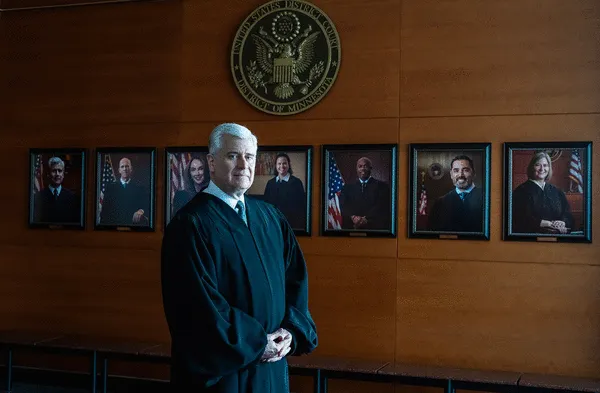
MINNEAPOLIS -- After Minnesota's chief federal judge summoned the head of U.S. Immigration and Customs Enforcement to his courtroom to answer for the government's violations of court orders in immigration cases, public reaction was swift.
A mix of praise and criticism was directed at Chief Judge Patrick Schiltz in the immediate aftermath of his order. The measure also yielded another type of reaction that became more frequent in recent months: threats.
As thousands of federal agents fanned across Minnesota during the Trump administration's immigration crackdown, the state became a battleground for legal challenges with federal judges falling squarely in the crossfire. The bench was tasked with determining high-stakes legal questions such as whether the surge overstepped the limits of the federal government's power granted by the Constitution or if federal agents engaged in racial profiling against legal residents and U.S. citizens.
Some degree of harassment and threats has always come with the job of being a federal judge. But sitting judges told the Minnesota Star Tribune that at the height of the surge, the intensity and rancor of harassing phone calls and emails that followed high-profile rulings were unprecedented.
U.S. District Judge John Tunheim said his chambers felt it during Operation Metro Surge while he weighed a lawsuit against the Trump administration's Operation PARRIS, another operation that affected 5,600 Minnesota refugees who hadn't yet received their green cards.
"There was more threat-related activity because that got so much attention," he said.
Tunheim and other judges declined to go into detail about the nature of the threats in efforts to avoid copycat behavior.
Harassment against Minnesota's federal bench aligns with the experience of judges across the country who said they've felt under siege as threats have risen since the start of 2025.
In a rare public forum, a panel of active U.S. judges recently detailed and decried the unprecedented amount of death threats, doxxing and intimidation they've faced. The panel followed a loosening of the federal judicial system's rules that allowed judges, who are typically inhibited from speaking publicly, to openly discuss judicial security issues.
On top of a shelf in Schiltz's chambers rests a prayer card and a photo of Daniel Anderl, the son of New Jersey U.S. District Judge Esther Salas; he was fatally shot by a disgruntled attorney at their doorstep in 2020. It's a stark reminder of a world with increasing political violence.
Fanning the flames are attacks on social media and comments from the nation's elected officials on both sides of the political aisle. Chuck Schumer in 2020 said Supreme Court justices Neil Gorsuch and Brett Kavanaugh would "pay the price" if they ruled to uphold state restrictions on abortion. President Donald Trump called for the impeachment of a judge who ordered a temporary stop to the deportation of alleged Venezuelan gang members.
"It's cyclical," Schiltz said. "And we're in a cycle now."
Amid Metro Surge, Schiltz was called an "activist judge" by a Homeland Security spokesperson after the judge accused ICE of violating numerous court orders. Minnesota's U.S. Attorney Daniel Rosen claimed U.S. District Judge Laura Provinzino engaged in a "lawless abuse of judicial power" when she found a military lawyer in civil contempt for not returning identification documents to an immigrant previously ordered released.
Judges said the incendiary comments further stoke the threatening atmosphere.
"It's not appropriate. It gets people riled up," Tunheim said, calling threats against judges "threats against the rule of law."
Ron Zayas, chief executive of Ironwall, which contracts with courts for online security, said the number of threats against federal judges jumped exponentially in recent years. Federal judges, he explained, often deal with higher-profile, hot-button issues that "piss people off more than anything else."
"It starts with a grievance. Somebody gets upset," Zayas said. "Then they make a post."
The matter was recently raised by a federal magistrate judge in Minnesota during a routine hearing against a protester charged during Operation Metro Surge.
"It seems as though every time one of my colleagues' names is mentioned in a tweet or a post, they receive phone calls, terrible phone calls, death threats, and the same," Magistrate Judge Shannon Elkins said.
Mark Osler, an attorney at St. Thomas law school, said threats against judges have been seen in history before, but a "radicalization" occurring on social media has deepened concern.
"It's [people] who are convinced that judges are evil actors, who are doing things so horrific that they must be stopped." Osler said. "And it's a really dangerous dynamic."
What crosses the line from a harsh critique to a viable threat falls to the U.S. Marshals Service, which provides security to federal judges. Data from the agency shows the number of threats against federal judges rose from 403 in 2022 to 564 last year. As of April 30 of this year, the number of threats is on pace to exceed last year's total by more than 40%.
In a statement to the Star Tribune, the agency said it cannot provide a state-by-state breakdown on how many threats have occurred against judges per district, citing safety and security concerns.
Prior to Operation Metro Surge, a Minnesota man was charged after federal prosecutors said he was found printing a 236-page diatribe he described as a "blood soaked killing guide" titled "How to kill a federal judge." The man, Robert Ivers, had previously been convicted of threatening to kill a judge. He now awaits trial.
Judges said critics have the constitutional right to disagree with their rulings, but officials should use the court system to appeal their opinions rather than resorting to violence or intimidation.
"A [judge] needs a thick skin. But it doesn't mean it's a bulletproof skin," said Kimberly Mueller, director of the Bolch Judicial Institute at Duke Law School and former district judge in California.