The climate crisis is accelerating the frequency of devastating events across the world, displacing millions and disproportionately affecting women.
The water mark on Naira Santa Rita's wall told the story before she could find the words for it. High and brown, like a scar, it was the line left by the floodwater on 15 February 2022 - the night Petrópolis drowned.
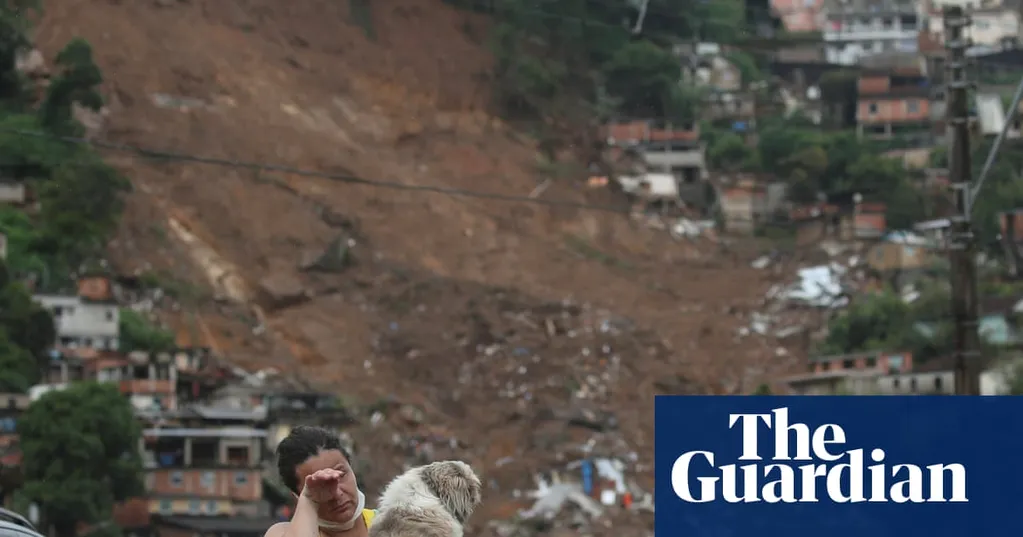
Within minutes, the mountain city she called home became a war zone. From her window, she watched bodies float past in the streets below. More than 230 people died that night, in what was until then Brazil's worst climate disaster.
But Santa Rita's story extends far beyond that single tragedy. She is one among millions in a global crisis that remains largely invisible: climate displacement, a phenomenon that disproportionately destroys women's lives.
The numbers are staggering. Over the past decade, climate-related disasters have displaced 250 million people globally - equivalent to 70,000 people forced from their homes every day.
According to the UN high commissioner for refugees (UNHCR), more than 120 million people worldwide are now forcibly displaced. Of these, about 90 million live in countries with high or extreme exposure to climate risks, and half exist in the brutal intersection of conflict zones and severe climate threats.
In Latin America and the Caribbean - the region most exposed to extreme climate events after Africa - an average of 2.4 million people a year have been displaced within their own country over the past decade. And the future looks even darker: by 2040, the number of countries facing extreme climate risks is expected to jump from three to 65. By 2050, most refugee camps will endure twice as many days of dangerous heat as they do today.
"With the intensification of climate change, a significant increase in cyclical and prolonged displacements is expected," warns Sílvia Sander, protection officer at UNHCR. "Women who return to disaster-prone areas face successive displacements - being forced to move again and again - making life reconstruction difficult. Each new climate event destroys resources, increasing dependence on humanitarian aid."
Brazil has become a laboratory for this accelerating crisis. Three disasters in three years trace an upward curve of devastation: Petrópolis in February 2022, which killed 233 people; Recife three months later in May, when 130 people died; and Rio Grande do Sul in May 2024 - the state's largest natural disaster, affecting 2.4 million people across 478 municipalities, killing 183, and causing economic losses estimated in the billions of reais.
That February afternoon, Santa Rita, then 24, had cancelled her two-year-old son Cainã's medical appointment. The rain was intensifying. "The city becomes chaotic when it rains," she says. The decision saved their lives - two buses full of passengers were swept away in the city centre.
But even inside her social housing complex in Correias, 15 minutes from Serra dos Órgãos national park, concrete offered no protection. Within half an hour, the rain became a deluge.
"You think you're safe in a building - you're not; it's an illusion," Santa Rita recalls. "I saw water coming in, not through the drain, but through the walls. You can't control water, tell it, 'Stop, don't come in.' You see it, and everything's already gone."
With her mother, a kidney patient who had recently received a transplant, and young Cainã, Santa Rita grabbed only documents, medicines and their dog before climbing to safety. The morning after revealed total destruction: the fridge on the floor; everything ruined; with that damning water mark left high on the wall.
What came next illustrates what experts call the "layered vulnerabilities" of climate displacement. As a single mother and intern with an ailing mother to care for, Santa Rita faced disaster economics in action: rents jumped from R$1,500 to R$5,000 (approximately £210 to £700) as landlords exploited the emergency.
Her mother's health deteriorated as Petrópolis had lost medical facilities for kidney patients. They had no choice but to leave for Juiz de Fora in the neighbouring state of Minas Gerais.
"The burden of domestic and care functions - looking after children, elderly relatives and people with disabilities - places women in a position of additional vulnerability during forced displacements," Sander says.
"This multiple responsibility means women tend to prioritise the safety of others, which can delay their own escape and increase exposure to risks."
The pattern repeats with brutal consistency, says the expert. "Factors such as poverty, race, informal work and single motherhood interact with the effects of climate change and create layers of interconnected vulnerability," Sander says.
"In the context of structural racism - the systemic discrimination embedded in institutions and society - Black, Indigenous or other historically discriminated ethnic-racial women face additional barriers to accessing support."
Santa Rita, now a sustainability specialist who founded the Climate Institute (Instituto DuClima), has conducted a profiling of climate victims in Petrópolis. Since 1988, more than 600 people have died in extreme weather events.
"If you do the profiling, they're Black women; they're children. It's a very specific group. This is environmental racism," she says, using the term that describes how natural hazards disproportionately harm communities of colour and the poor.
"Women are the first to die when an extreme climate event happens," Santa Rita says, "because they'll save everyone before saving themselves."
Three months after the Petrópolis floods, 500 miles (800km) away in Recife, the pattern was repeated. On 28 May 2022, Sônia’s house at the top of Comunidade Sapo Nu hill – considered safe for decades – was engulfed by flood water. Her granddaughter, Eduarda Patrícia, sheltering below with two daughters aged seven and three, climbed to safety in the early hours. By 10am, water covered Sônia inside her home.
“The water was covering me inside my house,” Eduarda Patrícia recounts. Family members rescued them on plastic sheets pulled by ropes. “We just thought about God in that moment to save us.”
The aftermath revealed the state’s abandonment of victims: the family received R$2,500 (approximately £350) in aid – a single payment to rebuild everything they had lost – and have never received any psychological support.
Sônia, who had struggled with alcohol before the flood, needed rehabilitation after the trauma. The family moved her away from the flood-prone community – another forced displacement.
By May 2024, when the waters came for Rio Grande do Sul, the script was grimly familiar. Lake Guaíba’s level in Porto Alegre reached 5.37 metres, surpassing by more than 60cm the previous record set in 1941. Bianca Ramires, 49, a teacher in the Sarandi neighbourhood, trusted her neighbours’ decades of experience: this area never floods. She left with one backpack, expecting to return within days.
After 40 days, the washing machine had been swept into the living room, and the water’s force had scattered the furniture. “My graduation album, my diplomas, my certificates, my son’s childhood photos. Everything was gone.”
Yet the water’s retreat does not end the trauma. Júlia Louzada, a psychologist at the University of São Paulo’s laboratory of psychoanalysis, society and politics, who worked with survivors in Brumadinho, where a dam collapse killed 272 people, and Rio Grande do Sul, describes what she calls “psychic disorganisation” - the state in which the loss of home and community shakes the foundation of identity itself.
“Territory is this physical place, but it’s also a symbolic place, where memory is written, and where work networks, family, institutions are written,” she says.
“Many victims initially report shock, even anaesthesia. It’s a psychic defence. But it’s trauma inscribed in the body itself through sleep disturbances, tremors, sensory triggers. The sounds of rain take you back to that traumatic scene.”
Ramires echoes this: “Every time it rains, it’s panic. My relationship with Porto Alegre changed completely. I no longer have pleasure being here.”
Yet Louzada notes a paradox: women bear the greatest burden but also lead reconstruction. “They’re historically linked to care work; reproductive labour – they’ll continue these tasks in shelters; in displacement. But they’re also the spearhead; the people at the front in processes of material and symbolic reconstruction of territory.”
Santa Rita’s experience drove her to action. She wrote what became Bill 1594; Brazil’s first legislative proposal for a national climate displacement policy. “If we manage to approve this policy,” she says,“we’ll set a precedent in world history.”