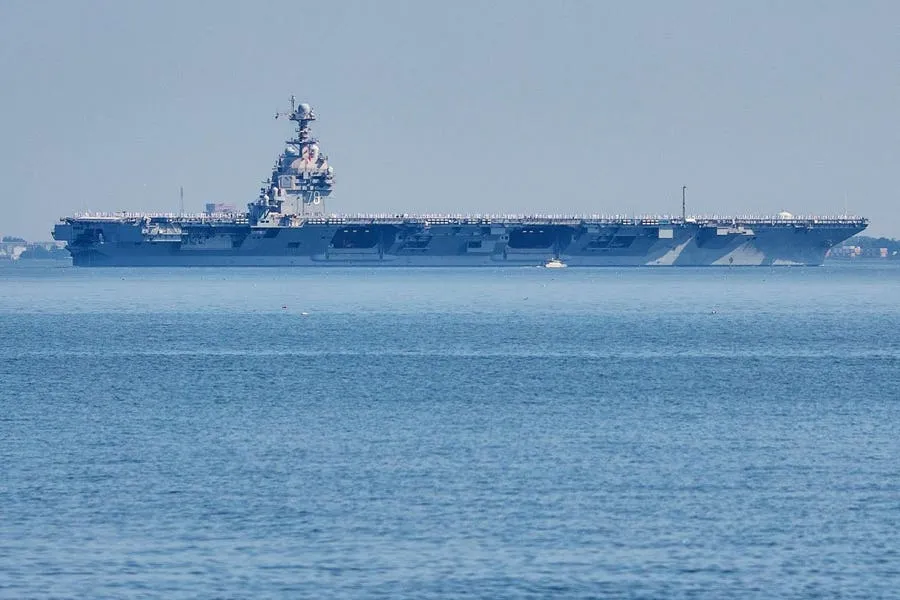
The record-length deployment of the United States Navy's newest and largest operational nuclear-powered supercarrier continues. The USS Gerald R. Ford (CVN-78) has been at sea for 299 days as of Sunday, surpassing the post-Vietnam War-era record of 294 days of the USS Abraham Lincoln (CVN-72) set during that aircraft carrier's 2019-2020 deployment.
U.S. Navy officials have indicated that USS Gerald R. Ford could be deployed for up to 11 months, equaling and even surpassing the 332-day deployment of USS Midway (CVA-41), which lasted from April 10, 1972, until March 3, 1973, at the peak of the Vietnam War. That mission has remained a benchmark for long-term carrier operations, for which CVA-41 received a Presidential Citation.
CVN-78 Is Back In The Middle East Region
According to reports, the USS Gerald R. Ford, along with the Arleigh Burke-class guided missile destroyers USS Mahan 9 (DDG-72) and USS Winston S. Churchill (DDG-81), transited the Suez Canal over the weekend.
CVN-78 and her escorts are now operating in the United States Central Command area of responsibility in the Red Sea. The Gerald R. Ford Carrier Strike Group had previously been in the waters between Africa and the Arabian Peninsula when a fire broke out on the flagship supercarrier in the middle of March, forcing its return to port for repairs.
The carrier first headed to Crete and then to Split, Croatia, where she departed on April 2, resuming operations.
Carrier Build Up Continues
The deployment to the Middle East was unexpected, and USS Gerald R. Ford was redirected to the region in February after operating in the Caribbean. Although she remained in the Red Sea, she supported CVN-72, which had been dispatched to the Arabian Sea in January after previously conducting operations in the South China Sea.
The embarked airwings from both of the nuclear-powered flattops have carried out airstrikes on Iran as part of the ongoing Operation Epic Fury, the now more than seven-week-long conflict that began on February 28, 2026.
The U.S. Navy continues to deploy more warships to the Middle East, including a third nuclear-powered supercarrier.
The 10th and final Nimitz-class supercarrier, the USS George H.W. Bush (CVN-77), is now transiting around the southern tip of Africa at the Cape of Good Hope, and could reach the region in the coming days.
As previously reported, there is speculation that CVN-77 and her escorts are avoiding the Bab el-Mandeb Strait that connects the Red Sea and the Gulf of Aden.
Its name, which means "Gate of Grief/Tears," has long been known as a potential navigation hazard due to its shallow waters, reefs, and unpredictable winds that can create high waves capable of swamping small watercraft.
A more serious concern in the past decade has been from the Iranian-backed Houthis, as the group has carried out drone attacks, missile strikes, and even helicopter-borne boardings of commercial shipping. Although the U.S. reached a peace deal with the Houthis last May, there remains a concern that the Yemen-based rebel group could resume attacks on ships transiting the straits in support of Tehran.
It should be noted that no U.S. Navy carrier has traveled through the waterway since the USS Dwight D. Eisenhower (CVN-69) in December 2023. CVN-77 is likely to avoid the area entirely, with CVN-78 remaining in the Red Sea. However, both supercarriers and their embarked aircraft can still easily reach targets in Iran if the air campaign resumes.
Navy Denied Sailors Were Facing Food Shortages
On Saturday, the U.S. Navy also sought to dispel rumors that the crews of the USS Abraham Lincoln and the America-class amphibious assault ship USS Tripoli (LHA-7) were facing food shortages due to their lengthy time at sea.
In a post on X, the U.S. Navy wrote, "Fresh meals. Full service. Mission ready. Sailors aboard USS Abraham Lincoln and USS Tripoli continue to receive regularly prepared meals at sea -- no interruptions, no shortages."
There had been reports last week that sailors were given unappetizing, meager rations.
It is unclear how long the U.S. Navy's supercarriers and other warships will remain in the region. Still, the Trump administration confirmed on Sunday that U.S. negotiators will head to Pakistan to resume talks with Iran before the already fragile ceasefire expires on Wednesday.
When the U.S. Navy's flattops finally come home could hinge on those talks.