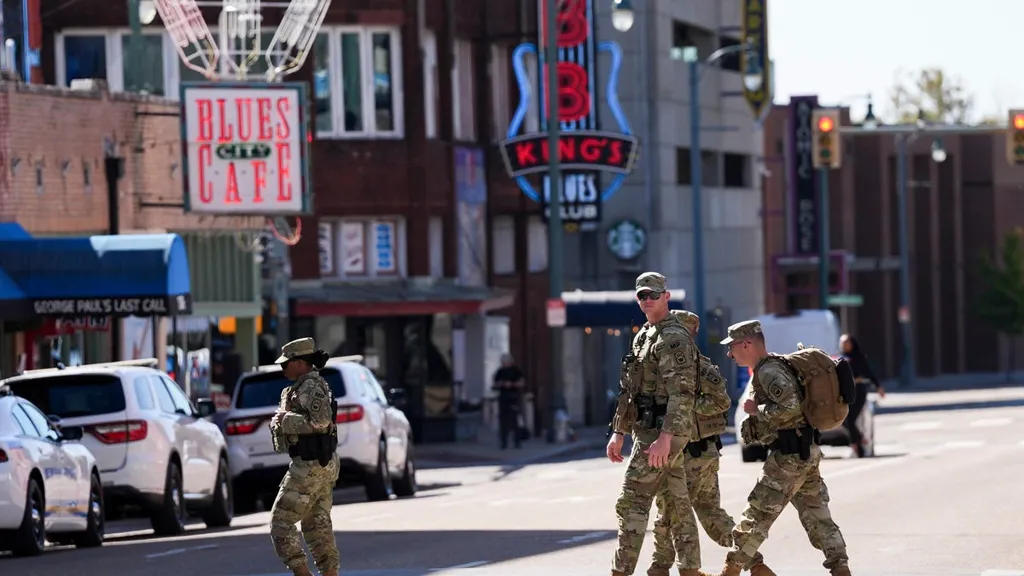
NASHVILLE -- A panel of three judges from the Tennessee Court of Appeals on March 5 heard arguments about the constitutionality of Gov. Bill Lee's deployment of the National Guard to Memphis, as a group of local and state officials is suing to block it.
The Tennessee Attorney General's office filed the appeal weeks after Davidson County Chancellor Patricia Head Moskal granted a temporary injunction against the National Guard deployment. If that injunction were to go into effect, the guard would be withdrawn from Memphis pending the final ruling in the case.
Three questions were brought by the state to the appeal: whether plaintiffs invoked an available waiver of the government's immunity (known as sovereign immunity) from being sued, if they have standing and if Lee violated state law in deploying the National Guard to Memphis.
A fourth question was added to the appeal by the plaintiffs, which asks whether a court is likely to agree with the plaintiffs that the National Guard's deployment violates the Tennessee Constitution.
Appellate Judges Andy Bennett, Frank Clement, Jr. and Jeffrey Usman presided over the hearing. They first heard from Tennessee Solicitor General Matt Rice, a high-ranking member of the attorney general's office.
Rice's arguments were quickly interrupted by Usman, who almost immediately began asking questions about why sovereign immunity was being invoked, saying he was "struggling to see why."
Judges question nature of 'crime emergency'
Usman would later push Rice on the state's explanation of Memphis' alleged crime emergency. Rice had said Memphis, which had the highest crime rate in the nation in 2024, had a crime rate that qualified as a "grave emergency," allowing for the deployment of the National Guard.
Usman questioned this, saying Memphis has had high crime for years and that all cities have to combat crime. He also questioned if there needed to be a sudden change for "grave emergency" to apply to Memphis.
"To the extent your honor is asking whether we think that all crime is an emergency, that is not our position," Rice said. "Our position is that having the most violent city in the country, which is a stark contrast from even the second-closest city -- it's 345% [higher than] the national average -- and four times more violent than Mexico City, we think that qualifies as a grave emergency."
Rice said he believed there was no requirement for a sudden change, but went on to say that if the court were to hold the need for a sudden change, the state's position would hold strong still. He pointed to 2024, saying, "crime throughout the entire rest of the country was going down, and crime in Memphis was going up. I think that is an emergent condition that would justify the deployment of the National Guard."
Though Memphis had the highest per capita crime rate in the nation, crime in Memphis did not rise. It was declining from a previous high in 2023, though still above many recent years.
Usman quickly followed that by asking if there was a definitive end to the National Guard's presence in Memphis, saying that emergencies have an endpoint. Rice did not directly say what that point would be, and neither did Attorney General Jonathan Skrmetti during a press conference after the hearing.
"I don't think there's any objective standard out there where, if you hit a certain threshold or if there's a certain amount of time, the guard won't be there. This is not going to go on forever," Skrmetti said.
Role of National Guard debated
Meanwhile, when the plaintiffs' attorney Joshua Salzman, senior attorney for Democracy Forward, began his arguments, the judges honed in on his arguments about whether the National Guard was a militia or an army. Salzman's position was that it is a militia, meaning it would only be able to be deployed in the case of rebellion or invasion -- neither of which happened in Memphis.
The judges seemed skeptical of this argument, with Clement saying the National Guard, under this reading, could not be deployed for natural disaster relief.
Salzman hesitated to take a position on Clement's question; instead saying the "defining characteristic of a militia is that it is an armed assortment of people who are primarily civilians who are called into military service."
This, in Salzman's opinion, thoroughly described the National Guard.
He also went on to point to the lack of a concrete end date, saying this deployment could continue indefinitely if the judges side with the state. Salzman also cautioned the judges about the courts having a "long recognition that law enforcement, in particular, is something that is not to be conducted by military forces,and there's something particularly pernicious when troops control the streets of a city."
Rebutting this thought, Clement questioned the stationing of National Guard troops on American streets in the wake of the 9/11 attacks on the World Trade Center. At that time, Clement said, National Guard troops were conducting law enforcement.
"I can remember looking out my office window and seeing National Guard troops walking around with their guns and other equipment, patrolling the streets, patrolling the sidewalks around the Capitol and in other areas," he said. "So that was wrong? That was illegal?"
Salzman, however, said 9/11 "might have been the quintessential sudden, unexpected" emergency in which to deploy the National Guard. Clement, however, did not seem any less skeptical.
Why are Memphis officials suing over the National Guard deployment?
The full list of plaintiffs is Memphis City Councilman JB Smiley, Jr., Shelby County Commissioners Erika Sugarmon and Henri Brooks, Shelby County Mayor Lee Harris, State Reps. GA Hardaway and Gabby Salinas, and State Sen. Jeff Yarbro. Yarbro is from Nashville and is the only non-Shelby County official listed as a plaintiff.
All of the officials are Democrats -- either currently serving in a partisan role or having run for partisan office -- and include officials from city, county and state government.
As the appeal was pending, and while the appellate court deliberates, the temporary injunction granted will remain on hold.
On Oct. 17, just weeks into the deployment of the National Guard in Memphis, a series of officials filed the lawsuit. They claimed the manner in which the National Guard was deployed violates the Tennessee Constitution.
The 24-page lawsuit points to Lee's "unilateral decision" to deploy the National Guard as unconstitutional. According to the plaintiffs, the National Guard may only be called up in the case of "rebellion or invasion" and when the Tennessee General Assembly declares public safety requires it.
It can also be called up at the request of a local governing body, such as the City of Memphis or Shelby County government. The Tennessee General Assembly can also call up the National Guard in this instance.
None of these took place ahead of the deployment.
Attorneys with the Tennessee Attorney General's office placed the bulk of their argument on the powers of the governorship. According to them, the courts do not have the power to say when the National Guard can be deployed by the governor because it is a political decision. They also said it is an operational decision that is entirely at the discretion of the governor.