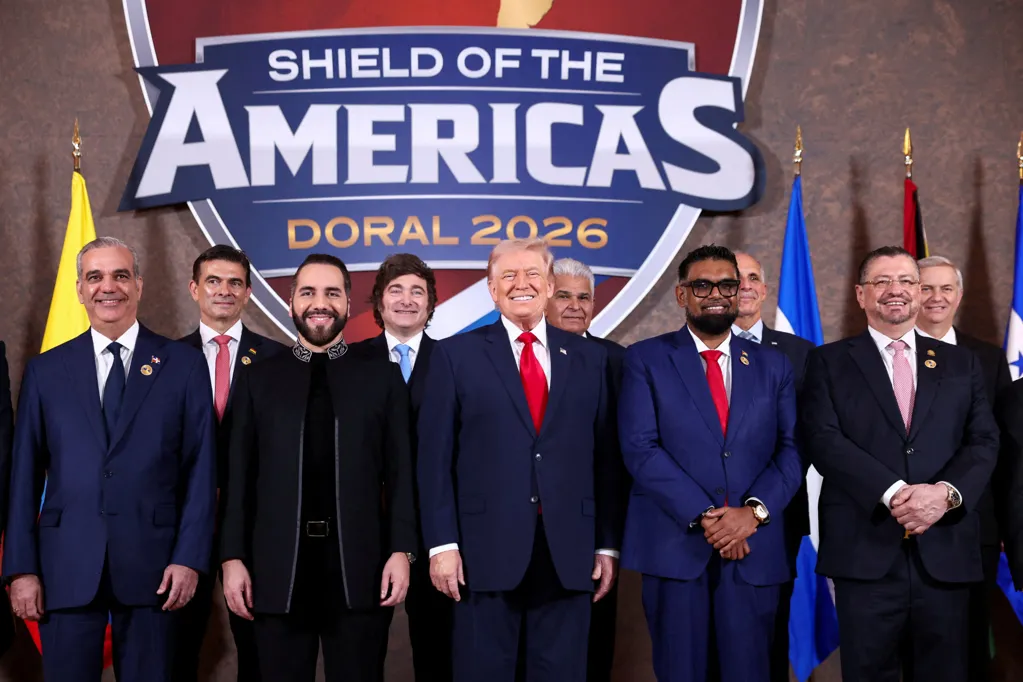
WASHINGTON -- The Trump administration's new Shield of the Americas initiative reflects Washington's renewed focus on the Western Hemisphere and the growing recognition that cartel violence poses a hemispheric security challenge. The initiative aims to deepen cooperation among regional governments through intelligence sharing, joint operations, and expanded military coordination to dismantle criminal networks responsible for drug trafficking, migrant smuggling, and rising violence across the region.
To launch the initiative, the administration convened thirteen leaders from across Latin America and the Caribbean at a summit in Doral, Florida. From Honduran President Nasry Asfura to Chilean President-elect José Antonio Kast, the group largely consisted of center-right to hard-right leaders broadly aligned with the Trump administration.
The instinct behind the initiative is correct. A coordinated regional response is necessary to disrupt criminal networks. But if the Shield of the Americas is to achieve its stated goals, it must address a deeper reality: The region's security challenges are rooted in institutional weakness. A coalition of politically aligned governments is not enough. An effective and durable Shield of the Americas must be built on strong institutions.
Democratic progress in countries across Latin America has stalled or reversed in recent years. Weak rule of law, systemic corruption, and fragile public institutions have created fertile ground for criminal networks to thrive. Cartels succeed not primarily because of military capability but because governance gaps allow transnational organized crime groups to infiltrate police forces, judicial systems, and political parties.
The consequences are visible throughout the region. Latin America accounts for roughly one-third of the world's homicides despite representing less than a tenth of the global population. Criminal organizations have evolved into sophisticated multinational networks that traffic drugs, weapons, and people across borders while corrupting state institutions along the way. The result is not only violence but also weakened states that struggle to respond effectively.
This institutional fragility affects the United States. Weak governance fuels migration, destabilizes regional economies, and deters the kind of transparent, rules-based investment environment that US businesses require.
At the same time, initiatives centered primarily on military coordination risk addressing symptoms rather than underlying causes. Security cooperation is necessary, but it cannot succeed in environments where institutions remain vulnerable to corruption and capture.
To be effective, the Shield of the Americas should therefore expand beyond security coordination to include a serious investment in strengthening governance and the rule of law across the region. Evidence from the Atlantic Council's Freedom and Prosperity Index underscores why. Across three decades of global data, rule of law consistently emerges as the most influential driver of prosperity. Countries that strengthen judicial independence, combat corruption, and enforce predictable legal frameworks create stable environments necessary to attract investment and resist criminal capture.
Washington should therefore pursue three complementary priorities.
First, the United States should support anti-corruption and rule-of-law institutions that directly undermine the operating environment of criminal networks. This includes funding independent prosecutors, strengthening financial oversight bodies, and supporting judicial reforms that improve transparency and accountability. When institutions can investigate corruption and enforce the law impartially, criminal networks lose the protection they rely on.
While the Trump administration has sought to rein in what it views as excessive foreign aid spending globally, the proximity and strategic importance of the Western Hemisphere should encourage a more targeted approach. Strengthening rule-of-law institutions in Latin America is a strategic investment that advances both US and regional interests.
Second, security cooperation and economic engagement should be linked to governance reforms that make countries more stable and investable. Transparent procurement systems, predictable regulatory frameworks, and professional law-enforcement institutions create the conditions necessary for long-term economic growth and foreign investment. These reforms also make it harder for malign actors to secure opaque deals that undermine security and stability.
Third, Washington should expand the toolkit used to strengthen democratic resilience in the region. Alongside traditional security assistance, the United States can leverage investment financing, public-private partnerships, and democracy assistance programs to reinforce rule-of-law reforms, strengthen oversight institutions, and support democratic institutions. Doing this can help ensure that security gains outlast any single government or political coalition.
One limitation of the Shield of the Americas lies in its composition. Colombia, Mexico, and Brazil -- all led by left-leaning governments -- were absent from the summit despite being among the hemisphere's largest and most influential countries. So too were leaders such as Guatemalan President Bernardo Arévalo and Uruguayan President Yamandú Orsi, who have largely aligned with Washington on security and economic priorities over the past year.
In a region known for its constant ideological tides, a security strategy built primarily around ideological convergence will struggle to endure. Cartels and criminal networks operate across borders regardless of ideology, and an effective response will require engagement with democracies across the political spectrum.
The Shield of the Americas could represent an opportunity for regional coordination against cartels. But if implemented narrowly as a security alliance, it risks becoming another short-lived effort that fades with political cycles. If it evolves into a broader strategy that strengthens the institutions underpinning democracy and the rule of law, however, it could help build a safer and more prosperous hemisphere for decades to come.
The United States is right to seek a stronger shield against cartels and malign influence in Latin America. But the strongest defense is not a coalition of friendly governments; it is a hemisphere where institutions are resilient enough to resist and dismantle criminal networks.