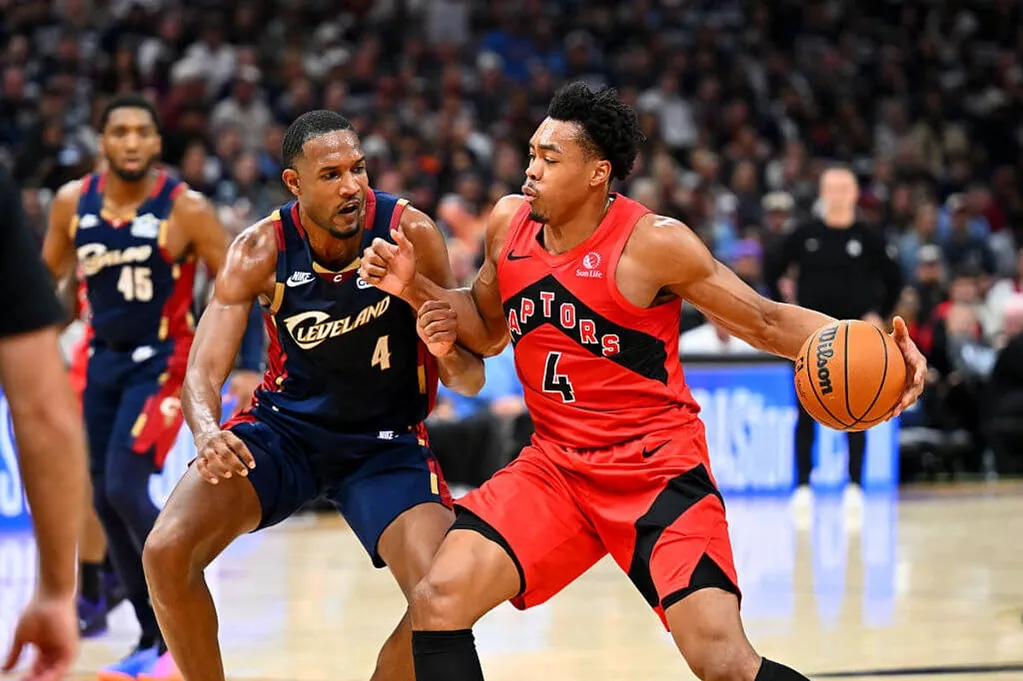
CLEVELAND -- Being the head coach of a young, inexperienced playoff team facing an opponent with much more experience must be tough. Even if you have worries, you don't want to project them, lest your team realize that maybe it should be worried, too.
The Toronto Raptors were a run-of-the-mill offensive team this year, but only because they scored on the run more than any other team. Toronto's half-court attack was fine, but certainly not what they relied upon. The biggest playoff truism? The pace slows down in the spring.
"Nothing can change. Nothing should change in that regard. We've got to be able to run on makes and misses," Raptors head coach Darko Rajaković said Thursday, two days before they returned to the playoffs for the first time in four years with a 126-113 loss. "We've got to try to play to our strengths. Obviously, our opponent is going to try to slow us down, try to do everything in their power. They don't have much say in that. It really depends on us and how willing we are to push the ball and how focused we are going to be to do that on makes and misses."
It's a nice thought, that your opponent is powerless to stop you if you just put your mind to it. That's not the reality of the playoffs, especially when you're the less talented team. A better team is staring back at you, trying to keep you from doing what allows you to excel. And when that team has two world-class guards who are used to seeing all sorts of different coverages, and you don't even have your best approximation of them, dictating terms is a pipe dream.
Which is to say, the Raptors scored one fast-break point in Game 1, 17.9 shy of their league-leading average. It's not as easy as just willing it so. Contrary to what Rajaković said, the Cavaliers have some say in the matter.
"I feel like they were getting back," Scottie Barnes said. "Just trying to wait for us, other than them top-locking (Brandon Ingram). But everyone else was just trying to stay compact, stopping us from running."
"I think you could see it was a focus for them to get back in transition," added RJ Barrett, one of the biggest beneficiaries when the Raptors are able to score on the move. "We ran against them a lot during the year. I think that was a focus. But also, we've got to get stops."
So, which one is it: You need to stop the other team to run, or you can run regardless? Nobody would say it is easier to create transition opportunities when you have to inbound the ball from under your basket, but is it even possible?
What nobody on the Raptors wants to say: There isn't much loafing back in transition in April like there is in January. Therefore, the stops become crucial. That was the most disappointing part of Game 1, and the most concerning part of things going forward. The Cavaliers seemed unbothered when they were able to get a shot off.
In building the No. 5 defence in the league, the Raptors relied heavily on forcing turnovers. Both Donovan Mitchell and James Harden had four, and the Cavaliers had 17. But those aren't players who are typically going to be susceptible to full-court pressure, players who are going to be sped up by anyone who doesn't have exceptional length and quickness. The Raptors have two of those guys -- Scottie Barnes and Collin Murray-Boyles -- but it is not as if the Cavaliers' bigs can be ignored. Meanwhile, the Cavaliers always have one high-quality shooter out there. More often, they have more than that.
Even in a best-case scenario, both Harden and Mitchell can get off pull-up 3s late in a possession. The Raptors have nothing like that, especially without the injured Immanuel Quickley. It's not so easy to create havoc against a team so skilled.
"That's a really good team. It is what it is," Murray-Boyles said after his first playoff game. "They have great pieces all around, and obviously the head of the snake -- I don't even know who's the head of the snake for this team. They're just so talented."
"I think it's pretty hard (to slow down Cleveland's guards). But I think we can play a lot harder than we did today," said Jamal Shead, who started in place of Quickley. "I think we have another level. We can make all the adjustments we want. But at the end of the day, we just have to play harder."
With apologies to Shead, that is the ultimate balm after a blowout loss in a playoff debut. Shead and Barnes, who shot 32.1 and 30.4 percent from 3, respectively, combined to make eight of their 10 attempts. This was a 13-point loss going on 30.
It is not just about playing harder. It is about playing better and smarter, which is precisely what the opponent is trying to stop you from doing. Ingram took just nine field-goal attempts, just fourth among the starters (although Ingram took 10 free throws), with the Raptors not crisp enough to set him up for typical looks in the second half as the Cavaliers guarded him from the top side of screens. Without Quickley, there wasn’t much dangerous playmaking on the second side of the floor.
Cleveland, the far more experienced team, was dictating terms. That is what you would expect. And while the Raptors can toy around with switching matchups -- perhaps Barnes guards Harden instead of Mobley -- and run through counters to the defence on Ingram, they are going to be slower to adjust to the adjustments by virtue of their lack of experience. Perhaps Quickley will come back, although that wouldn't solve many of the defensive problems. Perhaps getting Game 1 out of the way will loosen them up, allowing them to access that identity more easily.
"We did not do a good job of running with pace and force," Rajaković said. "Again, I think everything for us starts on the defensive end. And we've gotta get back to that."
It's an easy thing to say, and a much more difficult thing to do.