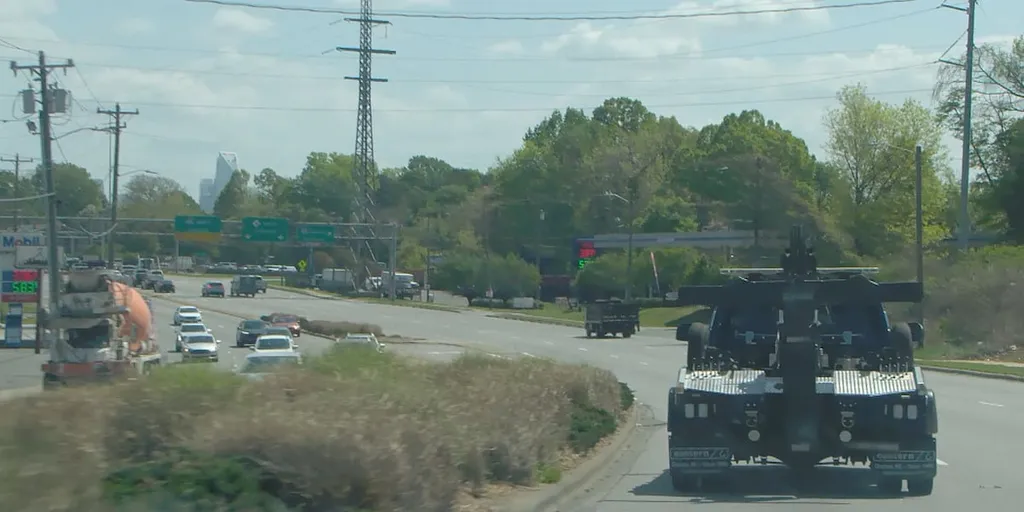
CHARLOTTE, N.C. (WBTV) - A Charlotte police officer threatened to arrest a tow truck driver for towing a commercial vehicle, citing a new state law. Tow truck companies say the new law is being misinterpreted by Charlotte police.
Frank Edwards, owner of No More Locked Doors, said one of his drivers was threatened with arrest and jail time while impounding a commercial vehicle. On March 26, Edwards recorded video of an interaction with Charlotte-Mecklenburg police officers enforcing the law's interpretation.
"If we don't drop that vehicle, what are you going to do to us?" Edwards asked in the cell phone footage.
"We have been advised this is a new law," the Charlotte officer responded. "We've been advised to educate and then move on, but ultimately it is a misdemeanor. So, we can either issue a citation or take someone to jail. We don't want to do that."
A new state law that prevents commercial motor vehicles from being booted is being interpreted by Charlotte-Mecklenburg police to mean that commercial vehicles cannot be towed at all.
On March 16, Charlotte-Mecklenburg Police Department attorney Jessica Battle sent an email to all officers claiming that lawmakers intended for the word "immobilization" to cover more than just booting. She said the law also includes towing.
WBTV received a copy of the letter sent to the city of Charlotte that appears to have led to this new interpretation.
However, the message from the state lawmaker who is behind the booting ban falls short of claiming that towing of commercial vehicles is now prohibited.
The letter from state Representative Mike Schietzelt was sent on Feb. 26 and claims that "the City of Charlotte is currently permitting towing operators to engage in practices that plainly violate the new statutory requirements."
The letter claims Charlotte is allowing tow truck companies to hook occupied commercial motor vehicles and force drivers to either get towed in their cabs or be left roadside -- which is "exactly what the statute was enacted to prevent."
The Charlotte-Mecklenburg Police Department declined to interview or comment on its new towing policy. WBTV also requested information on tow truck drivers who were cited or arrested under the new law, but the department has not provided those details.
The change in enforcement is a stark departure from how Charlotte police have typically enforced towing disputes. WBTV's reporting has shown that officers in Charlotte, and across North Carolina, routinely tell people that towing disputes don't fall under their purview and is instead a "civil matter."
Edwards with the No More Locked Doors towing company said Charlotte-Mecklenburg police are enforcing beyond what the law allows.
"The general statute specifically is talking about booting and immobilization using a booting device or anything similar to it. It has nothing to do with impounding or towing a commercial vehicle," Edwards said.
The same law regulates how trucking companies can get their cargo back after they have been towed.
Edwards has a contract to tow tractor trailers that do not follow posted rules from a Shell station lot off Sunset Road. Truckers have a free parking space at the location and are allowed to stay for two days.
Edwards said he cannot currently tow commercial vehicles that violate the lot's rules.
"That's like saying, if I was to come to your home and park a commercial vehicle in front of your yard. With this new so-called interpretation, you won't be able to call to get that towed away," Edwards said.
The booting rule went into effect in December 2025. Edwards said he supports the law if it only regulates booting.
"I'm all for the non-booting. That weeds out a lot of people who don't have tow trucks, who don't even have a towing company, that don't even have a yard like we're standing in right now," Edwards told WBTV.
"I just want answers. You know, if something is not a law, how can an interpretation from one person make it law?"
WBTV Investigates has reported on the Wild West of Towing in North Carolina for nearly a decade, revealing the industry is flooded with felons and fraudsters who are making big money towing cars and booting trucks.
North Carolina is one of 10 states that does not cap towing fees or have a licensing board for tow truck companies. A bipartisan group of lawmakers is working to change that, but attempts have come up short.