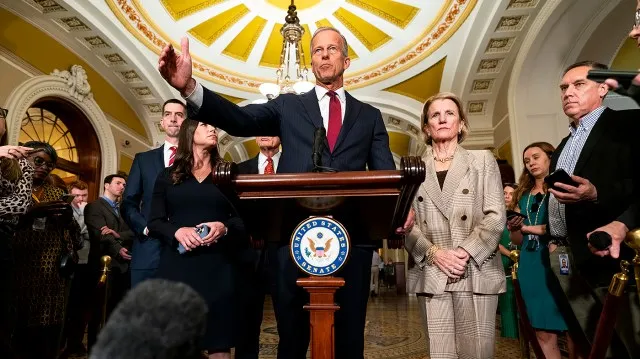
President Trump's allies are planning to take over the Senate floor this week in a bid to pass the SAVE America Act, setting up a major test for Senate Majority Leader John Thune (R-S.D.) who is under pressure from Trump and the MAGA base to extend the debate over voting reform for as long as possible.
GOP senators are playing their cards close to the vest ahead of this week's marathon debate over the Safeguard American Voter Eligibility (SAVE) America Act, which would require people registering to vote to show documented proof of citizenship.
But they're bracing for long hours and possible late nights in a bid to build momentum for the bill, which already has broad public support. A recent Harvard CAPS/Harris poll of 1,999 registered voters found that 71 percent support the SAVE America Act.
Trump allies, frustrated that they aren't able to force Democrats to stage a so-called talking filibuster to block the bill, are pressing Thune to keep the measure on the floor as long as possible to force Democrats to defend their opposition.
"How long it goes is going to be instructive because the point of this is exhausting Democrats, the point of it is pain, the point of it is forcing a public and political process and seeing what comes out of it," said a Republican strategist who favors a showdown with Democrats over the legislation.
"Is this going to be a fist fight or not? How bloody is Thune going to make this?" the strategist said.
Sen. Mike Lee (R-Utah), a leading proponent of the bill, says Trump wants to see Republicans go all out and is envisioning an epic floor fight, like the two-month battle that preceded the Senate's passage of the 1964 Civil Rights Act.
"What I want to do is try to maximize the period of time in which we debate it," Lee said.
Lee recalled that during the battle over the 1964 Civil Rights Act the Senate stayed in session for 60 days "and used an approach that is similar to what I think we ought to do here."
"They faced a 32-vote cloture deficit at the time it came over from the House in March of 64," Lee said. "They were able to close a 32-vote cloture deficit. It took them 60 days but they got there."
"Debating a bill that continues to get more popular even as people are trying to slow it down and stop it and obstruct it sometimes sharpens the minds of individual lawmakers and makes them more amenable in the end to negotiation," Lee added. "That's what we're looking at here."
Lee, a close Trump ally, suggested that the president will closely watch this week's Senate debate. Trump has put intense pressure on Thune to get the bill through the upper chamber and last week said he would not sign any legislation until the SAVE America Act hits his desk.
"The extent of his satisfaction with the process will depend on whether in his view we gave it everything we have," he said.
Sen. Katie Britt (R-Ala.) said Republicans are still "working through" their floor strategy but are preparing for a battle.
Asked if Republicans would hold the floor for quite a while, Britt declared: "Heck yeah."
It usually requires 60 votes to begin debate on a bill, but Thune has found an easier way to get the measure onto the floor to give Lee and other Trump allies a chance to have an open-ended debate on the measure.
Thune has planned the vote on a motion to proceed to the SAVE America Act so that it will be considered as a message from the House, allowing Republicans to get on the bill with a simple-majority vote.
It's a big concession to conservative colleagues because there's little chance of getting 60 votes to advance the legislation to a vote on final passage given strong Democratic opposition to the measure.
But Thune has repeatedly rejected entreaties from Trump and conservative colleagues to force Democrats to wage a talking filibuster, which would require them to actively hold the floor with debate and amendments in order to prevent the bill from passing.
Thune told GOP senators last week that he doesn't have enough votes to require Democrats to sustain a talking filibuster because the GOP conference isn't unified enough to repeatedly table Democratic amendments to derail the SAVE America Act.
"The votes aren't there, one, to nuke the filibuster and the votes aren't there for a talking filibuster. It's just a reality," Thune said last week. "I'm the person who has to deliver sometimes the not-so-good news that the math doesn't add up but those are the facts and there's no getting around it."
One of the strongest objections from Republican senators who don't want to force Democrats to wage a talking filibuster is that doing so would allow Democrats to force votes on an unlimited number of amendments.
That means that Democrats could force tough votes on extending the enhanced Affordable Care Act health insurance premium subsidies that expired in January or to restore the Medicaid cuts enacted by last year's One Big Beautiful Bill Act.
Some Republicans believe Democrats could wage a talking filibuster against the SAVE Act for weeks or even months by continually offering new amendments, which they believe would allow Democrats to speak on the floor an unlimited number of times under Senate precedent.
Instead of forcing a talking filibuster, Thune is letting Republican colleagues decide how long to talk about the bill in an effort to boost its public profile and put Democrats on the defensive.
"This bill needs to remain on the Senate floor, before we file cloture on the bill, for as long as it takes to get it done," Lee said in a video posted on social media Friday.
A cloture vote would need 60 votes to end debate and advance the measure to a simple-majority vote on final passage.
GOP senators say they will force Democrats to take tough votes such as on an amendment to require people to show voter identification to vote by mail.
"We expect to be addressing some amendments next week. I think the leader is going to use tree-filling amendments to guide our progress through the amendments," Lee said, explaining that Thune will use Senate procedure to force votes on Republican-favored amendments and block Democratic-sponsored amendments.
Even so, the measure is unlikely to pick up any Democratic support. Even Sen. John Fetterman (D-Pa.),the centrist Democrat who is most inclined to vote with Republicans on issues,says he opposes the bill.
That means for the SAVE America Act to have any chance of passing the Senate, conservatives will have to use their floor time this week to convince GOP colleagues that the bill is so important to the future of election integrity that it warrants requiring Democrats to wage a talking filibuster.
But so far,a large group of Republican senators don't want to force a talking filibuster over the issue,which they fear would dramatically change how bills are debated and voted on in the future.