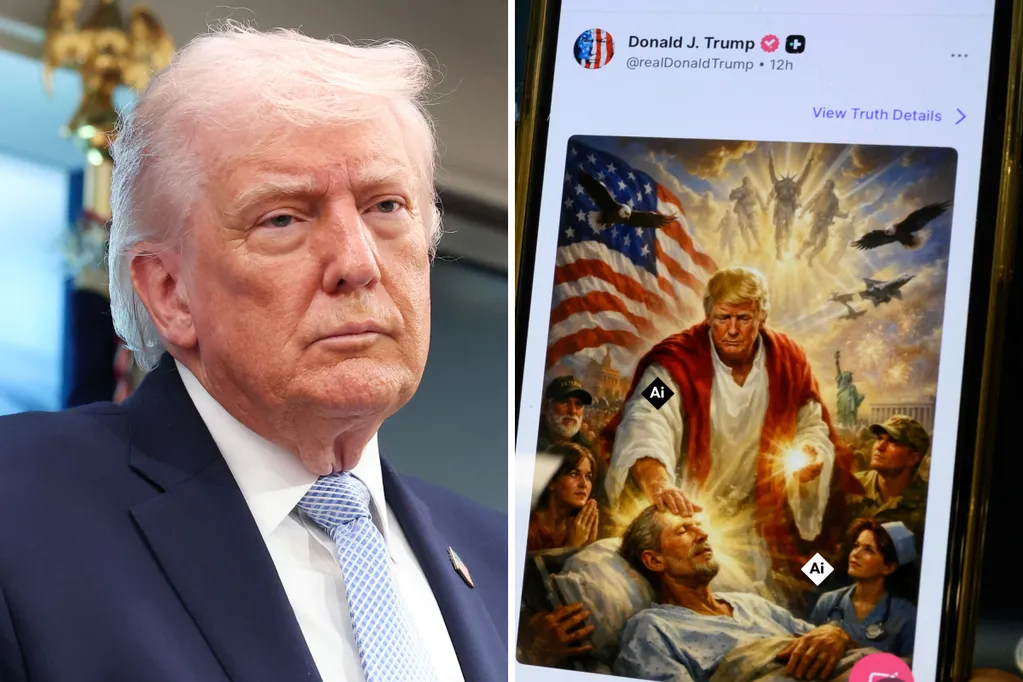
President Donald Trump's job approval rating fell underwater in Utah in April as support slipped sharply among religious voters, with Republican backing also weakening, according to new polling.
Utah's religious voters form a central pillar of Republican support, making their sudden shift a warning sign for Trump's coalition in culturally conservative states.
The erosion points to growing unease with Trump's tone and foreign policy choices among faith‑driven voters, even as national approval within the GOP remains largely stable.
Newsweek contacted the White House for comment via email outside regular working hours.
Utah's political identity is shaped as much by religion as partisanship, and changes among the state's faith‑based voters tend to carry outsize political meaning.
The latest polling suggests Trump may be testing the patience of a group that has long been central to his strength in the Beehive State.
A new Deseret News/Hinckley Institute of Politics poll conducted by Morning Consult surveyed 815 Utah voters between April 15 and 20 and found that 54 percent disapproved of Trump's job performance, compared with 44 percent who approved.
The poll had a margin of error of plus or minus 3 percentage points, and the findings mark a sharp reversal from March, when Trump was still above water in the state.
Just one month earlier, 51 percent of Utah voters approved of the president's job performance, while 46 percent disapproved, showing how rapidly opinion shifted.
Much of that movement appears to be concentrated among religious voters.
Approval among Christians in Utah dropped markedly in April.
According to the poll, 51 percent of Christian voters in the state approved of Trump's performance, down from 63 percent in March -- a double‑digit decline in one month.
The contrast with national sentiment is striking. A separate Deseret News/Hinckley Institute national poll surveyed 2,057 U.S. voters and had a margin of error of plus or minus 2 percentage points.
That survey showed 50 percent of Christian voters nationwide approving of Trump's performance in April, a slight increase from February.
The decline was even more pronounced among members of the Church of Jesus Christ of Latter‑day Saints, a demographic group that plays an outsize role in Utah politics.
While 54 percent of Latter‑day Saint respondents still approved of Trump in April, that figure was down 9 points from March. Disapproval rose to 43 percent, up from 35 percent a month earlier.
Matt Monday, the director of public affairs at Morning Consult, suggested the survey's timing might help explain the shift.
The poll was conducted after several high‑profile social media posts by Trump, including an expletive‑laden message on Easter Sunday and a now‑deleted AI‑generated image depicting him as a Jesus‑like figure.
Those posts, Monday said, might have contributed to the erosion among faith‑oriented voters, particularly in a state where religious norms strongly shape political expectations.
Jason Perry, the director of the Hinckley Institute of Politics at the University of Utah, said Utah voters tended to weigh tone alongside policy, especially when religion was involved.
"Utah voters, they tend to respond not just to policy, but they do respond to tone, particularly when it touches on things like religion or respect for institutions," Perry said in the polling report.
"You put all of these together into one, into really a small period of time, and it has had a direct impact on his approval rating here in the state of Utah," he continued.
Perry added that while Utah voters were often slower than others to abandon political leaders, their patience had limits.
"Utah voters are patient," he said, "but they do have a threshold."
Support among Republicans also declined, though less dramatically than among religious groups.
Nationally, Republican approval of Trump remained strong. The national poll found that 83 percent of GOP voters approved of Trump's job performance in April, only slightly down from 86 percent in February.
In Utah, however, Republican backing softened. Just 74 percent of Utah Republicans approved of Trump's performance in April, a 10‑point drop from the previous month. Twenty‑two percent said they disapproved.
"What's interesting about this particular poll is, yes [Trump's] underwater -- but it's where that movement is coming from," Perry said, pointing to the combined effect of religious discomfort and Republican slippage.
Foreign policy appears to be exacerbating those concerns, particularly the ongoing war in Iran. When asked specifically about Trump's handling of the conflict, 41 percent of Utah voters approved, while 54 percent disapproved -- a worse showing than his overall job rating.
"The important thing to remember is, polls are just snapshots in time," Perry said. He noted that the April survey came at a moment when the Iran conflict had become more prolonged and more politically salient. "One of the key driving forces here is the war in Iran," he added.
Monday echoed that assessment, saying the war appeared to be "doing most of the work" in shaping the latest approval numbers.
That pattern extends beyond Trump himself. Defense Secretary Pete Hegseth, the Cabinet official most closely associated with the war, was the only senior administration official to see a similar downturn.
About 40 percent of Utah voters disapproved of Hegseth's performance; compared with 39 percent who approved; while 21 percent said they were unsure.
Taken together; the results suggest that in Utah -- a state where Republican identity; religious values and foreign policy caution are closely intertwined -- Trump is facing mounting resistance from voters who have long been considered part of his base.