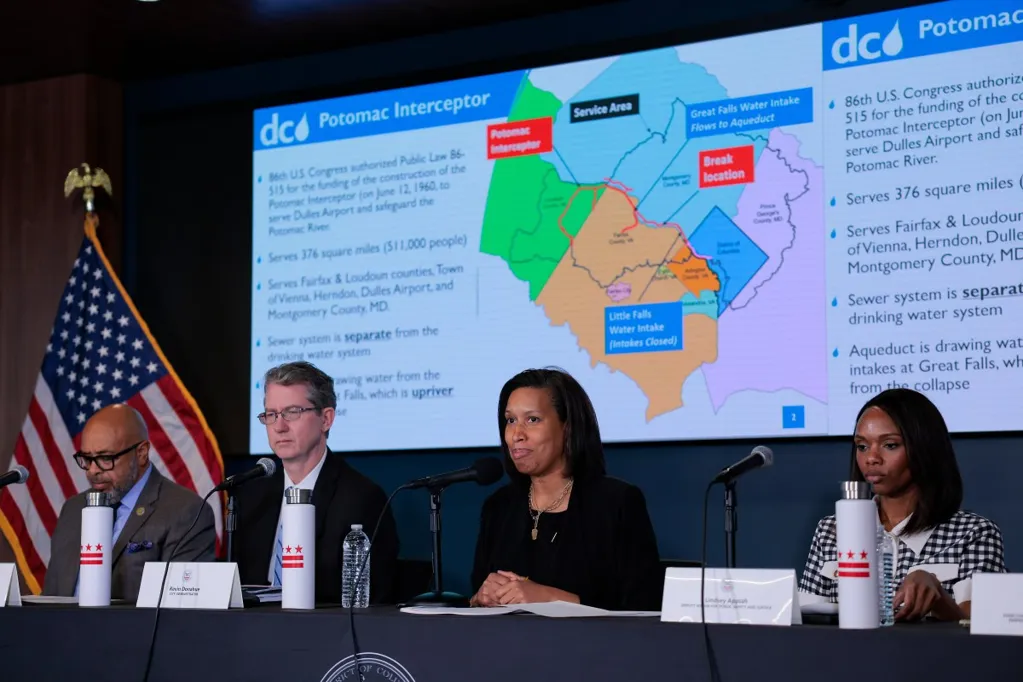
President Donald Trump on Saturday approved Washington, D.C., Mayor Muriel Bowser's request for federal assistance to clean up the Potomac River after last month's sewer line collapse created a potential ecological disaster.
Trump indicated earlier this week he would approve the request when he posted on Truth Social that he would direct federal authorities to provide necessary "management, direction, and coordination" to protect the river, which is the primary drinking water source for the nation's capital.
Newsweek reached out to DC Water for comment by email on Saturday afternoon.
A massive sewage release began on January 19 when a decades‑old section of the Potomac Interceptor sewer line collapsed in Montgomery County, Maryland. The failure sent more than 200 million gallons of untreated wastewater into the Potomac River and adjacent waterways before an emergency bypass system was activated several days later.
Environmental and public‑health experts described the incident as one of the largest sewage spills in U.S. history, raising alarms about contamination levels, infrastructure oversight, and the vulnerability of a river that supplies drinking water to millions.
Health concerns quickly became central to the debate, as testing detected elevated levels of fecal bacteria such as E. coli and other pathogens in affected stretches of the river, prompting state agencies to issue recreational water advisories.
DC Water, which is leading the cleanup, estimated on February 6 that approximately 243 million gallons of wastewater had overflowed from the site since the rupture. Sherri Lewis, a spokesperson for DC Water, said the overflow was initially 40 million gallons a day and stayed at that level for five days.
Public health officials have also said there is no evidence that drinking water systems were affected.
Bowser on Wednesday declared a local public emergency and asked the Trump administration for support in a 15-day order in which she directed emergency and city officials to "activate, implement, and coordinate mutual aid agreements between the District of Columbia and federal, state, or local jurisdictions as needed." She also appealed directly to the president for help and a major disaster declaration.
Trump authorized the Federal Emergency Management Agency (FEMA) on Saturday to begin supplementing response efforts due to "emergency conditions resulting from a sewer line collapse."
FEMA can now coordinate all disaster relief efforts, specifically to "identify, mobilize and provide, at its discretion, equipment and resources necessary to alleviate the impacts of the emergency."
Mark K. O'Hanlon has been named as the Federal Coordinating Officer for federal response operations in the affected area.
The issue has rapidly turned into a major political flashpoint for state and local leaders along the river. On Monday, Trump wrote on Truth Social that the incident had turned into a "massive Ecological Disaster" that he blamed on local leaders -- specifically Maryland Democrat Governor Wes Moore.
"A sewer line breach in Maryland has caused millions of gallons of raw sewage to be dumped directly into the Potomac River, a result of incompetent Local and State Management of Essential Waste Management Systems," the president wrote earlier this week. "This is the same Governor who cannot rebuild a Bridge. It is clear Local Authorities cannot adequately handle this calamity."
However, Moore fired back at Trump, asserting that the federal government is responsible for the Potomac Interceptor and has been "for the past century," stressing that the pipe "is on federal land."
"Maryland agencies and DC Water presented updates on the cleanup during a two-hour legislative hearing," Moore wrote on X. "Trump's EPA was invited. They refused to attend."
"Maryland officials were onsite within hours of the leak to help coordinate the response and protect the public. We will continue to partner with regional leaders," the governor added.
Recovery efforts are ongoing. It will take an estimated four to six weeks longer than initially anticipated to get a system in place, including bringing in bigger equipment, to address the problem and begin removing the large rocks and boulders inside the sewer line, DC Water previously said.
This article includes reporting by the Associated Press.