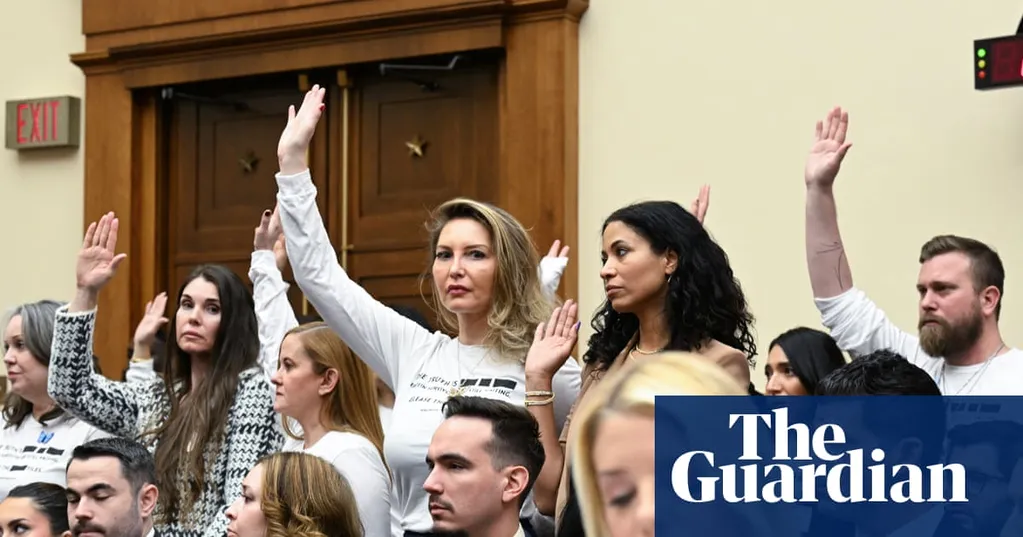
In the days since Pam Bondi's exit from Donald Trump's justice department, Jeffrey Epstein survivors and transparency advocates have been confronted by mixed messaging, prompting questions about whether a full accounting of his crimes would ever be revealed.
Legal veterans told the Guardian that authorities' decisions - such as Bondi's failure to appear for a congressional subpoena about her handling of Epstein investigative files - portend poorly for accountability. Moreover, her replacement's comments about the status of Epstein investigations have been perceived by some as an effort to acknowledge prior missteps without presenting definitive solutions.
Bondi's non-appearance at her scheduled congressional deposition did not come as a surprise.
Trump's Department of Justice, now helmed temporarily by his former criminal defense attorney Todd Blanche, had told the House oversight committee that Bondi would not appear for the 14 April hearing. Committee members said they were told this non-appearance was because Bondi "is no longer attorney general and was subpoenaed in her capacity as attorney general".
A committee spokesperson said: "Since Pam Bondi is no longer attorney general, Chairman Comer will speak with Republican members and the Department of Justice about the status of the deposition subpoena and confer on next steps."
Comer also reportedly engaged in behind-the-scenes efforts to avoid Bondi's deposition prior to her removal, according to the New York Times.
Robert Garcia, the ranking Democrat on the committee, vowed that his colleagues would take action after Bondi failed to appear. "Pam Bondi is evading a lawful congressional subpoena by failing to appear before the oversight committee for a deposition about the Epstein files and the White House cover-up," he said in a statement. "She must appear before the committee, and if she continues to ignore the law, Oversight Democrats will move forward with contempt proceedings immediately."
He added: "We will fight until there is true accountability and justice."
Adding to the confusion is the committee's insistence that Bondi will eventually appear.
An oversight committee spokesperson said in a statement: "Ranking Member Garcia is a hypocrite. The Clintons defied lawful subpoenas for seven months, and he said nothing and never wrote a letter to the chairman. When the oversight committee moved to hold them in contempt of Congress, he voted no. Last week, the Department of Justice indicated that Pam Bondi would not appear for the 14 April deposition because she is no longer attorney general. We are working to reschedule the deposition. Ranking Member Garcia's outrage is purely performative."
Whether this push for transparency and justice will yield anything in the way of actionable information remains ever unclear as the Epstein investigation remains mired in political logjams despite broad public support for accountability. Blanche's recent comments have only added to the confusion, prompting questions about what's next in the saga.
Blanche claimed on Wednesday that the DoJ would back additional inquiries into Epstein, saying at the Semafor World Economy conference that he would support congressional hearings with victims. "We have said repeatedly from day one that if there's any victim that wants to come forward and talk about what they know, whether it's something that happened by Mr Epstein, who's dead, or another individual or individuals, that's what the FBI does," he said.
"I have never said we're moving on," insisted Blanche, who this summer interviewed Epstein accomplice Ghislaine Maxwell in a sit-down that was widely derided for questions that many felt were easy, except in relation to Trump's political opponents. "There's a lot of people in this country that correctly feel that we did not get closure with Jeffrey Epstein ... I couldn't agree with that more."
Two weeks prior to these comments, however, Blanche downplayed controversy surrounding the DoJ's handling of these files. While the Epstein Files Transparency Act (EFTA) mandated that the justice department release all investigative documents by 19 December, authorities repeatedly missed this deadline - and questions remain about whether documents purportedly withheld under lawful exemptions should actually be disclosed.
Spencer Kuvin of Goldlaw, who has represented numerous Epstein victims, addressed Bondi's absence and Blanche's recent statements.
"These developments only underscore how fragile accountability becomes when those in power blur the lines between advocacy and obligation," Kuvin said. "If the court finds willful noncompliance, contempt isn't just appropriate - it's necessary to preserve the integrity of the process.
"As for Mr Blanche, trust is earned through transparency and action, not titles or affiliations. Right now, for the victims, this feels less like progress and more like a standstill - justice delayed yet again, with too many questions and not enough answers."
Ann Olivarius, a longtime women's rights attorney who founded the law firm McAllister Olivarius, said the Bondi subpoena "doesn't evaporate because Pam Bondi was fired".
She added: "Bondi oversaw the handling (or mishandling) of these files and was the attorney general when survivors' identifying details were exposed. She owes Congress her testimony, and she owes these women an explanation. If she refuses, contempt is entirely appropriate."
Olivarius also said: "There is no reason to believe that Todd Blanche will be in a substantial[ly] different position than Bondi - the role of AG is now akin to a courtier at a medieval court: whatever power he wields must be to please the king. Todd Blanche has sent contradictory signals at extraordinary speed, and it is starting to feel like intentional strategic ambiguity, speaking the language of transparency while engineering its limits."
Olivarius pointed to the politics surrounding Epstein in relation to Trump, who was among Epstein's many rich and powerful associates. Trump said he and Epstein had a falling-out prior to Epstein's conviction on state-level prostitution counts in Florida.
The Epstein controversy has shadowed Trump's presidency for more than a year. Trump vowed on the campaign trail that he would release the files - ramping uphis far-right fan base, who believe that Epstein was part of an elite global cabal that trafficked girls.
Trump's justice department backtracked on releasing files prior to the EFTA's passage, however, prompting extensive criticism. A July DoJ memo claiming there was no client list and that there was no evidence "that could predicate an investigation against uncharged third parties" ultimately set the stage for congressional action.
"I expect a defensive approach that follows what the law strictly requires, not what justice demands," Olivarius said of DoJ's future treatment of these files. "However, he [Blanche] will not be operating in a vacuum and congressional oversight will be critical. Bipartisan pressure is real and growing, and the House oversight committee's plan to call co-conspirators to testify is significant here."
Neama Rahmani, founder of West Coast Trial Lawyers and a former federal prosecutor, said he did not expect much would change at the justice department under Blanche.
"Blanche doesn't look like he's going to move the needle," Rahmani said, noting that "he's done a lot of talking for Bondi on this".
At this point, Rahmani said, lawmakers are likely the best bet in getting accountability - by using courts to enforce legal demands.
"I think it's really a job for Congress," Rahmani said. "I really think the House oversight committee should file a lawsuit, get a district judge involved, have him or her review the documents in camera, outside the presence of the public, to see if what is being withheld on the basis of responsiveness or privilege is appropriate," he said of files withheld. "That's what a judge is there to do."
"We really need Congress to challenge the DoJ, and I just don't see that happening yet."
Asked for comment about Blanche's plans on future handling of the Epstein files, a justice department spokesperson said: "His comments speak for themselves."
Asked for comment, the White House said: "Just as President Trump has said, he's been totally exonerated on anything relating to Epstein. And by releasing thousands of pages of documents, cooperating with the House oversight committee's subpoena request, signing the Epstein Files Transparency Act, and calling for more investigations into Epstein's Democrat friends, President Trump has done more for Epstein's victims than anyone before him."
It added: "The DoJ has repeatedly been clear: they encourage any victims of Jeffrey Epstein, who wish to speak, to contact the FBI and any survivor who has information on an abuser is encouraged to contact federal law enforcement."