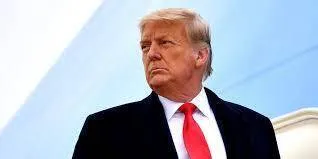
Washington (Web Desk/Agencies): US President Donald Trump announced on Tuesday that the United States would temporarily halt its mission aimed at assisting commercial ships through the Strait of Hormuz, pointing to what he described as major progress toward a broader agreement with Iran.
Earlier in the day, US Secretary of State Marco Rubio had explained that the operation, launched on Monday, was intended to escort stranded oil tankers out of the Gulf region. Shipping activity in the Strait of Hormuz has been severely disrupted since the conflict erupted, affecting nearly one-fifth of the world's oil supply and intensifying the global energy crisis.
In a message posted on Truth Social, Trump wrote: "Based on the request of Pakistan and other Countries, the tremendous Military Success that we have had during the Campaign against the Country of Iran and, additionally, the fact that Great Progress has been made toward a Complete and Final Agreement with Representatives of Iran, we have mutually agreed that, while the Blockade will remain in full force and effect, Project Freedom (The Movement of Ships through the Strait of Hormuz) will be paused for a short period of time to see whether or not the Agreement can be finalized and signed."
Iran did not immediately issue a response to Trump's remarks as it was early Wednesday morning in Tehran.
Following Trump's announcement, US crude oil prices dropped by $2.30, falling below the significant $100-per-barrel level that had been surpassed after tensions in the region sent energy markets soaring over the past two months.
The White House did not provide immediate clarification regarding the nature of the reported diplomatic progress or how long the suspension of the operation would continue.
US Secretary of State Marco Rubio and other senior American officials had earlier maintained that Iran must not be allowed to dictate movement through the strategic waterway. Tehran has effectively restricted access to the strait since the US-Israeli military campaign began at the end of February.
In response, Washington imposed a blockade on Iranian ports and began escorting commercial vessels through the passage.
The US naval escort missions carried out during the previous 36 hours, referred to by Trump as "Project Freedom," reportedly came under attack from Iranian forces, increasing concerns over the fragile ceasefire already in place.
Iran's Revolutionary Guards navy warned that any vessel deviating from routes approved by Tehran inside the strait would face a "firm response". Meanwhile, Iran's chief negotiator stated that discussions had "not even started yet" after a series of incidents in the key maritime corridor.
Speaking to reporters at the White House, Rubio said the United States had completed the goals of its military operation, which began alongside Israel on February 28.
"Operation Epic Fury is concluded," Rubio said. "We're not cheering for an additional situation to occur."
"This is not an offensive operation; this is a defensive operation," Rubio said. "And what that means is very simple -- there's no shooting unless we're shot at first."
Rubio further stated that Washington had "achieved the objectives" of the conflict.
"These guys are facing real catastrophic destruction to their economy," he said while also noting that Trump continued to favour a negotiated settlement with Tehran.
One of Trump's primary aims behind launching military action against Iran was to ensure the country does not obtain nuclear weapons, an accusation Iran has repeatedly rejected. However, Tehran has still not surrendered more than 900 pounds of highly enriched uranium.
Earlier on Tuesday, US Defence Secretary Pete Hegseth said American forces had successfully secured a route through the Strait of Hormuz and that hundreds of commercial ships were waiting to move through the area. He added that the four-week ceasefire with Iran remained in place.
"Right now the ceasefire certainly holds, but we're going to be watching very, very closely," he said.
Chairman of the Joint Chiefs of Staff General Dan Caine said Iranian attacks targeting US forces had remained "below the threshold of restarting major combat operations at this point".
When asked what Iran would have to do in order to violate the ceasefire, Trump responded: "They know what not to do."