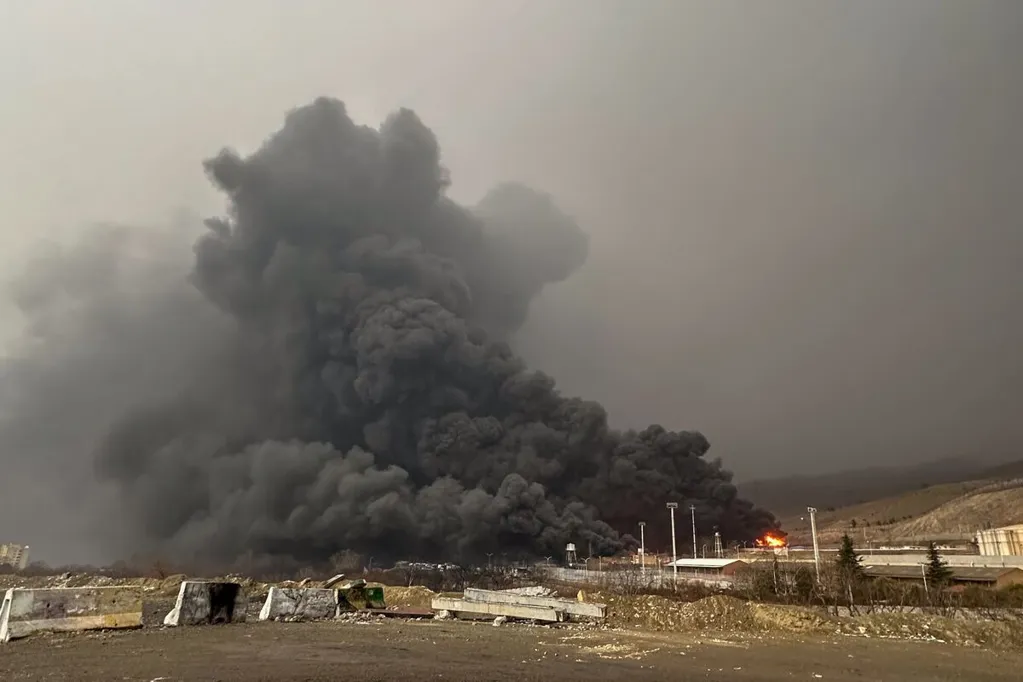
Iranian President Masoud Pezeshkian said Tehran was prepared to reduce tensions "on the condition that the airspace, territory, and waters" of neighboring countries aren't used to launch attacks on the Islamic Republic.
President Donald Trump on Monday said the US and Israel were making significant progress in their war on Iran and could end the conflict "very soon," curtailing an oil-price surge.
Trump said he didn't believe the fighting would be over this week, but insisted the operation was ahead of schedule. The US Navy will escort tankers out of the Middle East to maintain a steady oil supply through the Strait of Hormuz, he added. The effective closure of the strait, vital to the world's flow of petroleum and to container shipping, has caused oil and natural gas prices to soar and stoked fears of inflation.
Brent crude, having climbed to almost $120 a barrel early Monday, is back down to $91.50 but is still up more than 50% this year on the US-Iran tensions. There's as yet little sign Hormuz can be opened quickly, with Iran continuing to retaliate with drone and missile strikes across the region.
On Tuesday, Saudi Arabian oil giant Aramco said it would be able to ramp up a pipeline that can take crude to the kingdom's west coast -- thus bypassing Hormuz -- to full capacity in a few days.
"Together with our Israeli partners, we're crushing the enemy in an overwhelming display of technical skill and military force," Trump told Republican lawmakers. He later said the US had hit 5,000 targets in Iran, reducing the country's missile capability to a tenth of what it was. The military objectives of the war could be described as "pretty well complete," he said.
Tehran pressed ahead with attacks on Arab states in the Persian Gulf on Tuesday. The United Arab Emirates said it was responding to a missile threat from the Islamic Republic hours after it reported a drone attack on its consulate in Iraq's Kurdistan region. One person was killed in an attack on the Bahraini capital of Manama while Kuwait intercepted six drones.
Still, there are early signals that the attacks on some countries, including the UAE—which has been targeted more than any other in the Gulf by Iran since the war began—are waning.
Iranian President Masoud Pezeshkian said Tehran was prepared to reduce tensions "on the condition that the airspace, territory, and waters" of neighboring countries aren't used to launch attacks on the Islamic Republic, according to semi-official Mehr news agency.
Pezeshkian made those remarks during a phone call with Turkey's President Recep Tayyip Erdogan, following the interception of an Iranian missile in Turkish airspace by the North Atlantic Treaty Organization's air defenses on Monday. He's made similar comments in the past week, and they've caused confusion in the region since Iran continues to attack the likes of the UAE and Saudi Arabia, which say they aren't allowing Israel or the US to use their airspace for strikes on the Islamic Republic.
Trump pledged during his election campaign to ensure the US didn't become embroiled in protracted wars on foreign soil and an extended campaign along with more American casualties and sustained high gasoline prices will weigh on the Republican Party's chances of retaining control of Congress in mid-term elections in November. Polls show an overwhelming majority of Americans oppose the war, and heavyweights in Trump's Make America Great Again movement as well as several GOP politicians have condemned it.
Countries from Australia to South Korea and the UK have either helped to boost defenses of allied countries in the Gulf or are assessing requests to do so, as Arab states continue to be the target for the bulk of Iran's retaliatory attacks.
The US president said drone launches from Iran had fallen by 83% since the first few days of the conflict and that the US had sunk more than 50 Iranian ships. He threatened to strike additional "important targets," including power plants.
On Monday, the UAE announced the lowest number of drone launches targeting its territory since the war began.
Trump said he could waive "certain oil-related sanctions to reduce prices" but didn't offer additional specifics beyond acknowledging he had discussed the topic with Russian President Vladimir Putin in a phone call earlier Monday. Russia has faced a range of restrictions on its vast oil industry, including a price cap on its crude and US sanctions on its two largest producers -- a bid to deprive the country of revenue over its war in Ukraine.
"We're looking to keep the oil prices down," the US president said. "They went artificially up because of this excursion."
Trump acknowledged unanswered questions that remained about the leadership in Tehran and vowed he would "not relent until the enemy is totally and decisively defeated."
Iranian Foreign Minister Abbas Araghchi, interviewed on PBS's News Hour on Monday, said his nation had "very bitter experience" of negotiating with the Americans. He pointed out that the US had chosen to attack Iran in June last year and again this year when talks between them were ongoing.
"So I don't think talking with Americans anymore would be on our agenda," he told PBS.
Elsewhere, Syria said Lebanon-based Hezbollah fired artillery shells at its army positions west of Damascus, according to state-run Sana. It also said Hezbollah had been sending reinforcements to the border between Syria and Lebanon.
Trump told CBSBloomberg Terminal the Strait of Hormuz was seeing more ship traffic and he is "thinking about taking it over." It was not immediately clear what specific actions the president was contemplating.
The effective closure of the Strait of Hormuz has forced Saudi Arabia, the world's biggest oil exporter, to reduce production, according to a person familiar with the matter. That follows similar moves by the United Arab Emirates, Kuwait and Iraq.
Read More About the Iran War:
- The US reported its seventh casualty on Sunday. Two Israeli soldiers and about a dozen Israeli civilians also have lost their lives. More than 1,300 Iranians have died in the war so far, according to an official toll that number hasn't been updated for several days.
- Israeli forces maintained attacks on southern Lebanon, aiming to degrade Iran-aligned Hezbollah. Some 486 people have died in Lebanon, according to the nation's health ministry.
- Four civilians have so far died in the UAE, while two members of its armed forces were killed when a malfunctioning helicopter crashed. There also have been several deaths in other Gulf countries.
- On Sunday, Ayatollah Mojtaba Khamenei -- whose father Ali Khamenei ruled the country for almost 37 years and was killed when US-Israeli strikes began on Feb. 28 -- was chosen as the new supreme leader.
- The 56-year-old has deep ties to the Islamic Revolutionary Guard Corps, about the most powerful military and economic organization in Iran. The group pledged full obedience to the new leader. He's yet to speak publicly since being elected.
- Trump indicated his displeasure, saying Iran should put in a leader "that's going to be able to do something peacefully, for a change."
- The new leader "shares many of the same ideological leanings as his father and will aim to maintain continuity -- including in the war," said Dina Esfandiary, a Bloomberg Geoeconomics analyst. His election "suggests Iran won't be shifting tack in the Middle East war," she saidBloomberg Terminal.