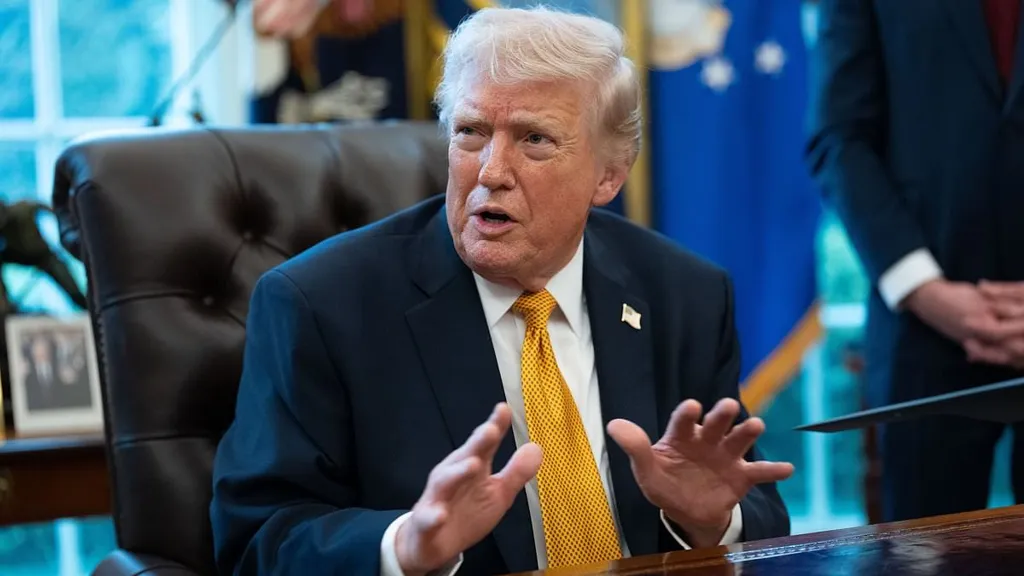
Donald Trump's confidantes are increasingly concerned he may be losing control of the Iran war, as allied countries rejected his plan to reopen the Strait of Hormuz.
Trump has demanded that US allies deploy warships to help reopen the critical oil passageway. But France, Japan, Australia, and the United Kingdom have no plans to assist Trump in protecting commercial shipping vessels from Iranian attacks.
Now in its third week, Trump's war has driven gas prices to an average of $3.8 per gallon from $2.9 before the war began as the narrow strait through which a fifth of world oil flows remains strangled by the threat of Iran's mines and missiles.
Trump's allies fear the spiraling conflict has boxed him in without a clear off-ramp, raising concerns he may be forced to put troops on the ground to salvage victory.
'We clearly just kicked [Iran's] ass in the field, but, to a large extent, they hold the cards now,' said one person close to the White House to Politico.
'They decide how long we're involved - and they decide if we put boots on the ground. And it doesn't seem to me that there's a way around that, if we want to save face.'
Some allies believe Trump risks being dragged into an open-ended conflict with Iran as the midterm elections approach. The escalating conflict could inflate the cost of living while voters already remain frustrated with affordability.
'The terms have changed,' said a second person familiar with military operations in Iran. 'The off-ramps don't work anymore because Iran is driving the asymmetric action.'
The war has also caused a schism within Trump's MAGA movement among top allies, including Tucker Carlson and Megyn Kelly.
Trump for years has argued against regime change wars in the Middle East.
US intelligence has also determined that Iran's brutal regime will likely remain in power, despite relentless airstrike by the military.
The Islamic Revolutionary Guard Corps will likely exert greater domestic control over Iran as the country's internal secret police.
The Israeli defence minister Israel Katz said security chief Ali Larijani and Gholamreza Soleimani, the commander of Iran's Basij forces, have joined the late Ayatollah Khamenei in the 'depths of hell' following targeted overnight airstrikes.
The attack on Larijani comes four days after he marched alongside thousands of Iranians at a Quds Day rally in Tehran where he criticised Trump during a live interview.
Iran's Supreme Leader Ayatollah Mojtaba Khamenei, who has not been seen since the war began, has said that the US and Israel must be 'brought to their knees' and accept defeat before any peace deal can be achieved.
Meanwhile, shipping in the Gulf and along the narrow strait, which carries around a fifth of the world's oil, has come to a near-standstill.
The human toll comes amid mounting concerns over the financial cost, the Pentagon having burned through $5.6 billion worth of munitions in the first two days of the war
'For the White House, now the only easy day was yesterday,' the source familiar added. 'They need to worry about an unraveling.'
The White House and Pentagon, however, continue to argue the war is a 'tremendous success' by claiming the US military has naval and aerial superiority over Iran.
Despite the success touted by the administration, the US navy is still unable to guarantee the safety of commercial oil tankers by escorting them through the Strait of Hormuz.
The US military has moved additional forces to the region, such as the warship USS Tripoli, carrying a 2,000 Marine Expeditionary Unit capable of seizing Iranian ports.
The deployment has led some to believe Trump will soon launch a limited ground offensive against the Islamic Regime to alleviate the global oil crisis.
Trump in recent days has suggested fighting with Iran could end soon, but has also warned the US is prepared for a long-term offensive.