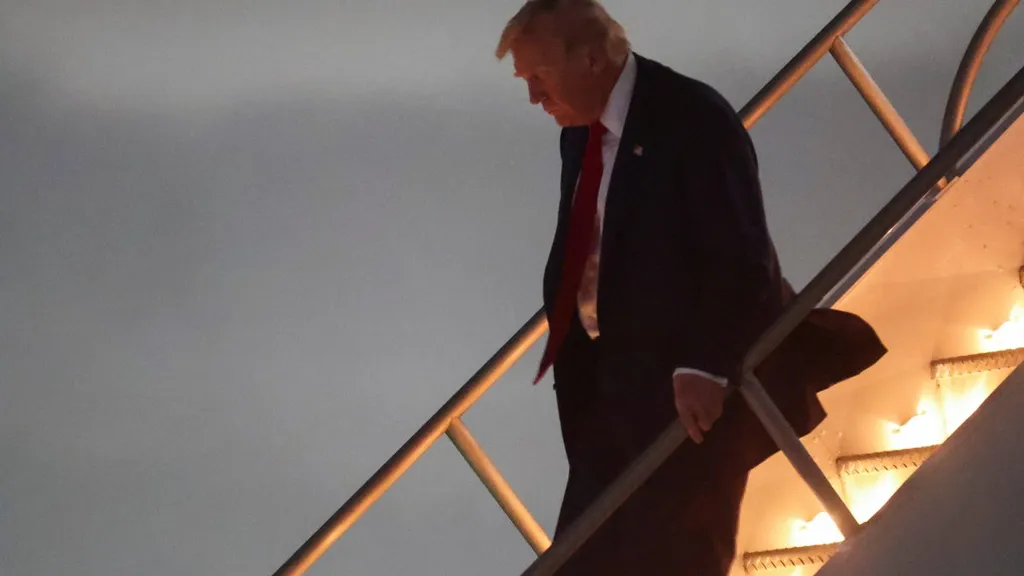
President Donald Trump attended a dignified transfer of six Americans killed in an Iranian drone attack during the first weekend of fighting in the open-ended war Trump administration officials said would likely result in additional servicemembers' deaths.
Four of the servicemembers were part of an Iowa-based reserve unit that the Pentagon says was stationed in Kuwait. They were killed in a March 1 drone attack.
The soldiers were Capt. Cody A. Khork, 35, of Winter Haven, Florida; Sgt. 1st Class Noah L. Tietjens, 42, of Bellevue, Nebraska; Sgt. 1st Class Nicole M. Amor, 39, of White Bear Lake, Minnesota; Sgt. Declan J. Coady, 20, of West Des Moines, Iowa. The U.S military says that Maj. Jeffrey O'Brien, 45, of Waukee, Iowa, and Chief Warrant Officer 3 Robert Marzan, 54, of Sacramento, California, was also killed in the attack.
Among the dignified transfer attendees were first lady Melania Trump, Vice President JD Vance and second lady Usha Vance, Defense Sec. Pete Hegseth, Attorney General Pam Bondi, White House Chief of Staff Susie Wiles and Department of National Intelligence director Tulsi Gabbard.
U.S. Sen Lisa Blunt Rochester of Delaware, U.S. Senator Joni Ernst of Iowa, U.S. Sens. Deb Fischer and Pete Ricketts of Nebraska were in attendance and Florida Gov. Ron DeSantis, Nebraska Gov. Jim Pillen and Iowa Gov. Kim Reynolds also attended the ceremony.
Dignified transfers are reserved for members of the military who were killed in action and always take place at Dover. They involve the transfer of the casket by military personnel from the aircraft that transported them to an awaiting vehicle.
Trump traveled from Miami for the transfer. He and Secretary of State Marco Rubio are hosting a March 7 summit for Latin American leaders at the president's Doral golf club. He is expected to return to Miami after the dignified transfer in Dover.
Nation grieves for Americans killed in action
The president first acknowledged the deaths in a March 1 video that posted to his social media account.
"As one nation, we grieve for the true American patriots who have made the ultimate sacrifice for our nation. Even as we continue the righteous mission for which they gave their lives, we pray for the full recovery of the wounded and send our immense love and eternal gratitude to the families of the fallen," Trump said. "Sadly, there will likely be more before it ends. That's the way it is."
Trump pledged to do "everything possible" to protect American troops. And he vowed to avenge the soldiers' deaths.
"As the president said, we grieve for these American patriots and their families as we continue the righteous mission for which they gave their lives," White House press secretary Karoline Leavitt said at a March 4 briefing when announced Trump's plans to attend the dignified transfer.
Trump's strikes on Iran have come under scrutiny as the regional death toll continues to rise, with nations across the Middle East and other regions such as Ukraine joining the ongoing fight.
The death toll in Iran exceeded 1,200 as of March 6. U.S. officials said they are investigating a strike on a girls' school in southern Iran that killed an estimated 175 people.
The last time the president attended a dignified transfer was in December when two Iowa Army National Guard troops and their interpreter, who were killed in Syria during a mission to combat the Islamic State, were returned to the U.S.
Democrats in Congress tried and failed this week in mostly party-line votes in the House and Senate to block Trump from continuing the strikes in Iran.
Trump has said the war could last four to five weeks. Pentagon chief Pete Hegseth has said it could go on longer or end more swiftly, but he noted that the United States would not quit its bombing campaign until the American military fulfilled its objectives. What those objectives are is not entirely clear: Trump has said the United States wants to eliminate Iran's navy, destroy its ballistic missile capabilities and keep Tehran from obtaining a nuclear weapon.
U.S. officials, such as Hegseth, have said the war will not be "endless" while emphasizing the United States has enough munitions to carry out an indefinite number of strikes.
Contributing: Michael Loria, Chris Kenning, Chris Quintana, Kevin Baskins, Kyle Werner of USA TODAY.