You're reading the Evening Briefing Europe newsletter.
You're reading the Evening Briefing Europe newsletter.
You're reading the Evening Briefing Europe newsletter.
Understand the most important stories of the day with context and analysis only Bloomberg can deliver.
Understand the most important stories of the day with context and analysis only Bloomberg can deliver.
Understand the most important stories of the day with context and analysis only Bloomberg can deliver.
Bloomberg may send me offers and promotions.
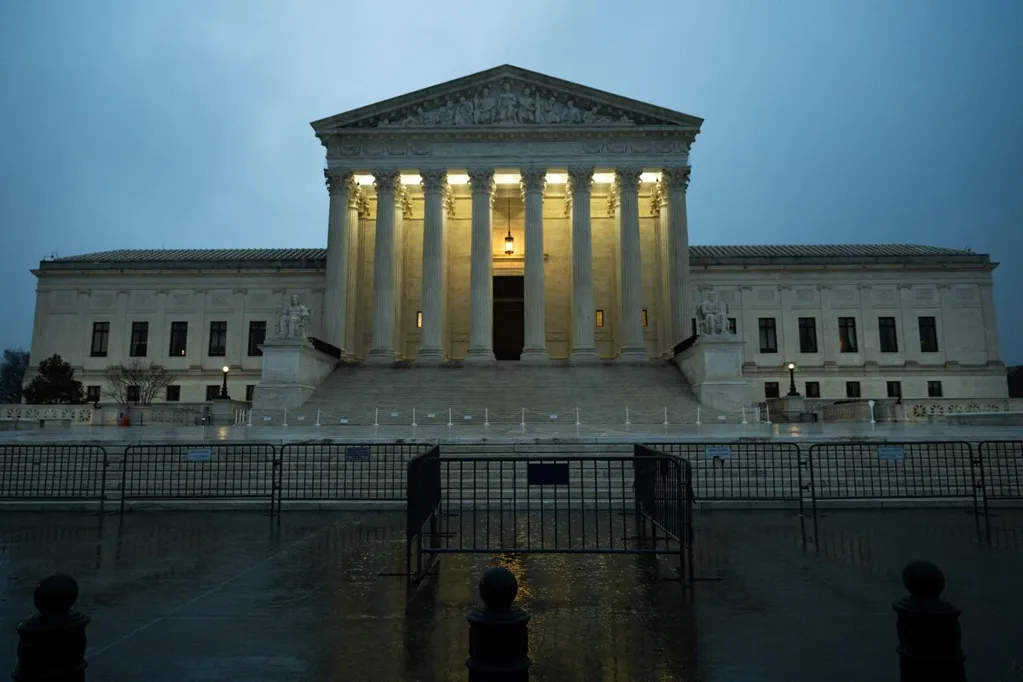
The US Supreme Court struck down President Donald Trump's global tariffs, dealing a blow to the centerpiece trade policy of his administration. In a 6-to-3 ruling against the measures, America's highest court ruled Trump exceeded his authority by invoking federal emergency measures to justify the levies.
The president's initial reaction was to label the decision a "disgrace," according to CNN. He is to hold a press briefing shortly. The Supreme Court's ruling followed the release of data showing the US economy underperforming expectations. Stocks surged and the dollar fell on the news.
Tariffs were a thorn in the side of the European Union's economy from the moment Trump took office. They prompted the bloc to try diversifying trade and increase purchases of goods and services made domestically. The levies hurt European industries from steelmakers to pharmaceuticals. The market uncertainty they unleashed helped raise the price of precious metals to record highs.
To be sure, it might be too early for opponents of the tariffs to declare victory. The White House has said it will quickly replace the levies using other legal tools. If fully allowed, court-ordered refunds could total as much as $170 billion - more than half the total revenue Trump's tariffs have brought in.
What You Need to Know Today
Higher taxes and lower spending aren't hemming in the UK's economy. Retail sales surged to a 20-month high, yielding a new measure of optimism among businesses and buoying economic momentum. That's good news for Chancellor of the Exchequer Rachel Reeves, who'll next month be able to report the country's biggest budget surplus on record.
A string of bullish data points since the turn of the year has defied warnings of an economic slump triggered by the Labour government's £26 billion ($35 billion) of extra tax hikes in its November budget.
Whether the UK's turn of fortune is enough to revive the popularity of Prime Minister Keir Starmer's government remains an open question. His premiership has been addled by rumours of his demise, prompting some to wonder whether Starmer may not last long enough to enjoy the fruits of the UK's improving conditions.
France's ascendant far right has European institutions digging firewalls. Historically, Paris has played a crucial role in driving the EU's political and economic agendas. But with the far-right National Rally holding a commanding lead ahead of next year's presidential elections, many see the need for democratic firewalls.
France's central-bank chief, Francois Villeroy de Galhau, already announced he would leave his post prematurely and Christine Lagarde is considering her future as president of the European Central Bank, so as to prevent possible far-right influence in naming successors. That's a potentially risky strategy; the move to politically engineer replacements ahead of schedule could backfire and turn into another round of elite-bashing.
Russian crude shunned by India is being snapped up by China. Our shipping data shows that deliveries of discounted Russian oil to Chinese ports surged in February, more than offsetting the drop of imports by India. Russia's ability to find buyers for its energy is vital for the Kremlin as the war in Ukraine approaches the four-year mark, with millions of barrels building up at sea, and signs that production and drilling rates are under pressure.
India meanwhile is replacing Russian oil with product from Saudi Arabia, importing the most this month from the Gulf nation in more than six years.
Separately, the head of Kenya's national assembly said today that as many as 1,000 fighters from the east African nation were recruited by Russia to its war against Ukraine. There's mounting concern in a number of African countries about Russian recruitment abroad to bolster its manpower-strapped military
Trump said he is considering a limited military strike on Iran, ramping up pressure for a quick deal over its nuclear program. The US has been amassing its largest concentration of military assets in the Middle East in more than two decades. It has prompted speculation that Trump is planning a protracted campaign aimed at ousting the Iranian regime. The ultimatum means Trump's likely to make a decision when the International Atomic Energy Agency convenes to discuss the Islamic Republic's nuclear program March 2. IAEA Director General Rafael Mariano Grossi told us yesterday he's trying to broker a compromise but that time is running out for diplomacy.
The catastrophe bond market is drawing in new issuers at a rate never seen before. John Seo, managing director and co-founder of Connecticut-based Fermat -- a hedge fund manager specialized in so-called cat bonds -- says he's aware of 16 new issuers coming to market in 2025. That's as much as eight times the historical average for first-time issuers, Seo said. He expects cat bond sales of about $24 billion this year, testing last year's record.
Investors in catastrophe bonds are seeing a decline in risk premia to levels not seen since before Hurricane Ian hit Florida in 2022, as a surge in fresh capital drives down potential returns. Investors make money on the securities if a predefined catastrophe doesn't occur, and lose money if it does. In recent years, bondholders have generally come out on top.
The Dance Floor Is Disappearing In a Sea of Phones
Electronic music's club culture is facing an existential moment as bigger venues, higher ticket prices and social media turn dance floors into spectator events. That's a big deal for European cities like Berlin, where technoculture is part of the citiies cultural heritage.
Private-sector activity in the euro area surpassed expectations as manufacturers recorded their best performance since 2022 thanks to surprise growth in Germany. The Composite Purchasing Managers' Index compiled by S&P Global rose to 51.9 in February from 51.3 the previous month. Germany, the region's biggest economy, was the main driver, with manufacturing expanding for the first time in more than 3 1/2 years as the government ramps up expenditure on defense and infrastructure. While France's reading improved, it fell just shy of 50.
What You'll Need to Know Tomorrow
For Your Commute
The vehicles that outlasted the Model S are still operating in its shadow. Love it or hate it, the success of the Tesla Model S forced every legacy automaker to jump into the race that Musk created -- to fill the world with electric vehicles. It changed everything else along the way -- and will continue to drive what comes next.
More from Bloomberg
- * Markets Daily for what's moving in stocks, bonds, FX and commodities
- * Breaking News Alerts for the biggest stories from around the world, delivered to your inbox as they happen
- * Balance of Power for the latest political news and analysis from around globe
- * Money Distilled for John Stepek's daily newsletter on what market moves mean for your money
- * The Brink for exclusive coverage of corporate distress , bankruptcies turnaround stories
Explore all newsletters at Bloomberg.com.