President Donald Trump told a group of Latin American leaders that they need to work with the US to target drug trafficking cartels as he sought to bolster US leadership in the region.
"Every leader here today is united in the conviction that we cannot and will not tolerate the lawlessness in our hemisphere any longer," Trump said Saturday as he hosted the Shield of the Americas summit at his golf club near Miami. "The only way to defeat these enemies is by unleashing the power of our militaries."
He added, "We have to use our military, you have to use your militaries."
The gathering of Trump-friendly leaders from the Western Hemisphere is part of a broader effort to strengthen regional security cooperation ahead of his April meeting with Chinese President Xi Jinping in Beijing. Saturday's summit was also aimed at shoring up support for the administration's anti-drug trafficking operations following the US arrest of former Venezuelan President Nicolas Maduro and subsequent takeover of the country's oil industry.
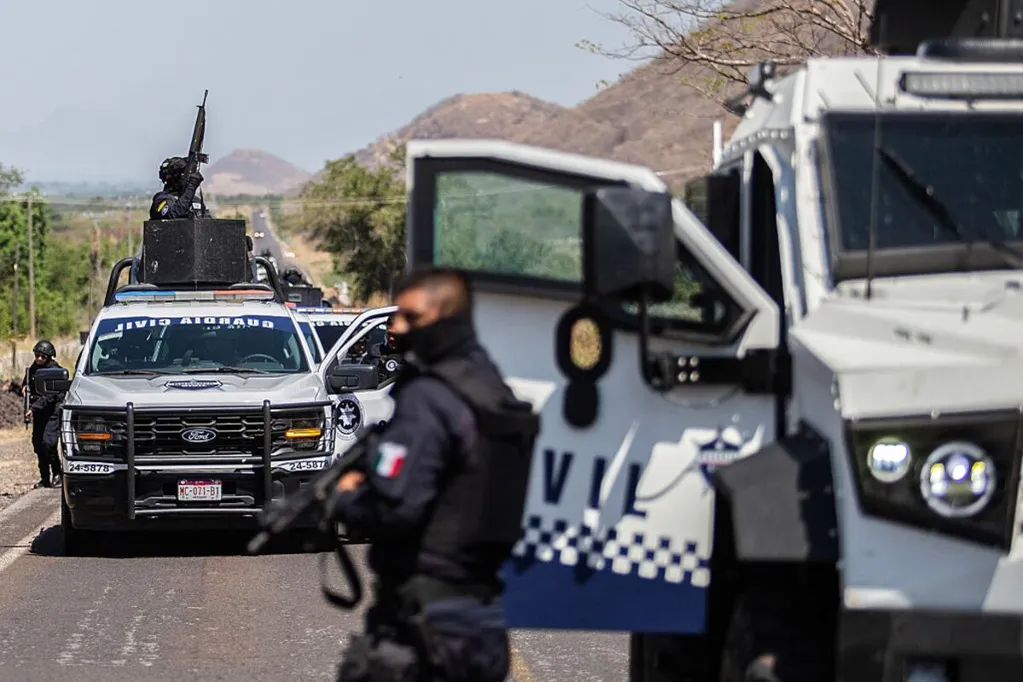
Trump on Saturday laid into Mexican President Claudia Sheinbaum, saying she had rebuffed his suggestion to let the US eradicate the cartels operating there.
"The cartels are running Mexico," he said. "We can't have that."
The Trump administration has championed US dominance in the Western Hemisphere, where China has built up its presence through trade and investments on infrastructure, energy and manufacturing. As part of his spin on the 19th-century Monroe Doctrine, which the president has dubbed the "Donroe Doctrine," Trump has pressured Latin American countries to embrace Washington instead of Beijing.
The Iran war that began one week ago cast a shadow over the summit. Trump moved up his appearance at the event and only did brief photo appearances with individual leaders, irking some counterparts, according to people familiar with the matter. Later Saturday, Trump is due to attend a dignified transfer ceremony for six servicemembers killed in the war.
The war has already convulsed financial markets and led to a spike in oil and gasoline prices and left countries in Latin America bracing for the economic fallout. Nations like Chile and the Dominican Republic remain vulnerable to spikes in crude prices, which have surged with transit through the Strait of Hormuz, one of the world's most important waterways for energy supplies, all but shut off.
Saturday's meeting drew comparisons to the Summit of the Americas, a key meeting for regional leaders, where a frequent issue of controversy was whether to include the left-leaning governments of Cuba and Venezuela. Mexico, Colombia and Brazil are among the countries with prominent leftist leaders that are not participating in Saturday's summit.
Trump has hinted at possible action in Cuba, where an ongoing oil blockade is straining Havana's economy. "Cuba is in its last moments of life as it was," Trump said Saturday. "It'll have a great new life, but it's in its last moments of life the way it is and but our focus right now is on Iran."
On Friday, he told CNN that he intended to put Secretary of State Marco Rubio "over there."
At the summit, leaders from Argentina, Bolivia, Chile, Costa Rica, the Dominican Republic, Ecuador, El Salvador, Honduras, Panama, Paraguay and Trinidad and Tobago are signing a charter affirming the right to chart their own destinies free from interference and emphasizing the importance of democratic principles and private enterprise, according to White House officials.
The US announced Thursday that it had re-established diplomatic relations with Caracas, but it was unclear if Venezuela would participate in the summit. Interim President Delcy Rodriguez welcomed a US delegation led by Interior Secretary Doug Burgum this week.
The coalition is also expected to work on advancing strategies to address narcoterrorism and mass migration. Officials provided few details about what the US hopes to achieve at the summit beyond security cooperation for its military operations in the Caribbean and Eastern Pacific.
Delegations have expressed frustration over what was cast as a lack of planning and preparation from the White House and State Department, according to a person familiar with the matter, who was granted anonymity to discuss the agenda.
Just days before the summit, Trump fired Department of Homeland Security Secretary Kristi Noem, instead naming her as the special envoy to the Shield of the Americas initiative. The move left summit participants uncertain about her new role, although she was present Saturday at the gathering.
"It's not somebody who's known for being a Latin America expert and who is very much associated with one particular element that has shaped US-Latin America policy, which is migration," Oliver Stuenkel, a senior fellow at the Carnegie Endowment for International Peace, said of Noem. "It doesn't give you a sense that Trump is really prioritizing this because it was more likely he needed to remove Kristi Noem from this position and create something else for her, and that happens to be envoy for the Shield of Americas."
Still, Trump's military moves have raised questions about the US strategy to blunt Chinese influence in the Western Hemisphere, according to Benjamin Gedan, a senior fellow and director of the Stimson Center's Latin America program.
"The leadership in Latin America is much more focused on trying to overcome this very extended period of slow growth and public frustration with poor governance, and there's a real mismatch in the US agenda for Latin America and what Latin Americans themselves are hoping to get from international partners," Gedan said. "There's this sense that the Monroe Doctrine are magic words that once said aloud, scare off all competitors from the Western Hemisphere."
That hasn't stopped the Trump administration from ramping up pressure on Latin American countries to reject Chinese investments as it seeks to re-establish the region as part of its sphere of influence.
Panama rescinded a contract with Beijing to operate its strategic ports while Ecuador announced joint anti-drug military operations with US forces earlier this week. El Salvador has struck an agreement to jail US deportees and Trinidad and Tobago has provided logistical support for US strikes on drug boats. The US imposed visa restrictions on three Chilean officials tied to an undersea digital cable project proposed by Chinese firms, alleging a security threat.
"As the situations in Venezuela and Cuba should make clear under our new doctrine, and it is a doctrine, we will not allow hostile foreign influence to gain a foothold in this hemisphere," Trump said. "That includes the Panama Canal."
After the Chinese inaugurated a sprawling port in Peru in 2024, the Trump administration warned of security risks and countered with a $1.5 billion plan to support construction of a nearby naval base. And last year, Argentina's President Javier Milei secured a $20 billion lifeline to stem a currency slide and shore up market confidence ahead of crucial elections.
Saturday's summit failed to include Latin American countries with prominent leftist leaders. Such an ideological approach could undermine longterm efforts to curb Chinese influence, according to Gedan.
"It's hard to see how that's a recipe for a successful, stable regional engagement strategy," Gedan said.