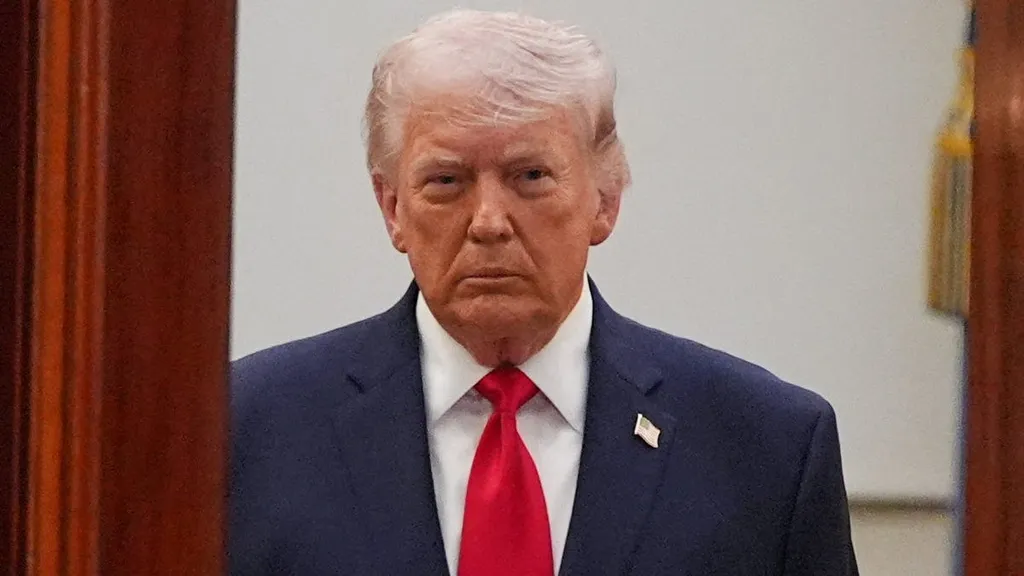
President Trump gave a national address on the Iran war, threatening to take Iran "back to the Stone Ages where they belong."
On Day 33 of the war with Iran, President Donald Trump declared victory was at hand. Almost.
In a primetime address from the White House, Trump extolled what he called "swift, decisive, overwhelming victories on the battlefield" - victories so decisive he suggested the war would wind down after another two or three weeks of military strikes that could "bring them back to the stone ages, where they belong."
"We are on track to complete all of America's military objectives shortly, very shortly," he said.
But he made it clear that he is prepared to leave a messy and problematic situation behind.
The 19-minute speech included no new details about the war's course and no more than a brief reference to the possibility of negotiated settlement.
But he also didn't mention of the possibility of expanding the war by deploying the thousands of U.S. ground forces now being massed in the region. And he recast what had been described as a fundamental goal - to gain control of the highly enriched uranium now buried in Iranian territory - as a step he no longer sees as necessary.
The sites were under "intensive satellite surveillance and control" and U.S. forces could return to the region if Iran tried to retrieve it, he said. (That surveillance has been underway for years, of course, well before the war began.)
A president anxious to end the war, and soon
He even indicated an inclination to leave it to other nations to reopen the Strait of Hormuz, now in an Iranian chokehold that is driving up energy prices. Countries more dependent than the U.S. on the oil that is shipped through the passageway should "build up some delayed courage" and "just take it, protect it, use it for yourself," he urged.
Besides, he predicted, the strait will "open up naturally" when the war ends.
All that points to a president anxious to end this war, and soon.
Before the speech, there had been speculation both that Trump might announce the war's end and that he might announce the war's escalation. Both theories were based on contradictory comments he was making about just what the essential goals were.
In a social media post Wednesday, the president said the U.S. wouldn't consider a ceasefire until the Strait of Hormuz was open and free, vowing to blast Iran "into oblivion" until it was.
But in an interview with Reuters, also on Wednesday, he said the U.S. would consider the war over "pretty quickly" and could return for "spot hits" if necessary.
As it turned out, the speech aligned more closely with the Reuters interview than the post on X.
A skeptical audience and an unpopular war
Trump was addressing a skeptical American public.
In a CNN Poll taken March 26-30, just a third of those surveyed approved of the decision to launch attacks on Iran, support that has eroded since the war began. In a Reuters/Ipsos survey, two-thirds said the U.S. should end the conflict soon, even if all its goals hadn't been achieved. That included four in 10 Republicans.
Trump's overall job approval rating has sagged - to 36% in the Ipsos poll and 35% in the CNN poll - amid GOP alarm that the Iran war was shaking an already-difficult political landscape for the midterm congressional elections in November.
Meanwhile, the war continues.
Bombs struck Tehran on Wednesday, setting plumes of smoke above the capital. Iranian missiles hit some sites in Israel, where many Jews were celebrating the first night of Passover. Israel launched strikes on Lebanon and Iran sent missiles to the United Arab Emirates.
The U.S. Central Command updated the number of targets that U.S. forces have hit in Iran during the war to 12,300. So far.