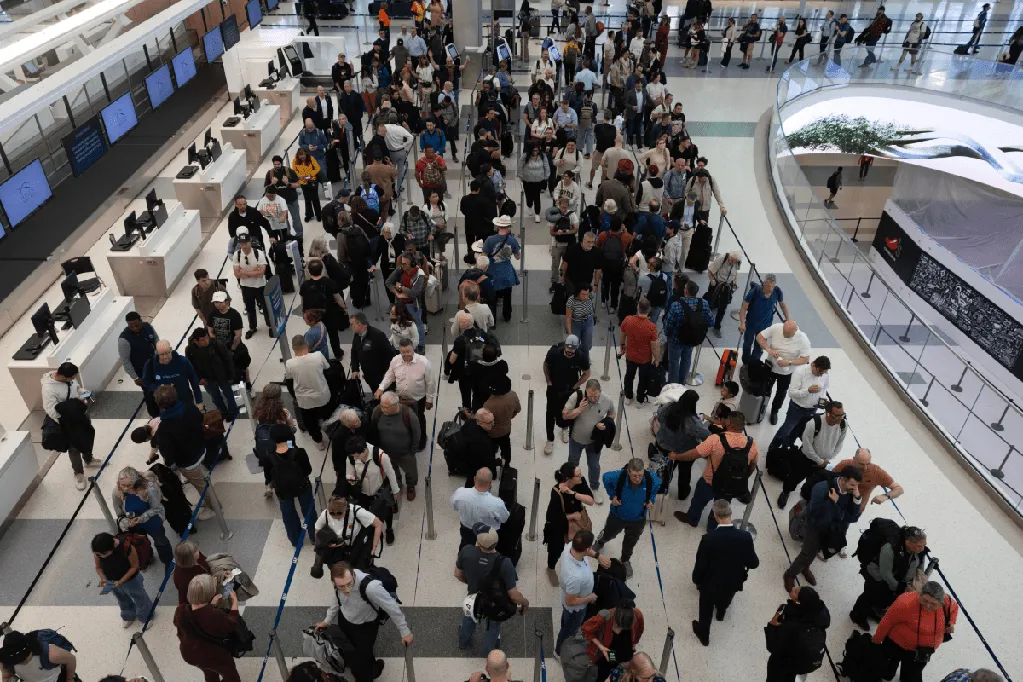
The result has been rolling security delays that can change dramatically from hour to hour.
Security delays varied widely by airport and time of day Friday, underscoring how uneven the disruption has become as staffing shortages persist.
Federal data cited in recent reporting shows callout rates reaching about 10 percent nationwide on some days, with even higher rates at certain airports.
At Hartsfield‑Jackson Atlanta International Airport, the world's busiest by passenger volume, travelers encountered lines stretching up to two hours at the main TSA checkpoint during the early‑morning rush.
Later in the day, wait times there fluctuated and were at 80 minutes at the time of writing, as of 08:50 a.m ET, per CNN's live tracker.
At Houston's George Bush Intercontinental Airport, one checkpoint reported a 90‑minute wait shortly after opening at 3:50 a.m. local time, while another checkpoint remained closed entirely because of staffing constraints, Business Insider reported.
At the time of writing, Houston's George Bush Intercontinental Airport was reporting delays of 150 minutes, per CNN's live tracker as of 08:43 a.m. ET.
Earlier this week, some Houston checkpoints had exceeded two hours, placing the airport among the hardest hit nationally.
Elsewhere, delays were more moderate but still noticeable. JFK and Salt Lake City International Airport reported 35 and 30-minute delays, at the time of writing, as of 08:48 a.m ET and 08:49 a.m. ET, respectively.
Miami, Newark, and LaGuardia generally saw waits of between 15 and 20 minutes, while Dallas‑Fort Worth and Denver experienced longer lines during peak morning periods before easing later in the day.
In Philadelphia, a video posted by a local reporter showed security lines backing up on terminal escalators during busy travel windows.
Not all airports have been affected equally. Travelers flying out of Los Angeles were reporting minimal TSA lines this morning, highlighting how conditions can shift dramatically by location -- and even by hour.
These disruptions are tied to the ongoing partial government shutdown, which has left the Department of Homeland Security and the TSA unfunded.
While agents are still required to report to work, many are doing so without pay, leading to elevated callout rates that have reached roughly 10 percent nationwide on some days, with higher levels at specific airports.
Security delays have fluctuated sharply not just by airport, but by hour.
Staffing levels can change daily depending on how many TSA officers report for duty, and even small swings have an outsized effect on throughput at checkpoints.
That has made planning especially difficult for travelers who may encounter smooth screening one day and gridlock the next.
Several airports have also asked the public to donate food, gift cards, and basic supplies to help support TSA employees working without pay, highlighting the strain on front-line staff.
Airports are urging passengers to arrive earlier than usual, with many recommending up to three hours before departure even for domestic flights.
Major hubs including Atlanta, Houston, JFK, Newark, Philadelphia, Dallas‑Fort Worth, and Denver are posting live TSA wait times on their official websites, often broken down by checkpoint.
Travelers can also consult the MyTSA mobile app, which provides estimated wait times in 15‑minute intervals.
However, the agency has warned that during the shutdown, live data may not always be available and the app may rely on historical averages instead.
Sheldon H. Jacobson, the founder professor of engineering at the University of Illinois Urbana‑Champaign and an expert on aviation security and airport security screening, told Business Insider: "The current unpredictability is being driven by unpredictable staffing levels; basically how many TSA officers are showing up for work on any given day. "TSA officers have historically been cross‑trained to do many different tasks so the number that show up is the key factor."
Transportation Secretary Sean Duffy said: "As we get into next week and they're about to miss another payment this is going to look like child's play what's happening right now."
Attention is now turning to Washington, where lawmakers face growing pressure to resolve the funding lapse.
With another missed paycheck looming and spring break travel continuing, officials warn that disruptions could intensify unless a deal is reached soon.