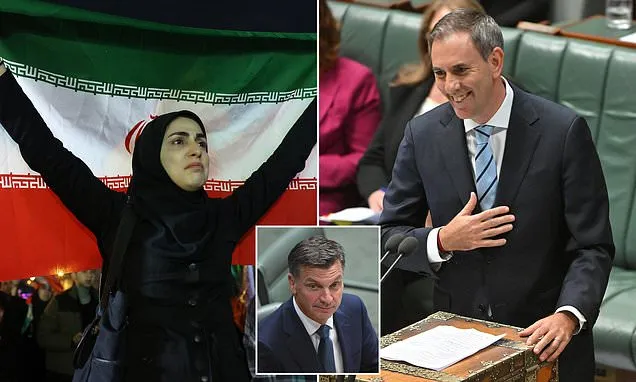
If there's one sure thing Australians can rely on after the US-Israel strikes that wiped out Iran's top leadership, it's that petrol goes up - and Jim Chalmers will pop up to reassure everyone not to get too worried because it's only headline inflation.
The same Treasurer who rarely misses an opportunity to blame anything other than domestic settings for persistent price pressures will suddenly discover a brand new external villain: rising oil prices courtesy of conflict in the Middle East.
It's a shame for him this didn't happen earlier, because unfortunately for Jim the threat of rising inflation was already afoot courtesy of domestic pressures he can control.
Iran's state media has confirmed the death of Supreme Leader Ayatollah Ali Khamenei, as part of a broader decapitation strike that also hit senior military and security figures.
Australia, for its part, rushed out a familiar line, supportive of stopping Iran acquiring a nuclear weapon while insisting we weren't involved and weren't given advance notice.
On cue the Greens condemned the strikes as illegal and warned about escalation.
Their instinct is always to treat Western power as the original sin in any conflict, even when the other side is a theocratic security state that crushes dissent, jails activists, and treats basic liberal freedoms as a contagious disease.
There's a grim irony in Australian progressives issuing pious statements about international law on behalf of a regime that has never had much time for the rule of law when it comes to its own people.
Treasurer Jim Chalmers should be delighted that he has a new external problem to blame for Australia's economic woes.
While it was strategically desirable to degrade Iran's military capability and attempt to help force political change, there is no certainty that what comes next is much better. The Middle East has always been tricky.
Iran has spent decades building a regional network of proxies, missiles and influence, while running a nuclear program that has kept the world in a permanent cycle of deadlines, inspections, breaches and denials.
Removing senior command figures and smashing parts of the missile and nuclear-related infrastructure is, at the very least, a direct hit on Iran's capacity to project power.
If the goal is to shorten the regime's reach to make it materially harder for Tehran to menace its neighbours, support armed terrorists or sprint towards a nuclear bomb, then knocking out key assets makes cold strategic sense.
However, the sobering truth is that Iran is not a normal dictatorship where you remove the leader and the system politely collapses. It is a regime built on institutions designed to survive exactly this moment. Even now, Iran's constitution provides for an interim arrangement while a successor is chosen.
So what happens next?
Expect the regime to continue with an even harder edge. Decapitation strikes don't automatically produce democrats.
The Revolutionary Guards and security services will attempt to tighten their grip; the clerical class will elevate a successor who is acceptable to the various power bases within the current construct.
A rally around the flag effect is possible even in a country where many loathe the leadership, especially if foreign attacks generate civilian casualties and humiliation.
A shift towards a more overt military-led order is likely. Even before these strikes, the Guards were already the spine of the system. After what's happened it's possible they decide they can't risk a messy clerical succession while they're under direct assault.
If that happens, hopes for regime change leading to liberalisation might be replaced by a different kind of authoritarianism.
Whatever happens the state of Iran will fragment for the foreseeable future. Expect elite infighting, and contested authority between clerics, security factions and the senior political figures who are left.
The outcome the west is hoping for involves mass internal revolt that overwhelms the regime and produces a genuine opening up of Iran. It has deep reservoirs of anger particularly among young people and women; its diaspora is politically engaged. But hope is not a plan. A leaderless uprising can be brave and still be crushed.
For the rest of us watching what happens from afar, the impact on the oil price and supply lines will hit hardest domestically. Iran's ability to threaten energy flows is precisely why the world takes it seriously.
With reports of disruption around the Strait of Hormuz and analysts warning of price spikes that could push crude prices sharply higher, you can already see the outlines of the economic shockwave to come.
Even if the worst case scenario doesn't eventuate, there will be short term pain for the global economy.
Australia is not certainly central to Middle East strategy, but we are exposed to the consequences of what happens there. For a start, our oil reserves are extremely low; a bipartisan failure - and one that the new opposition leader Angus Taylor's fingerprints are all over from his time as Scott Morrison's energy minister.
Australia also has sizable Iranian communities who despise the regime and fear for family back home, alongside Australians who worry (not unreasonably) about retaliation. That fear is only heightened in the wake of the Bondi massacre.
Trying to force political change in Tehran is not some reckless fantasy. It reflects the reality that the current regime has been a persistent source of instability and repression, and it has shown little interest in reforming itself out of existence.
But you can remove a tyrant and still end up with a vacuum, perhaps an even worse tyrant, or a state that fractures in ways that spill violence across its borders.
The world is better off without Khamenei at the apex of power in Iran. But nobody can honestly guarantee what Iran will look like next, not even Donald Trump with his rhetorical certainty.