Two British people who were onboard a cruise ship struck by a deadly rat-borne virus are self-isolating at home in the UK, health authorities have said.
Passengers on the MV Hondius returned to Britain independently after boarding the doomed vessel, according to the UK Health Security Agency.
Neither of the individuals are currently reporting symptoms but they have been classified as 'close contacts' of infected passengers.
A spokesman said: 'They are receiving advice and support from UKHSA and have been advised to self-isolate. UKHSA are supporting a small number of individuals identified as close contacts of those on the boat.'
'They are being offered support and are also self-isolating. None are reporting any symptoms. The risk to the general public remains very low.'
The pair had left the cruise ship at St Helena where it docked between April 22 and 24, before flying back to the UK via Johannesburg.
First Evacuations Underway
They later contacted health officials after hearing of the outbreak - which killed three people - aboard the vessel.
It comes as a British ex-police officer who was evacuated after falling ill was named for the first time today.
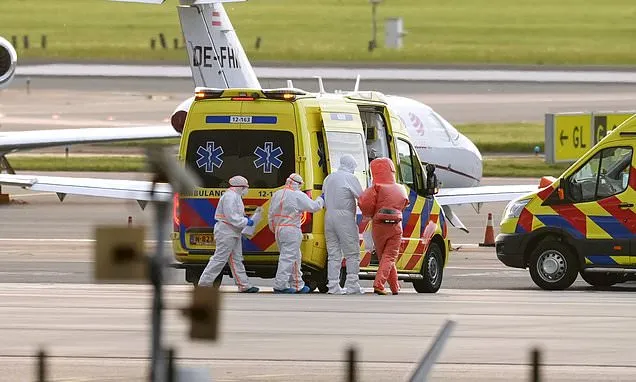
Martin Anstee, 56, was one of three suspected hantavirus patients removed from the ship and flown to the Netherlands for treatment on Wednesday morning.
Operator Oceanwide Expeditions confirmed this evening the first of two medicalised aircraft, carrying two of the three individuals transferred from MV Hondius, had landed in the Netherlands.
However, the second medicalised aircraft carrying the third individual was said to be 'experiencing a delay' - though the individual remains in a 'stable condition'.
More than 20 Britons on board the vessel are still awaiting their transferal - as they face being quarantined for up to eight weeks.
The MV Hondius will arrive in the Canary Islands on Saturday after local authorities were overruled by Spain's PM and ordered to allow the ship to dock so passengers and crew members could be checked by medics.
Virus Spreads to Switzerland
The vessel left Cape Verde this afternoon following the evacuation of Mr Anstee.
Canary Islands authorities tried to reject orders from Spain, fearing anyone on board the ship could bring the deadly virus onto their territory.
Their fears only grew when it emerged today the disease had spread to Switzerland after a passenger - who left the cruise before the virus outbreak - developed symptoms upon arriving home and is now being treated in Zurich.
The man is being held in an isolation unit and may be quarantined for up to 45 days to 'ensure that there is no risk to other patients,' the head physician of the Zurich hospital told local news outlet 20 Minuten.
The disease has an incubation period of up to eight weeks - which, in theory, is how long the 21 British passengers face being held in quarantine if the UK government decides to copy Spain's example.
Mr Anstee’s wife, Nicola, this evening revealed the ‘very traumatic few days’ endured by the family since her husband - an expedition guide and former British police officer - fell ill.
Death Toll Rises to Three
She told The Telegraph: ‘The fear with this virus is it can deteriorate very quickly so it’s been a bit up and down for him.
‘I don’t believe he’s in imminent danger now, but it was horrible.’
Ms Anstee, who first heard her husband was sick on Sunday, added it was a ‘relief’ he was now off the Hondius and in Holland for treatment.
She explained the symptoms had at first been ‘quite mild’ but later got ‘more serious’.
Although hantavirus infections are typically spread by rodents through urine, droppings and saliva the World Health Organisation (WHO) has now said it believes it may have passed from person to person aboard the luxury cruise.
The WHO has confirmed eight suspected cases of the virus on the vessel, which had been travelling from Ushuaia in Argentina to Cape Verde in Africa.
A 70-year-old passenger was the first to die followed by his 69-year-old wife. They were both Dutch nationals.
Another passenger of German nationality also died on board the ship.
A 69-year-old British man was taken to Johannesburg, South Africa, where he is being treated in intensive care.
The Ushuaia Connection
Around 150 people are still aboard the cruise ship under 'strict precautionary measures', Oceanwide Expeditions said.
The UKHSA said Britons on the ship would probably be flown home on a charter flight from the Canary Islands as long as they did not have symptoms.
Earlier, the Foreign Office said it was 'working urgently' to get British nationals struck on board home safely.
In a statement, Foreign Secretary Yvette Cooper explained the situation was 'very serious and deeply stressful for those affected and their families'.
It is still unconfirmed where the outbreak originated from - though officials today claimed the deadly virus may have been brought onto the vessel by a birdwatching couple.
Investigators said a Dutch couple, who later boarded the MV Hondius, visited a landfill site to snap birds in the city of Ushuaia, and may have been exposed to rodents carrying the lethal infection.
Footage from inside the vessel has shown the ship's decks mostly deserted, with only a few people wearing medical masks moving about.
Common spaces were empty as passengers were isolated in their cabins. At least five people with full protective gear, white overalls, boots and face masks were seen disembarking from the ship into a small vessel.
Hidden Danger
Another video shared on social media by Turkish influencer Ruhi Cenet shows the moment the vessel’s crew told passengers someone had died.
Footage shows a crew member saying: ‘One of our passengers sadly passed away last night.
‘I’m told by the doctor we’re not infectious. The ship is safe when it comes to that.’
But the video then cuts to Mr Cenet telling the camera ‘the situation was much worse than we were told,’ as he explains that a day after he left the ship, the wife of the person who had died also passed away.
‘After a third person died, it became clear that there was hantavirus on board.’
The cruise set sail from Ushuaia in Argentina on April 1, destined for Cape Verde, and counted 88 passengers and 59 crew members, with 23 nationalities onboard.
The WHO was trying to deduce how hantavirus had appeared on the ship, with the first person who died having developed symptoms on April 6.
The first stricken passenger, a 70-year-old Dutch man, died on April 11 as the ship steamed towards Tristan da Cunha.
His body remained on board until April 24, when it ‘was disembarked on St Helena, with his wife accompanying the repatriation,’ Oceanwide Expeditions said.
The man's 69-year-old wife later felt sick on a flight from St Helena to South Africa, and she died on April 26 upon arrival at the emergency department of Johannesburg hospital.
The next day, a British passenger on the cruise became 'seriously ill and was medically evacuated to South Africa,' the company said.
South African authorities have confirmed the 69-year-old, who is being treated in a Johannesburg hospital, tested positive for the hantavirus.
On May 2, another passenger of German nationality died on board the ship.
Health officials are now trying to trace at least 80 passengers who were onboard the same two flights as the Dutch woman before she died.
The Eight-Week Window
According to the UK Government's hantavirus advice, symptoms typically appear between two and four weeks after exposure, but can range from two days to eight weeks, meaning illness may develop in other passengers in the coming days or weeks.
Around 40 per cent of cases result in death, according to the US Centers for Disease Control.
Early symptoms can include fatigue, fever, muscle aches and intense headaches.
They are not usually spread person-to-person and are typically only transferred via bodily fluids and close contact.
The risk of contracting the illness can be reduced by minimising contact with rodents.
Meanwhile, the UK Government is putting 'plans in place' for the onward travel of Britons stuck aboard the cruise ship.
In a post on X, Prime Minister Sir Keir Starmer said: 'My thoughts are with those affected by the hantavirus outbreak onboard the MV Hondius.
'We are working closely with international partners to support British nationals on board, and we're putting plans in place for their safe onward travel.
'The risk to the wider public remains very low - protecting the British people is our number one priority.'