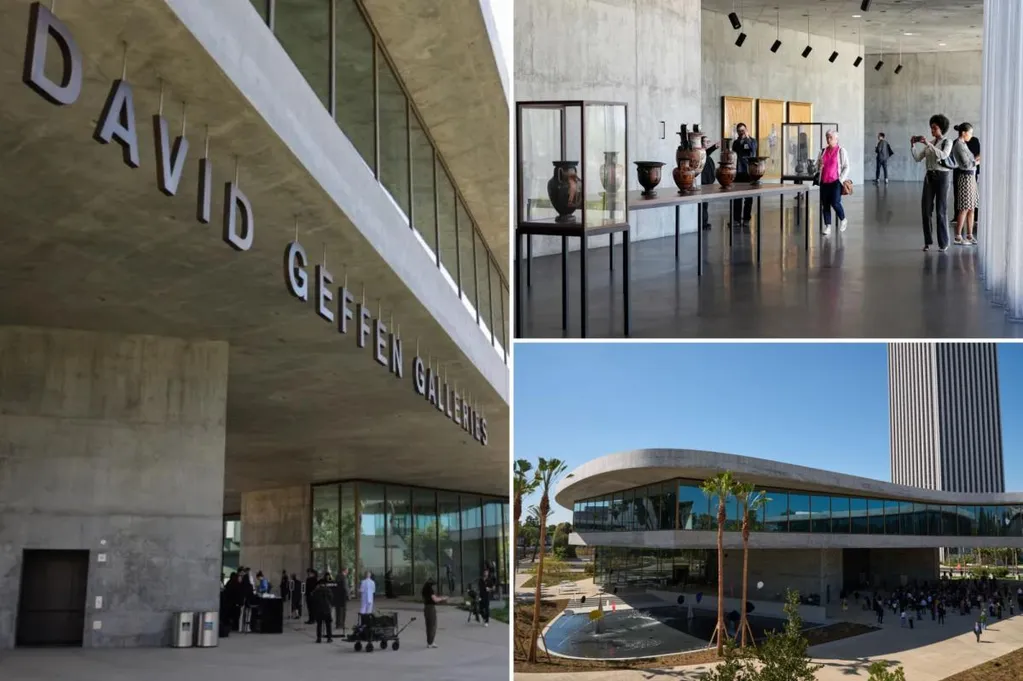
After nine months of judiciously installing 1,700 pieces of art in what was a barren new concrete and glass structure, the Los Angeles County Museum of Art's new David Geffen Galleries are finally all dressed up and ready to rock.
Opening to the public Apr. 19, a slew of LACMA treasures are finally out of storage and back on display throughout the 110,000 square feet of new real estate -- notably stretching across a single elevated floor spanning Wilshire Boulevard, nearly 30 feet above the busy roadway.
The 900-foot-long, curvy construct was designed by Swiss minimalist, experiential architect Peter Zumthor, and is accessed by monumental steps on both sides of Wilshire. Don't worry, there's an elevator or two, as well.
Last June, the completed empty building was introduced to the public via a series of performances from LA jazz composer, bandleader, and saxophonist Kamasi Washington, who led more than 100 musicians, split into ensembles and dotted about in different galleries, performing Washington's Harmony of Difference.
Despite the building's music and movie mogul namesake and benefactor's deep roots helming the careers of giants from The Eagles to Nirvana, the evening was mostly notable for the way the acoustically harsh concrete chambers caused cacophonous sonic bleed.
Sound? Not so great. Visually, a stunner.
The architectural art-piece ties together -- in a slinky, concrete bow -- the Miracle Mile cultural collective known as Museum Row, where Wilshire Blvd. and Fairfax Ave. meet.
This includes the Peterson Automotive Museum's covetable cars, the La Brea Tar Pits & Museum's ice age fossils, the Academy Museum of Motion Pictures' film histories -- and, in a matter of weeks, a new subway station on Metro's growing D line, connecting the district to Downtown, Beverly Hills and eventually beyond.
LACMA now has 220,000 square feet of galleries, a significant increase from its 130,000 square feet in 2007, when the two-decade campus expansion began. This final part cost around $724 million alone.
The building is owned by the County of Los Angeles, which donated $125 million. Besides Geffen, who coughed up a reported $150 million, other major donors include the late LACMA board of trustees co-chair Elaine Wynn, and the W.M. Keck Foundation.
The south wing is named the Ressler Family Wing in recognition of donations from producer and '80s movie star Jami Gertz, and her husband, private equity investor and Atlanta Hawks owner, LACMA board member Tony Ressler.
The north wing is dedicated to Wynn, head of the Wynn casino empire, who passed last April. A collaboration between Wynn and LACMA on a proposed Las Vegas Museum of Art has drawn much criticism for its proposed siphoning off of major works to the Sin City site, currently in development.
Still, a recent bequest of Francis Bacon's major triptych Three Studies of Lucian Freud to LACMA was a gift from Wynn.
"I would rather have her here than those paintings," said Michael Govan, LACMA's CEO at a preview, "but they were promised upon her passing. They are here representing her beautifully in the galleries. She was our co-chair and really pushed this initiative forward."
Joining Bacon's startling work inside those giant window lined curvy galleries are an ancient frieze, Round-Topped Stella c. (1391-1353 BCE); Clara Peeters' Still Life with Cheeses, Artichoke, and Cherries (circa 1625); Manuel Arellano's La Virgen de Guadalupe (1691); Vincent van Gogh's Tarascon Stagecoach (1888); Katsushika Hokusai's The Great Wave off Kanagawa (1830-31); Diego Rivera's Día de Flores (1925), and Henri Matisse’s La Gerbe, a cut paper collage created late in the French master’s life (1953).
There are Marcel Breuer’s covetable chairs, and there are candlesticks and gates, and all sorts of everyday items superbly crafted decades or centuries ago.
It’s all displayed in non-hierarchal areas designated as “oceans,” as in Atlantic, Pacific, Indian, and Mediterranean -- even though the latter is technically a sea.
“Those are reminders we have always traveled and that different cultures have always been a part of a human conversation,” said Diana Magaloni, senior deputy director of conservation, curatorial, and exhibitions.
Special curtains were commissioned to shade the priceless artifacts from the damaging rays pouring in through the window walls that some thought might be a distraction from the art.
Far from it -- the experience is one of bringing art into the present, and the city into the experience.
"You're never cut off from Los Angeles," Magaloni added. "You stand in the building and know where you are, and you're not in a box."
The new outdoor space off Wilshire Boulevard, not yet fully completed, houses the 75,000-square-foot W.M. Keck Plaza, where new commissions by Mariana Castillo Deball and local artist Sarah Rosalena join LACMA's Rodin collection, Tony Smith's Smoke, and Alexander Calder's reworked 1965 mobile, Three Quintains.
The star of the new acquisitions is Jeff Koons's Split-Rocker (2000) -- a monumental, utterly charming sculpture adorned with thousands of living plants.
Raising much excitement is a new iteration of swanky Southern California food market Erewhon, known for its pricey, celeb-collaborated smoothies.
A second restaurant and a wine bar will open later this year, along with the Steve Tisch Theater, named for the Forest Gump producer, former New York Giants president and LACMA trustee, most recently in the news for a flurry of emails he exchanged with pedophile financier Jeffery Epstein.
Some Angelenos have been vocal in their criticism of the building. Zumthor's minimalism, a post-Brutalist hardness exacerbated by his choice of materials here -- concrete, concrete, and more concrete -- is unthinkable to them, especially after LACMA tore down the site's original 1965 William L. Pereira-designed buildings to make room.
According to an article in the Los Angeles Times, major donator the Ahmanson Foundation ended a fifty year partnership with LACMA in 2020 over what the LA Times reported as "disagreements with the Zumthor plan." Foundation President William H. Ahmanson remains a museum trustee, however.
Despite the controversy, however, officials were eager to point out that by commissioning local artists and hiring LA artisans and laborers, the project has been good for the community -- before even opening its new doors.
One of the laborers, James Anderson, a journeyman in the glaziers union, Local 636, called the building a "beast" -- one he wrestled with for over a year, he told The Post.
"The work on the Galleries was interesting from a logistical standpoint," he said of installing the custom-made glass framed in brass.
The sheer weight and tight spaces to install the giant windows on the first level presented unusual challenges -- especially on the long span across Wilshire.
"Every tiny movement was critical. With the glass being so heavy it quickly overloaded standard equipment," said Anderson.
"You can imagine being suspended over that road for weeks,trying to get a perfect swipe of vertical silicone caulking down a 13 foot window," he recalled. "One hand controlling a machine,and the other keeping the exact same pressure and angle all the way down."
What does he think of the result?
"For me," says Anderson,"the design of the building can be ugly,being honest. But once you get the perspective of the architect,seeing his other work,it takes on a different character。The raw bronze,the lighting,yeah,它’s beautiful after all is said和done。”