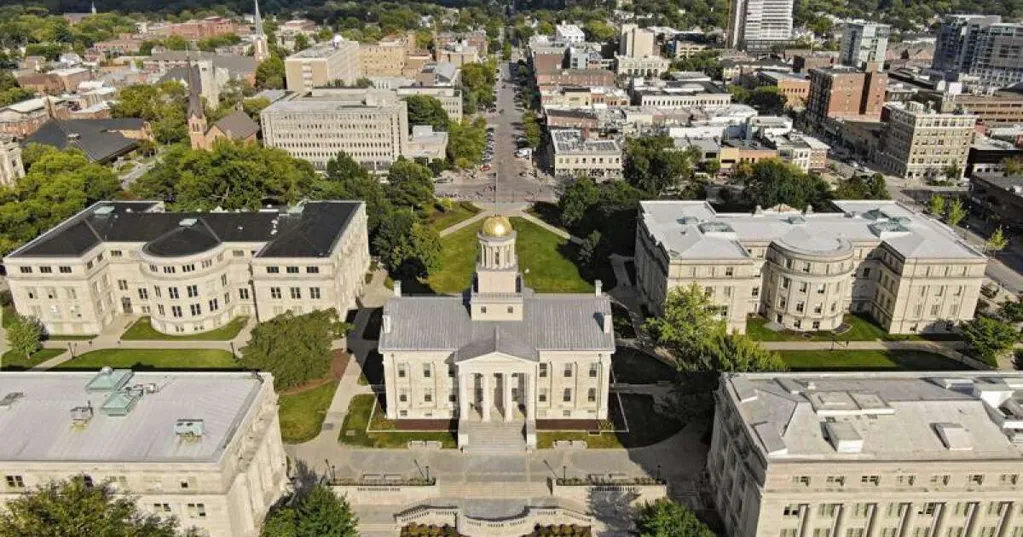
IOWA CITY -- University of Iowa faculty in African American Studies and Gender, Women's, and Sexuality Studies are preparing for closure of their programs after a review of "low-enrollment" degrees and majors compelled by the Legislature and Board of Regents.
"Pending Board of Regents approval to close the African American Studies and Gender, Women's, and Sexuality Studies majors and departments, we ask that you submit a request to change the department of your faculty appointment, to be effective July 1, 2026," an administrator wrote to program faculty Feb. 3, according to communication provided to The Gazette sharing details about "faculty line shift requests" as the college works "on the realignment of curriculum into other units this spring."
Although the university has not yet submitted official requests to the Board of Regents to close low-enrollment programs flagged by a "Workforce Alignment Review" in November, administrators are advising faculty to submit appointment change requests by March 30.
"Prior to submitting this request, please first discuss the change in appointment with the (executive officer) of the department in which you seek a new or increased appointment."
The looming closures come after years of criticism from Republican lawmakers about what's being taught on Iowa's public university campuses and how it's meeting Iowa's growing workforce needs -- with legislation proposed last session and in the current session to mandate curricular and program reviews.
"There are several bills in the Legislature that would direct the board to do a review of our programs and how they fit with high-demand jobs and workforce needs," former Board of Regents President Sherry Bates said in February 2025. "We do not need to wait for a bill. I am directing the board office, in consultation with the universities, to begin the review now and to have a full and complete report to the board by its November meeting."
That report produced a handful of findings and recommendations -- including identifying opportunities "for program reorganization or closure that would generate administrative efficiencies, improve academic program alignments, or create enhanced opportunities for workforce preparation."
Using thresholds of 25 or fewer students in bachelor-level programs and 10 or fewer students in graduate programs, the report identified 29 undergraduate or graduate low-enrollment programs at UNI, 47 at Iowa State and 29 at the University of Iowa.
The low-number UI programs included African American Studies, with 11 enrolled at the time, and Gender, Women's, and Sexuality Studies, which had 23 enrolled at the time of the report -- about half of whom counted it as their primary major, as opposed to a second or third major.
Other UI undergrad programs on the chopping block based on enrollment numbers include Russian, French, Italian, Classical Languages, and Religious Studies. At the graduate level, several programs right at the 10-or-fewer-students mark include Film Studies, Classics, and Orthodontics.
And while the report indicated enrollment as a meaningful measure in the evaluation of program vitality and relevance, those who compiled it also urged a "more nuanced analysis of which program enrollments are at a healthy minimum, within a watch zone, or at risk."
Department chairs, deans and provosts in determining a program's future should evaluate enrollment and workforce trends alongside other factors like tuition and grant funding generated, program age, facilities used, and state and legislative oversight, according to the report.
"Frequently, a college or university might identify that a program has a low number of majors, but teaches courses that are requirements for other associated programs," according to the report, pointing to chemistry as a required component of virtually all health care-related fields -- even though it qualifies as a low-enrollment major at UNI. "Similarly, courses from history, arts, literature and philosophy classes serve as critical courses in the general education and educator preparation curricula."
When asked for a list of majors or programs being eliminated, the UI communications team pointed to the November Workforce Alignment Review report.
"The report lists the programs under review and the number of enrolled students in them at all three public universities," UI officials said, citing a caveat committing to consider other factors in addition to enrollment like "licensure or accreditation requirements, the program's role in supporting other areas of study, available faculty resources, and how recently a program was established."
"Any proposed changes must be approved by the Iowa Board of Regents and will follow board policy, which stipulates,'The program shall not be terminated until after the last student has completed the requirements of the program.'"
That means even after board approval of closure, any students majoring in a low-enrollment program will be allowed to finish their degree.
To the question of whether faculty could be laid off in the process, UI communications officials said,"Many faculty already hold joint appointments and will continue teaching and research in other departments."
"This will allow the university to better align faculty work with areas of higher student demand. Courses in areas that continue to attract strong student interest will remain available to support minors, fulfill electives, and meet general education requirements."
That commitment was communicated to UI students in the Gender, Women's, and Sexuality Studies major via a Feb. 4 email from the interim department chair.
"You may have heard or seen recent news about proposed closures of some undergraduate majors," she wrote. "The most important thing to know is this: if you are currently declared in this major, you will be able to complete your degree. We are committed to supporting you through graduation."
The proposed closure, the chair wrote, reflects long-term enrollment trends.
"There are no immediate changes to course offerings for current students, and we will make sure you have the classes, advising, and support you need to stay on track," she wrote. "No minors or certificates are being discontinued at this time."
In the communication to faculty, administrators said department executive officers in April will submit letters evaluating faculty requests for line shift changes and their impact on the department's mission.
A College of Liberal Arts and Sciences executive committee then will advise the dean on change requests related to budgeted appointments "before a decision is communicated to the faculty member by the dean."
Although many UI faculty are afraid to speak publicly out of fear of workplace repercussions, alumnus Dominic Dongilli, 32, told The Gazette his experience in the Gender, Women's, and Sexuality Studies program fortified his degree by preparing him for a multidimensional and disciplinary world.
"I was born and raised in Nebraska and chose to attend the University of Iowa because of its interdisciplinary programs in American Studies and Gender,Woman's,and Sexuality Studies,"said Dongilli,w ho previously worked in conservation biology but wanted a more culturally dimensional career.
"At the University of Iowa,I took courses from over five different departments,"he said."The GWSS program was the only department that mirrored the multidisciplinary world of my postgraduate career."
Today,Dongilli is a historian and cultural resources specialist in the public sector and said the UI Gender,Woman's,and Sexuality Studies classrooms were where he most poignantly experienced the university's mission of education,research and public service.
"GWSS has an incredibly rich history and extensive impact in Iowa,"he said."If the Board of Regents and the provost were invested in the institution's mission to 'advance scholarly and creative endeavor through leading-edge research ...and improving lives' they would be expanding student access to established programs,n ot shuttering them."