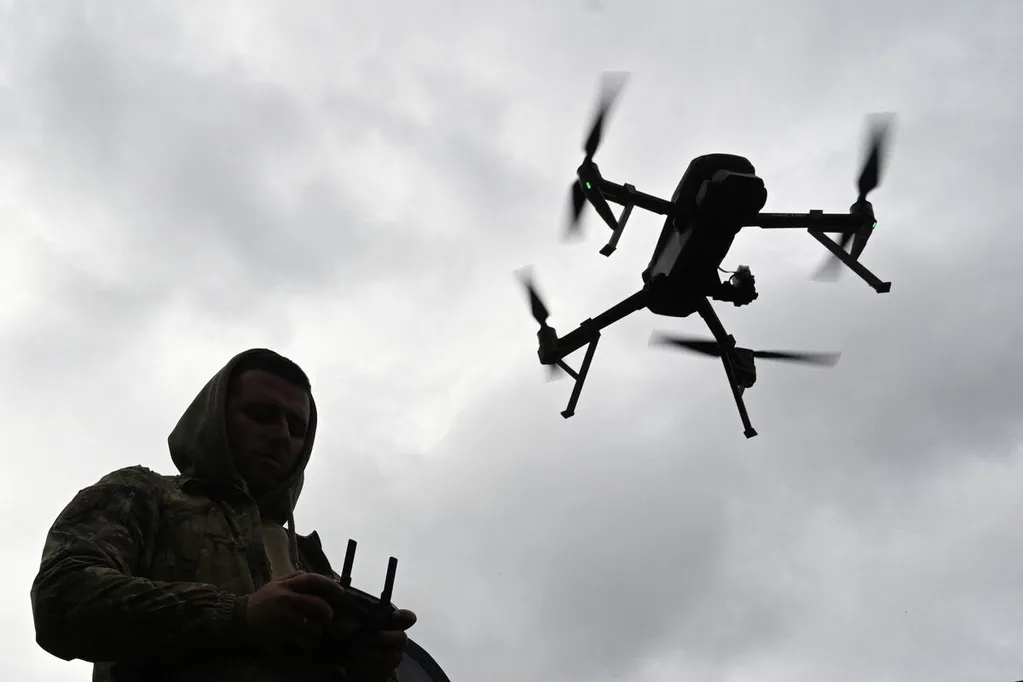
Russia's Yaroslavl oil refinery suffered damage after a Ukrainian drone attack overnight, according to the General Staff of the Armed Forces of Ukraine.
"A hit was recorded on the territory of the plant, followed by a fire," Ukraine's military said in its official Telegram channel.
The refinery in Yaroslavl, about 175 miles (282 kilometers) from Moscow, is co-owned by Rosneft and Gazprom Neft. It can process 15 million tons of crude year, equivalent to around 300,000 barrels per day.
Russia didn't comment on the attack. Yaroslavl Region governor Mikhail Yevrayev only reported on his Telegram channel the downing of more than 30 drones Friday night, with one child dead and his parents hospitalized after debris hit a countryside area.
Ukraine also struck an explosive-ammunition producer in Samara Region with missiles and artillery Friday night, its General Staff reported earlier, claiming "a subsequent explosion in the production area."
There was no official comment from Russia on this attack.
With Russia staging regular large-scale aerial barrages against Ukraine over the four years of its invasion, Kyiv has developed and increased its own capacities to hit targets inside Russian territory. More recently, Kyiv has been increasingly targeting Russia's Baltic oil infrastructure in an effort to reduce the Kremlin's revenues used to finance its war against Ukraine.
Latin American governments from Panama to Chile that politically aligned themselves with Donald Trump are now absorbing a hit from the global oil-price surge triggered by their US ally's war on Iran.
So far, many regional leaders are asking their people to grin and bear price increases rather than return to fuel subsidies that were once commonplace but have gone out of vogue because of they can no longer afford them.
But voters have long memories, and older generations can recall getting more help from the government in past crises. As inflationary pressures swell -- and anger simmers from below -- it's getting harder for right-wing leaders to stay the course. In Chile, the new government of conservative President José Antonio Kast is blaming reckless spending by his predecessor for forcing his hand.
"I have all the empathy in the world," Chilean Finance Minister Jorge Quiroz said when asked about the hardship wrought by pump price hikes of up to 54% imposed this week. "My empathy comes from truth."
The looming turbulence shows how the crisis in the Strait of Hormuz is rippling beyond Asia, which was hit first given its direct reliance on Middle East supply. Though Latin America is far from the key oil and gas artery that's been mostly choked off by Iran, it's still heavily exposed to oil price volatility.
While countries like Brazil and Mexico are crude exporters, the region as a whole imports more fossil fuels than it produces. Most of the shipments come the US Gulf Coast rather than the Mideast. Pricing is tied to international benchmarks, including Brent crude that has soared by more than 50% since the US and Israel launched the war on Tehran nearly a month ago.
The regional trailblazer for dismantling steep energy price adjustments is Argentina, where libertarian President Javier Milei took a "chainsaw" to massive fuel subsidies after taking office in 2023. Prices for domestic natural gas were once kept so low that Argentines would open windows in the wintertime rather than turn down the heat.
Pump prices are up sixfold over Milei's term so far. But yellow lights are now flashing. Gasoline prices have climbed another 15% since the start of March, according to data tracked by the University of Buenos Aires. In a bid to stem the rise, the government loosened ethanol blending rulesBloomberg Terminal this week to reduce the volatile oil component, and suspended a fuel tax increaseBloomberg Terminal due to take effect next month. But the overall trend is challenging his core pledge to slay inflation that's still running at around 33% annually.
In Panama, which imports all of its oil and gas, President José Raul Mulino at first ruled out fuel subsidies in response to the war-driven price surge. A 2022 freeze at the pumps to quell cost-of-living protests was a "disaster," he said at the time. "Panama is going to pay the price that has to be paid. I'm sorry."
It didn't take long for Mulino to back down. On March 25, his government announced caps on public transport fares, residential electricity rates and cooking gas prices, vowing further measures to monitor food and fertilizer costs. "We're working on a support plan in the face of the global energy crisis," Economy and Finance Minister Felipe Chapman said.
In oil-exporting Ecuador, President Daniel Noboa has so far maintained gradual upward revisions in fuel prices to align with international levels. Even though the country is now earning more from crude exports, it's also paying more for refined products like diesel that it has to import to meet demand that its refineries can no longer accommodate. The Noboa administration is weighing whether to extend costly subsidies for buses without aggravating the budget deficit.
Both Panama and Ecuador use the US dollar, so are less exposed than neighboring countries where currencies have plummeted.
In Brazil, Latin America's biggest economy, leftist President Luiz Inácio Lula da Silva took a more aggressive approach right from the start by stripping out taxes to keep fuel prices in check. Against the historic backdrop of crippling truckers' strikes, the issue is especially sensitive in an election year. But consumer prices blew past forecasts in early March, highlighting the far broader economic effects of the war.
Inflation is also accelerating in Mexico. State-owned oil company Petroleos Mexicanos is struggling to maintain costly subsidies on fuels, much of which are imported. If the war persists, President Claudia Sheinbaum’s officials fear fiscal accounts will suffer.
Surprisingly, fellow leftist Gustavo Petro of oil-producing Colombia is sounding more like his right-wing neighbors. “Gasoline subsidies are no longer possible,” Petro said on March 21. “As international prices go up, so will prices in Colombia.”
In Chile, trucking unions are so far sticking by Kast even though they were excluded from a package of relief measures. But protests are gathering pace. To fill a 50-liter tank of 93-octane gasoline at the new estimated price, Chileans are now paying around 15% of the monthly minimum wage.
Facing signs of a backlash, Kast “thought he could use the occasion to pull a Milei moment -- that there’s no money. But Chileans don’t perceive that the country is in a fiscal budget crisis.” said Patricio Navia, a political scientist at New York University.
“This will be a hard sell,” Navia added. “Other governments read history or have institutional memory and know that fuel price hikes often topple governments.”