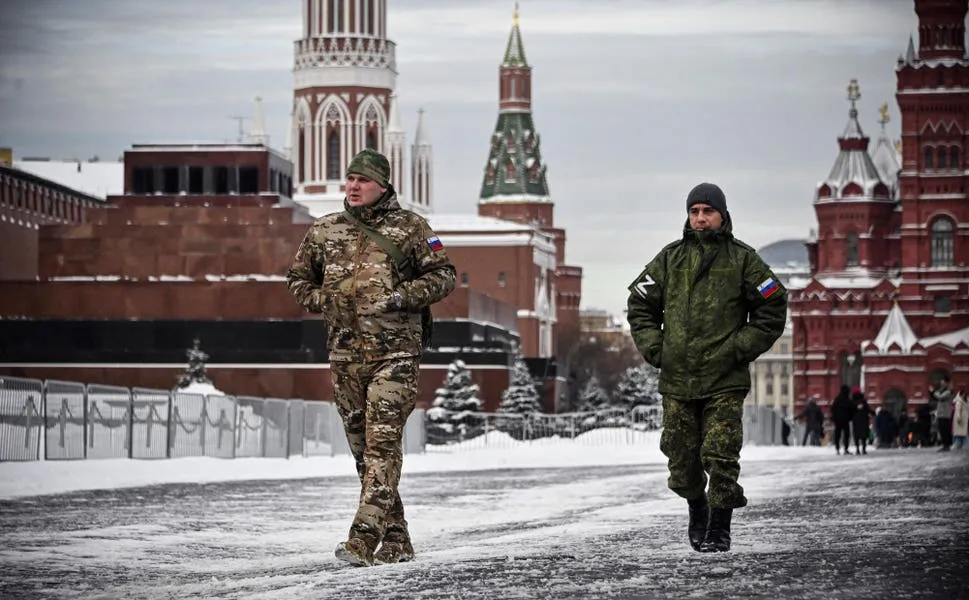
This week, the Kremlin hit a grim milestone in its ongoing war in Ukraine. On January 11, 2026, the conflict reached its 1,418th day, the same number of days the Soviet Union's Red Army fought against Nazi Germany during the "Great Patriotic War" from June 22, 1941, until Victory Day in Europe on May 9, 1945.
When Russia launched its unprovoked invasion of Ukraine nearly four years ago on February 22, 2022, its "Special Military Operation" was to "de-Nazify" and demilitarize Ukraine. Instead, the conflict has now dragged out longer than the fight against the actual Nazis.
Despite President Donald Trump's efforts to broker peace, the conflict seems no closer to resolution.
There are notable differences between the fight now and the war that ended 80 years ago last May.
"In 2026, not only is Moscow the invader - of Ukraine - but it's also struggling to achieve victory on the battlefield. Rather than sweeping across great expanses of territory, Russian forces are grinding forward at a snail's pace. More like World War I than World War II," Radio Free Europe reported.
It is true that Russia now occupies nearly a quarter of Ukraine; yet by comparison, the Soviet Red Army succeeded in driving the German forces back from the literal gates of Moscow all the way to Berlin, a distance of nearly 1,000 miles. Almost four years after it launched its invasion, Russia's forces are actually further from Kyiv than they were in the weeks after the attack.
Western history is filled with as many stories of "short and victorious wars" as it has seen long and enduring wars. As significant to Europe were the Six Weeks' War, which led to a unified Germany, and the Thirty Years' War, which almost destroyed the German peoples.
Yet, in the case of Russia, few of its wars were ever short, and those that were certainly weren't "victorious" for Moscow or St. Petersburg.
The Russo-Circassian War (1763-1864) lasted more than a century and culminated in Russia's control of the North Caucasus. Likewise, although not a single conflict, the Russo-Turkish Wars (1568-1918) spanned an even more extended period, a reminder that peace has often been elusive in the region. It was through those wars that much of modern Ukraine even came under Russian control.
Moscow clearly has played the long game.
That is also true of the Chechen-Russian conflicts, which have continued for more than two centuries since 1785, with major phases in the 19th and 20th centuries.
In shorter conflicts, Russia's forces have either faced defeat, as in the Russo-Japanese War (1904-1905), or fought a hard-won, costly victory, as in Finland during the 1939-1940 Winter War.
Beyond the loss of men and materiel, Russia's defeats have been costly in other ways. The humiliating defeat by the Japanese in 1905 resulted in the near destruction of the Imperial Russian Navy, but it also served as a significant catalyst for the 1905 Russian Revolution.
The war exposed the Tsarist regime's incompetence and shattered public morale. It further intensified discontent across Russia, leading to mass strikes and uprisings that challenged Tsar Nicholas II's rule. The revolution was put down, but just over a decade later, the February Revolution of 1917, during the First World War, which was going badly for Russia, toppled the centuries-old Romanov Dynasty.
Six decades later, the Soviet-Afghan War was an attempt by the Soviet Union to prop up the pro-Moscow regime of Haifzullah Amin. Instead of the expected swift victory, mirroring Cold War success in Czechoslovakia in 1968, Moscow was dragged into a conflict that lasted more than nine years and saw its military defeated by insurgent forces.
The loss in Afghanistan significantly contributed to the collapse of the Soviet Union. The war had greatly strained the communist nation's already fragile, ineffective, and increasingly stagnant economy. Just as the 1905 defeat demoralized the military, the withdrawal of Soviet Army forces in 1989 also demoralized the military, and the war eroded public trust.
The Ukraine War is unlikely to see the collapse of Russia, but it will continue to strain its economy, military, and society. That could lead to internal instability, but it has already impacted Russia in other ways.
Russia has seen a significant decline in arms sales, with exports dropping sharply, and France overtaking Russia as the second-largest arms exporter after the United States.
Many of Russia's highly touted military platforms have been scaled back due to cost constraints, notably the much lauded T-14 Armata main battle tank. Likewise, the Sukhoi Su-57 (NATO reporting name "Felon") has failed to attract any foreign buyers apart from Algeria, which purchased just 14 of the fifth-generation stealth fighter. The Russian Aerospace Forces are reported to operate fewer than 3 dozen of the aircraft, which have seen little use in Ukraine.
By comparison, more than 1,300 Lockheed Martin F-35 Lightning II fifth-generation multirole fighters have been delivered to U.S. military forces and partners worldwide. The aircraft was used by Israeli Air Force strikes against Iran last year with no confirmed losses.
There is no denying that Russia's war in Ukraine has been costly; as of last month it is believed that more than 156,000 Russian soldiers have been killed—more than died during nine years in Afghanistan but vastly fewer than died during Great Patriotic War (aka World War II).
Even if Russia were to lose in Ukraine—which most experts agree isn't likely anytime soon—it won't bring down government like in 1917 nor will there even be a revolution as in 1905. Likewise victory—which could also be elusive—will simply gain some territory that is now in ruins.
It would be a pyrrhic victory at best.
Russia will be weaker; its arsenals depleted; its prestige diminished when dust finally settles. The question may be when that will actually occur.