Russia has made big claims about its progress as it tries to portray its defeat of Ukraine as inevitable but these have only been incremental gains in the east and north of the country which have come at a huge cost in troops and equipment.
"2025 was a stalemate year with only a few territorial developments due to the growing exhaustion of both Ukraine and Russia," Ukraine analyst, Viktor Kovalenko, a military veteran, told Newsweek.
Newsweek has contacted the Russian and Ukrainian defense ministries for comment.
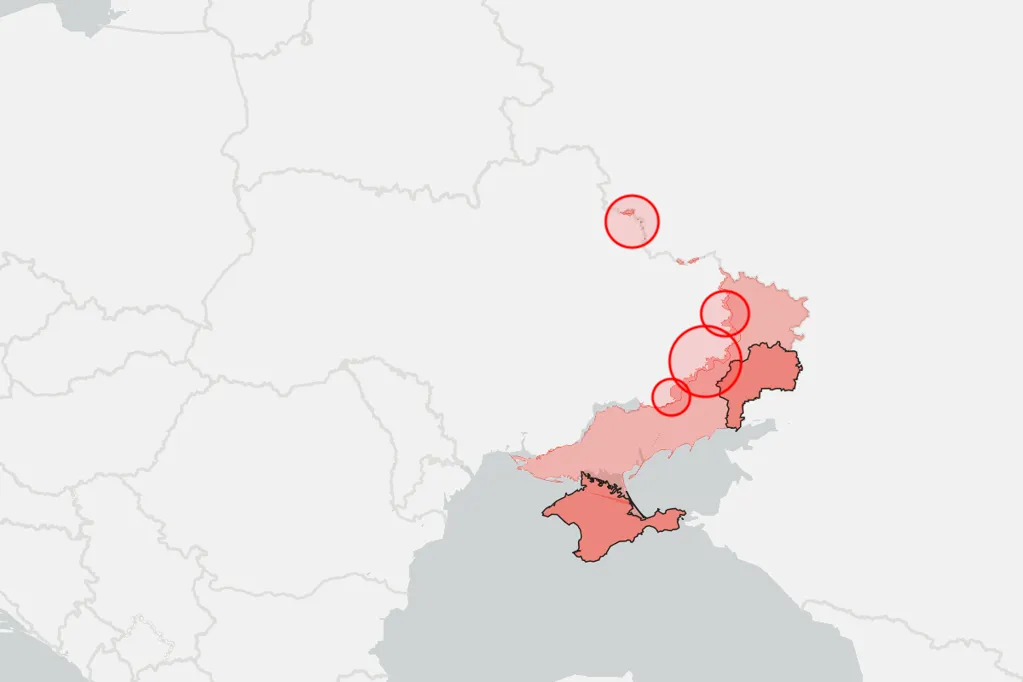
On February 24, Russia's full-scale invasion of Ukraine will enter its fifth year, marking a grim milestone in Moscow's aggression. Newsweek's map shows how the front line in Ukraine has changed throughout a year in which headline-grabbing meetings involving officials from the U.S. Ukraine and Russia yielded little progress in ending hostilities.
Russia occupies about one-fifth or 44,600 square miles of Ukraine's land. The front line stretches 620 miles through the regions of Kharkiv, Luhansk, Donetsk, Zaporizhzhia and Kherson. Moscow controls about three-quarters of the Zaporizhzhia and Kherson regions as well as mall parts of the Kharkiv, Sumy, Mykolaiv and Dnipropetrovsk regions.
In March, Russian forces said they had regained control of Sudzha, the largest town in Russia's Kursk region which Ukraine had stormed in a cross-border offensive the previous August.
Kovalenko, who produces the Ukraine Decoded substack, told Newsweek that Moscow's recapture of Kursk was a notable setback for Kyiv in 2025. "This year showed that the cross-border incursion into the Kursk Oblast of Russia was a strategic miscalculation by President Volodymyr Zelensky; however, it helped boost Ukrainian morale for a while," he said.
As Newsweek's map shows, Russia maintained and expanded control in eastern Ukraine, continuing its war of attrition and pushing the front line westward in parts of Donetsk and Luhansk oblasts, which comprise the Donbas region.
In August, Russian forces advanced about six miles beyond the front lines in their bid to seize the fortress belt, Ukraine's important defensive line, from the southwest, concentrating forces in the Toretsk and eastern Pokrovsk directions. Russia's capture of Pokrovsk in the Donetsk oblast, announced in December, was the second major battlefield loss for Ukraine, Kovalenko said.
By losing Pokrovsk, Ukraine has diminished the industrial resource base for the war effort which is central Ukrainian hub for mining rare coke coal, he said. "Its loss leaves the remaining metallurgy in the Zaporizhzhia and Dnipro regions largely unable to support defense and, moreover, remain profitable and competitive in postwar reconstruction."
Instead, the Russians would be able to restart two massive metallurgical plants in occupied Mariupol, renewing production of large quantities of cheap steel for new Russian tanks, artillery, and ammunition, Kovalenko added.
David Silbey, a military history expert from Cornell University, told Newsweek that the main assessment for 2025 was how little movement there has been on the front line. "We started the year with the Russians advancing slowly out of the east of Ukraine and we're ending the year with the Russians very slowly advancing out of east Ukraine," he said.
The Russians are still winning by holding onto the eastern provinces and pushing forward at an incremental pace, said Silbey, but given the cost in troops and equipment, "it's not much of a victory."
Throughout 2025, diplomatic efforts were highlighted with a meeting between Putin and President Donald Trump in Alaska. But further talks led to Russia rejecting U.S. terms for a ceasefire, while Putin has reiterated his maximalist war aims.
Yuriy Boyechko, CEO of Hope For Ukraine a charity which helps front line communities, told Newsweek the year's diplomacy had handed a "decisive geopolitical victory" for Putin against President Donald Trump.
He said that assigning inexperienced and politically-connected figures like Jared Kushner and Special Envoy Steve Witkoff to lead the complex, existential talks, "Putin's veteran diplomats played a masterful game of delay and distraction."
"This process has effectively neutered U.S.-led pressure, buying Russia crucial time to dig in on the battlefield, consolidate territorial gains in Ukraine, and keep the deadly conflict simmering on his terms throughout 2025," Boyechko added.
Ukrainian analyst Viktor Kovalenko: "This year, the Ukrainian Armed Forces experienced two notable battlefield losses: the city of Pokrovsk in the eastern Donetsk region and the territory they gained inside the Russian Kursk region."
He added: "Slowly but surely, the Russian troops squeezed them out of those locations that bear immense strategic significance -- their control could change the course of the war in favor for Kyiv."
David Silbey, associate professor at Cornell University said the Ukraine conflict in 2025 showed: "The static warfare of the First World War all over again. In that war, any visible movement was punished by a hail of machine gun and artillery fire; here it's drones.
"The result is the same though with both sides hunkering down below ground as much as possible and hammering each other with fire power -- for no real useful result."
The war enters the New Year with no ceasefire imminent. After U.S. officials held talks with both Ukrainian and Russian delegations at the weekend, U.S. Vice President JD Vance told the outlet UnHerd that progress has been made in negotiations but there is no certainty a peaceful settlement will be reached.