Dennis Valera is a reporter who joined WJZ in December 2022 and is very happy to call Charm City home.
Millions of tons of plastic pollute the planet every year, and the environmental impact speaks for itself.
But the pollution is also taking a toll on us, as that plastic makes its way into our bodies.
There's a lab at the University of Maryland-College Park working to curb the issue by finding natural ingredients to create bioplastics.
When CBS News Baltimore visited Dr. Po-Yen Chen's lab at UMD, many dishes were spread across one of the tables.
Inside those dishes were small pieces of paper, which eventually will become what many know as a food wrapper.
It's one of the number of products the lab is developing, but not with traditional materials and plastic, but with natural, biodegradable ones.
Dr. Abishek Sose, a postdoctoral fellow who's been working in Chen's lab since August, said some of the materials researchers are using are cellulose, gelatin, and even something that can be found in crab shells.
"You can find [all of these ingredients] naturally," Sose said.
19-to-23 million tons of plastic waste end up in the world's waters, according to the United Nations Environment Programme, or UNEP.
That pollution, in turn, ends up in people in the form of microplastics. Also as PFAS exposure, better known as forever chemicals, is tied to several severe health implications.
Sose and his colleagues even estimate that each person accumulates enough plastic in their body the size of a credit card each year.
"Our ultimate goal is to go green to resolve the issue of pollution in the environment, as well as the health effects that have been affecting the human body as well," Sose said.
The traditional process to find suitable materials for bioplastics takes time.
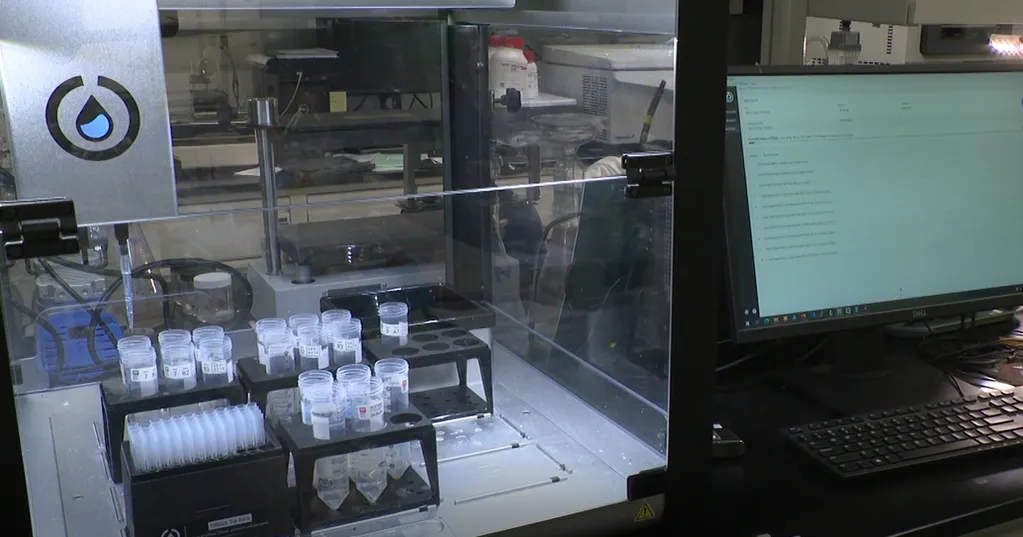
So, to help streamline things, the lab is using A.I., machine learning and robotics. The technology the lab is using is measuring, distributing, and even mixing the materials to test what exactly works.
"If you have four components, you'll probably have like 300 samples you need to [test]," said Haochen Yang, a chemical engineering PhD candidate who's been working on this for more than four years.
This research alone can take months, even years. But with the technology on hand, it's reduced to hours.
The researchers say it's helped bring results and demonstrated impact pretty quickly.
"Everything has been flowing really fast," said chemical engineering master's student Tram Le.
Helping get a step closer to reduce the toll plastic pollution has had on us and our planet.
"We are designing a way of making a new science itself," said Sose. "So that we go green in all the aspects, in all the materials that we have been designing."
At least one of the products developed in the lab is close to being able to be mass produced, with industrial partners picked out.