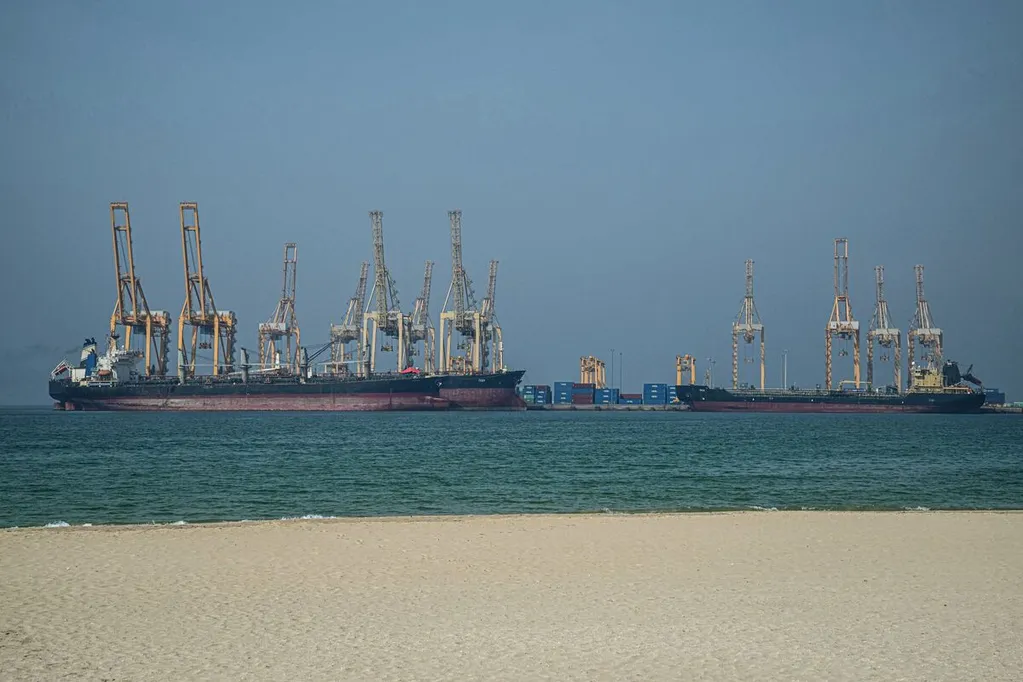
The constraint on fertilizer shipments is unfolding into a "food security timebomb," with the Middle East being a vital supplier of nutrients to grow staples like corn, wheat and rice.
The United Nations is ready to set up a corridor to allow fertilizer to move freely through the Strait of Hormuz and reach farmers for the planting season -- but doing so hinges on a political agreement to go forward, according to a top UN official.
"The UN is ready -- we have the teams identified, we have the system prepared, we have the technical design of the mechanism. We just need a political and diplomatic solution that allows us to start," Jorge Moreira da Silva, who is overseeing the initiative, said in an interview.
Talks with UN member states are underway in a bid to reach an international agreement, da Silva said. He didn't share who was involved but said he's having "extensive conversations with countries in the region, not only those that are more direct affected and involved in the conflict, but also globally."
The Hormuz strait has remained effectively shut since the war began. Iran was initially responsible for the halt and the US followed with its own blockade of ships leaving or entering Iranian ports on Monday. Negotiators from the two countries held ceasefire talks in Pakistan last weekend but were unable to reach a deal on ending the conflict.
The intensifying standoff has revived the push to open a safe shipping route for fertilizer and other goods to prevent a humanitarian crisis. With the Strait of Hormuz effectively shut, shipments of fertilizer have ground to a halt -- leaving farmers without the inputs needed to secure plentiful harvests and countries already exposed to hunger even more vulnerable. The Middle East is a vital supplier of nutrients to grow staples like corn, wheat and rice, and a key source of ingredients for their production elsewhere.
The International Rescue Committee, which has urged the creation of a "sustained humanitarian corridor' to allow life-saving aid to transit the strait, said the constraint on liquefied natural gas and cooking gas as well as fertilizer is unfolding into a "food security timebomb," in a statement. The group said it has $130,000 worth of pharmaceutical supplies destined for Sudan -- already suffering a humanitarian crisis -- stuck in Dubai.
Any deal to allow such a corridor would need to be agreed to by Iran and the US, who are considering an extension of their ceasefire to allow more time for peace talks. Experts say an agreement on a shipping route for fertilizer and aid could help Tehran and Washington demonstrate good will, without either losing leverage in broader negotiations.
"The challenge right now is there's two parties of conflict saying no to everything because there's leverage in keeping the strait closed," said Sam Vigersky, international affairs fellow at the Council on Foreign Relations. "The easiest place to say yes is on humanitarian aid because it requires no leverage being given up from either side."
"A humanitarian corridor is not a point of weakness for either but rather a point of good faith," said Vigersky, who was the lead US humanitarian negotiator at the UN until 2024.
The idea of establishing a corridor was presented by the International Maritime Organization, a UN agency responsible for shipping safety, at a meeting of more than 40 nations convened by the UK earlier this month, according to people familiar with the matter who spoke on condition of anonymity to detail private conversations. But it gained little traction initially because diplomats wanted to focus on negotiating the full reopening of the strait.
Discussions on a corridor, however, have revived as broader negotiations stall and worries mount about an escalation of the US naval blockade.
The chief economist of the UN's Food and Agriculture Organization, Máximo Torero, highlighted concerns about higher food prices, projecting that global fertilizer prices could spike as much as 20% in the first half of this year if the conflict continues. Sri Lanka, Bangladesh, India, Egypt, Sudan, Brazil and a number of African nations are most vulnerable.
Da Silva's task force draws on previous UN efforts such as the Black Sea Grain Initiative, an agreement between Russia, Ukraine, Turkey and the UN that saw millions of tons of grains mobilized and markets stabilized in the wake of Russia's invasion of Ukraine in 2022.
The new fertilizer mechanism will address issues including "monitoring, verification, and reporting," da Silva said.
Fertilizer supply disruptions are hitting at a critical moment in the planting season.
"If we miss that window, then we will be talking about humanitarian aid," da Silva said. "In my discussions, I am making it clear why this is needed, what the consequences of inaction will be."