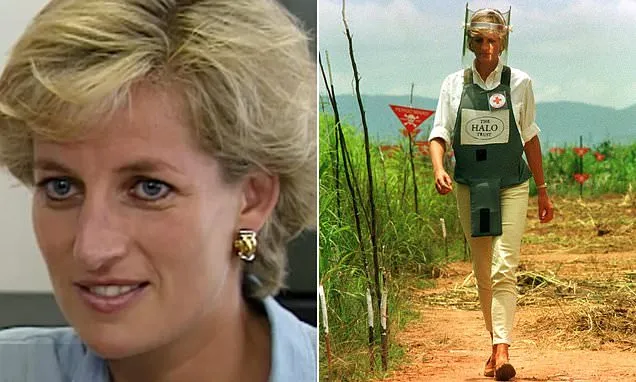
Unseen footage of Princess Diana taken on a controversial trip just months before she died has been released for the very first time.
The incredible behind-the-scenes video was filmed while Diana embarked on a landmark visit to Angola in January 1997 to campaign for a global landmine ban.
Taking place just eight months before her tragic death in Paris, the historic trip sparked vast political controversy and saw the princess dubbed a 'loose cannon' by a leading political figure.
Conservative government ministers spearheaded a deluge of criticism over the princess's actions and argued that her calls for a worldwide ban appeared to endorse the Labour Party's policy on the issue.
At the time, the Conservative Party's stance was that it would only agree to a global ban in the instance that all countries unanimously agreed to do so.
Now, rare footage of the princess taken on the landmark trip has been released as part of a new episode of ITV's Reporting History.
The remarkable sit-down interview showed Diana, then 35, being asked by Steve Scott, then ITV News' Africa Correspondent, whether she she saw herself taking a 'new hands-on role' in her future, in light of the trip.
In response, Diana said: 'I don't know, I already answered this Jenny.'
Diana Appears to Address Controversy Surrounding Visit
At another stage during the clip, Diana appeared to directly address the controversy surrounding her landmark visit.
When Scott queried whether he could ask the princess 'that question about the political role', Diana quipped: 'I would have thought that was the most important question'.
Off-camera, Diana's team appeared hesitant, with one individual heard saying: 'No, not the political one, you don't mean the political one'.
However, the princess insisted that she would like to answer Scott's question. Holding her hands up, she replied: 'No, no, I mean the one saying I'm not a political figure', before flashing a brief coy smile.
Dressed head to toe in body armour, Diana was famously captured calmly striding down a path surrounded by landmines from East Germany, Russia and China, alongside mine removal expert Paul Heslop from charity organisation The Halo Trust.
'My mind was in overdrive trying to make sure I wasn't going to be the most famous person in the world the next day for blowing up the Princess of Wales,' Mr Heslop later told the BBC.
Diana also remotely detonated a live landmine, declaring 'one down, 17 million to go' as she pushed the button on January 15, 1997.
Diana Faces Criticism
However, the trip also saw numerous public figures express their disdain.
Earl Howe, then junior defence minister for the Conservatives, reportedly described Diana as a 'loose cannon' who was 'ill-informed on the issue of anti-personnel landmines'.
Yet, British ambassador Roger Hart claimed that Diana saw such criticism as an 'unnecessary distraction', while Mike Whitlam, then director general of the Red Cross, thought they were merely a 'piece of mischief'.
At the time, the Daily Mail described her famous landmine walk as an effort to 'focus worldwide attention on the menace of anti-personnel mines and the plight of their victims'.
Meanwhile, Diana herself pledged: 'All I am trying to do is help. I am trying to highlight a problem that is going on all around the world, that's all.'
'I'm not a political figure, nor do I want to be one. I come with my heart and I want to bring awareness to people in distress, whether it is in Angola or any part of the world,' the princess told reporters at the time.
'The fact is I am a humanitarian figure, always have been and always will be.'
According to a Foreign Office dispatch document from Angola released by the National Archives in 2020, the 'furore' over Diana's seemingly controversial presence in Angola 'had little local impact on the visit'.
'The Angolan authorities were delighted that the Princess made the visit. The British Red Cross were pleased and so too was the Princess of Wales,' added Mr Hart.
Diana's Minefield Walk Draws Global Attention
Images of the princess walking through the minefield sent shockwaves around the globe and the high-profile coverage helped raise global awareness of landmines and the repercussions they caused for innocent people.
The princess was brought to tears when she met then 16-year-old Sandra Thijika, a victim of a landmine explosion, and watched on as the young teenager was measured for a prosthetic leg after a nine-year wait.
A poignant image of Sandra sat on the princess’s knee underneath a fig tree at a orthopaedic centre was broadcast around the globe and highlighted the exponentially high death and disability rates the country was enduring due to landmines.
22 years later, Sandra revealed that she had named her young daughter after Diana in a loving tribute to the princess who she fondly described as a ‘friend’.
‘I gave my daughter the name Diana because I loved her and she was such a good person. I loved her way with people. She was famous and she made me feel famous -- I will never forget her,’ she emotionally recalled.
‘We were not together long but when she left I felt I was saying goodbye to a friend.’
At the time of the princess’s visit, one in every 300 people in Angola had lost a limb due to the more than 15 million landmines across the country.
For Diana, her trip to Angola marked just the beginning of her landmine campaign work, with the princess also making a three-day visit to Bosnia in August of that year. Heartbreakingly, it would be her final humanitarian trip.
Impact of Diana's Landmine Campaign Lives On
'She was talking about following it up with visits to other heavily-mined countries such as Vietnam, Cambodia and Kuwait,' added Mr Hart.
These future campaigning trips never occurred. Just seven months later, on August 31, 1997, Diana tragically died in a car crash in Paris.
Yet the impact of her high-profile landmine visit would live on in the aftermath of her death.
According to Lou McGrath, who co-launched Mines Advisory Group (MAG) in 1989, Diana’s trip marked a ‘turning point’ in the campaign for a global landmine treaty.
Speaking to the BBC on the 20th anniversary of the princess’s death, Mr McGrath said: ‘She’d been heavily criticised by MPs for being political, but actually governments of the world had agreed it was a humanitarian issue.
‘Without her we couldn’t have brought forward what was the fastest arms control treaty in the world.’
Shortly after Diana’s death, recently elected Prime Minister Tony Blair pledged to ratify the Ottawa Treaty, a key international agreement that bans the use, production, stockpiling and transfer of anti-personnel landmines, by the first anniversary.
In December 1997, 122 governments signed up to the Ottawa Treaty, officially known as the Convention on the Prohibition of the Use, Stockpiling, Production and Transfer of Anti-Personnel Mines and on their Destruction.
The life-changing policy entered into force on March 1, 1999, with 164 countries now parties to the treaty.
Princess Diana's former bodyguard brands Andrew 'arrogant individual'
Princess Diana's former bodyguard Ken Wharfe has broken his silence on the Andrew Mountbatten-Windsor scandal, branding the disgraced former royal 'one of the most arrogant individuals I've ever had the misfortune of meeting.'
Wharfe, the SAS-trained Scotland Yard inspector who served as Diana's personal protection officer from 1988 to 1993, called Andrew's association with convicted offender Jeffrey Epstein 'excruciatingly toxic'.
'I did, on a few occasions, have dealings with him in a professional capacity,' he said of Andrew. 'And I found him to be one of the most arrogant individuals I've ever had the misfortune of meeting.'
Andrew, 66, was arrested on February 19, his birthday, at Wood Farm on the King's Sandringham estate in Norfolk on suspicion of misconduct in public office.
He was held for 11 hours before being released under investigation by Thames Valley Police. He has not been charged and has previously denied all wrongdoing.