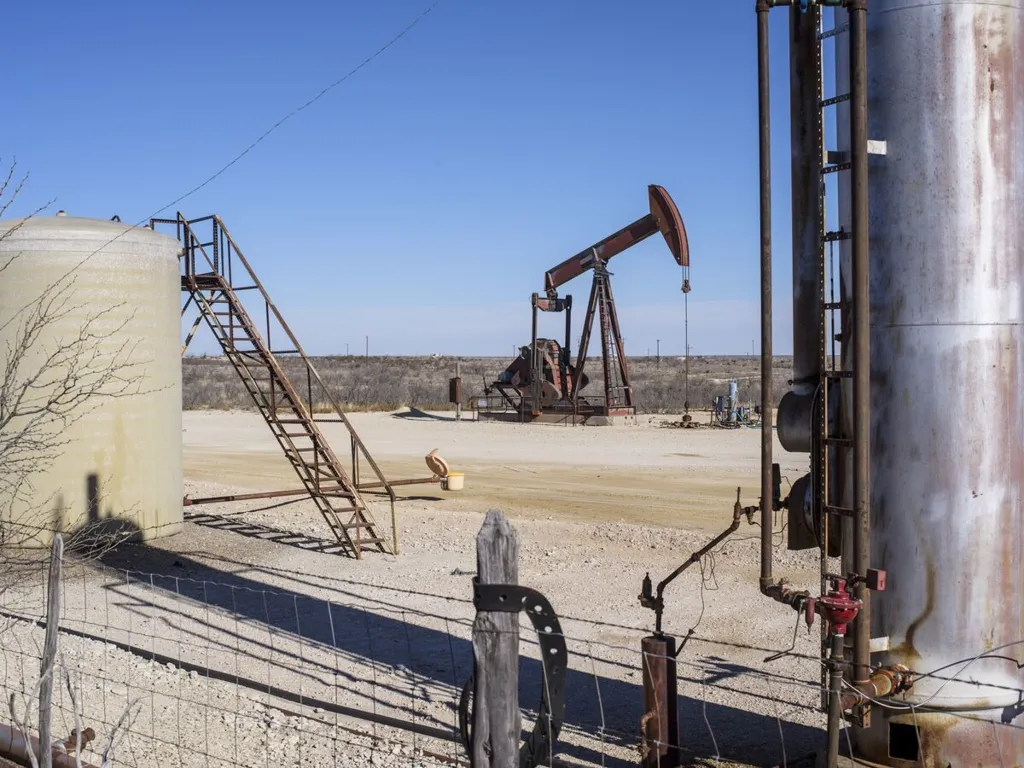
US crude production fell to near 13.7 million barrels a day in December, the lowest in six months, according to a monthly report from the US government.
The monthly figures represent a decrease of about 182,000 barrels a day compared to the agency's preliminary weekly estimates for December. The data spans a period when widespread expectations of a global supply glut were weighing on prices, partly as OPEC+ moved to restore barrels the group had withheld for years.
- Total liquids production eased to about 21.3 million barrels a day in December, down 1.8% from the previous month
- Gasoline, jet fuel and diesel demand were all largely in-line with the EIA's weekly estimates
As Russia's war economy strains under growing pressure from sanctions and slumping revenues, even businesses in regions that have benefited from massive increases in military spending are feeling the pain and turning to officials for help.
In Nizhny Novgorod region, an important industrial center since Soviet times with major defense factories and an automotive plant, the economic situation is causing "serious concern," according to documents seen by Bloomberg News.
The local industrialists' association set out a litany of troubles facing companies in a letter to a top regional official this month. It highlighted sharp falls in investment, profits, orders and production over the past year in the region of some 3 million people that's about 500 kilometers (310 miles) east of Moscow.
The association urged local authorities to raise its concerns with President Vladimir Putin's government in Moscow. It appealed for renewed investments, the return of preferential loan rates and faster settlement of invoices, pointing out that giant state enterprises such as the United Shipbuilding Corporation, Roscosmos, Rosatom, and Rostec were among the main culprits in overdue payments.
Payment delays may be an indication that financial stresses are spreading as contractors are forced to deplete their reserves to meet running costs or turn to costly borrowing that further erodes profitability. That's even as state spending on defense jumped about 30% last year, while it's projected to be largely flat in 2026.
Borrowing costs have ballooned as subsidized loans have dried up, forcing companies to pay commercial rates exceeding 20%, the association in Nizhny Novgorod said. The scale of unpaid invoices held by local businesses has surpassed 100 billion rubles ($1.3 billion), it said.
Some 20,000 people may lose their jobs in the region in the second half of the year unless the situation improves, according to an assessment and a survey of businesses that accompanied the letter and has also been reviewed by Bloomberg. Several major companies, including firms seen as systemically important to Russia, have already cut working hours to reduce costs, it said.
The Nizhny Novgorod regional government and the industrialists' association didn't respond to requests for comment.
The deterioration is in sharp contrast with last year when Nizhny Novgorod had practically no unemployment, according to Federal Statistics Service data, and wages grew strongly, according to regional officials. It reflects broader difficulties across the world's largest country by area as Russia's economy cooled sharply last year following the imposition of record-high interest rates.
The Bank of Russia hiked the key interest rate to 21% in October 2024 and kept it there until June to curb inflation and overheating after years of massive state spending on military and aid for businesses hit by sanctions.
Annual growth slumped to about 1% last year from 4.9% the year before. While the central bank has since eased the key rate to 15.5%, it sees Russia's economy expanding by only 0.5% to 1.5% this year.
A survey of more than 10,000 companies published by the bank in February showed that businesses nationwide reported weaker demand and tighter financial conditions and were cautious about investment and hiring.
Some of the country's largest businesses are asking the government for aid to ease pressures from high borrowing costs and weaker demand even as the state budget deficit is expanding amid declining oil and gas revenues.
Many of Russia's more than 80 regions face widening budget shortfalls that will force them to depend even more on Kremlin funding at a time when Moscow is prioritizing spending on the war that's now in its fifth year.
The combined deficit of regional budgets increased by more than 1 trillion rubles last year to 1.48 trillion rubles, more than triple the shortfall in 2024, Kommersant newspaper reported Thursday, citing calculations by the Analytical Credit Rating Agency in Moscow.
Russia plans to provide 3.55 trillion rubles of grants to the regions this year, with the amount set to rise by about 14% by 2028, according to the Finance Ministry. The Kremlin also is allowing regions to write off up to two-thirds of their debts on budget loans, amounting to 1.1 trillion rubles from 2025 to 2029, if they direct the funds to infrastructure projects and investment support.
Regional governments, more than half of which have relied historically on federal grants, are being forced to borrow more at high rates to cover budget gaps.
Nizhny Novgorod expects a budget deficit this year of almost 30 billion rubles that will be partially covered by a federal grant.
"We have had to turn down ministries on spending that is genuinely important but not an immediate priority," regional Governor Gleb Nikitin told local media in December. He underlined that social spending would be prioritized, including support for families of troops fighting in Ukraine.
Nizhny Novgorod's economy is typical of Russian regions that aren't dependent on revenues from oil and gas production. It combines Soviet era industrial capacity with a growing services and technology segment, though manufacturing, including military production, continues to dominate output and employment. The region is home to a nuclear warhead producer, an explosives supplier, several metallurgical enterprises and GAZ Group, Russia's largest maker of light commercial vehicles.
The fate of GAZ Group underscores how Russia's isolation from the West has weighed on key industrial enterprises. Founded by the Soviet Union in 1932 with help from Ford Motor Co., the plant was first sanctioned by the US in 2018 along with its billionaire owner Oleg Deripaska, who took control of the asset in the 2000s.
At its peak, the company had joint projects with Mercedes-Benz and Volkswagen, but has struggled under sanctions. Sales of its light commercial vehicles fell 33% last year to 40,570 units, according to Autostat Info, a Russian automotive market research agency.
The regional survey of more than 50 companies in Nizhny Novgorod's military and civilian industries, as well as 70 firms across the broader Volga area, was conducted quarterly throughout last year and paints a bleak picture. It was sent to the then deputy governor, Andrey Sanosyan, who oversaw regional industry and left his post last week after almost six years.
About 70% of companies reported a decline in investment in 2025, while 40% of civilian businesses said profits had slumped at least two-fold and none reported an increase in orders from a year earlier, with many now running at substantially reduced capacity. The picture was slightly better for some military firms with contracts to directly supply Russia’s war in Ukraine.
Both military and civilian enterprises reported a rise in late payments due to them and said that repaying loans at high commercial rates was eating further into their budgets and adding to their indebtedness. Part of the problem was due to significant delays in suppliers delivering components which had led final product deliveries and associated payments to slip. This had helped to create cash flow gaps pushing some enterprises to operate under "critical conditions," according to the assessment.
With the economic situation continuing to deteriorate, enterprises are gradually running out of the reserves that have allowed them to sustain operations until now, it added. That would leave firms with no option but to reduce production and staff, and even declare bankruptcy in the worst cases, the assessment warned.
Russia's economy in general is wrestling with an acute labor shortage that drove up wages sharply after the start of the February 2022 full-scale invasion of Ukraine as the military and defense industries absorbed huge numbers of people and hundreds of thousands fled abroad to escape the war.
European government officials familiar with the Nizhny Novgorod documents believe they show Russia is facing mounting economic headwinds that may make it harder for Putin to sustain his war in Ukraine. They argue that this may weaken the Kremlin's bargaining power over time as it floats massive business deals to US President Donald Trump's administration and pushes for maximum concessions in peace talks that remain deadlocked over Putin's territorial demands.
Others are more skeptical about the political impact. While predictions of Russia's economic collapse "are not without grounds," the Kremlin's war is driven by profound mistrust of the West and will continue until that's resolved, according to Tatiana Stanovaya, Senior Fellow at the Carnegie Russia Eurasia Center.
"The Kremlin will not make significant concessions even if faced with a protracted financial and economic crisis," she said in a Feb. 18 article.