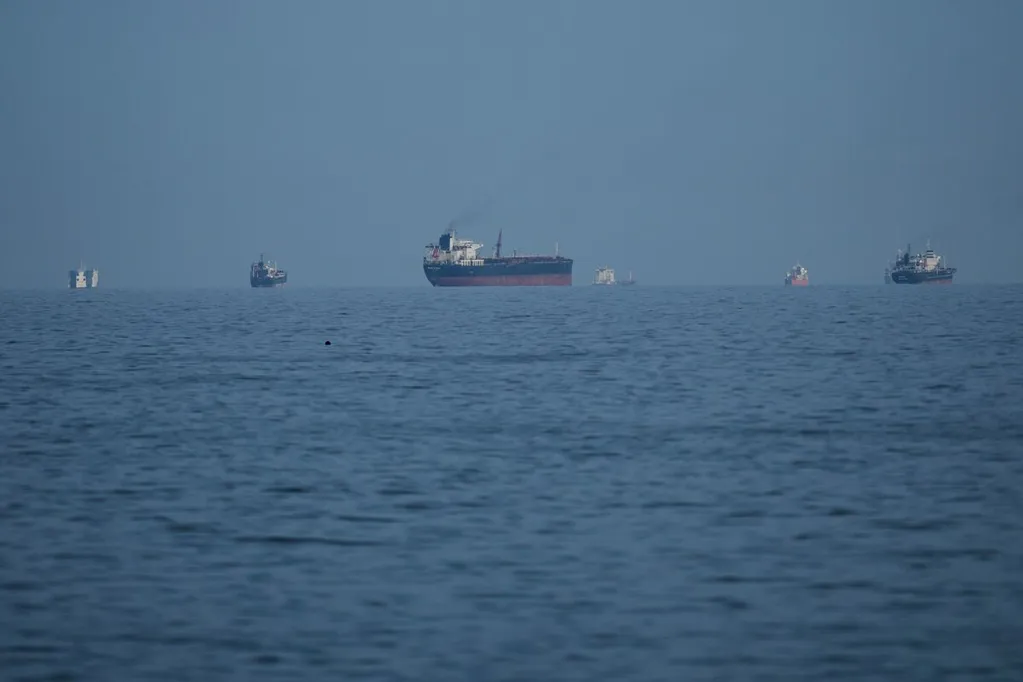
The US is doubling, to $40 billion, its commitment to provide reinsurance guarantees to ships willing to travel through the Strait of Hormuz with the addition of new insurance partners, including AIG and Berkshire Hathaway.
The move announced Friday is the latest US effort to ease worries over the vital waterway and to encourage traffic to resume, despite an effective Iranian blockade and continued hostilities in the five-week war.
The US International Development Finance Corp. last month announced a $20 billion reinsurance program. On Friday, the agency said Travelers, Liberty Mutual Insurance, Berkshire Hathaway, AIG, Starr and CNA will join Bloomberg Terminal Chubb to provide an additional $20 billion in reinsurance for the agency's maritime facility.
Friday's announcement marks the first significant details the DFC has revealed publicly about its reinsurance program since the project's original formation almost a month ago. The effective closure of the strait, which typically carries about a fifth of global oil and liquefied natural gas flows, has roiled markets and triggered a broad energy crisis.
"Along with Chubb, these leading American insurers bring deep underwriting experience in marine and marine war coverage, strengthening our efforts to help restore confidence in maritime trade," DFC Chief Executive Officer Ben Black said in a statement.
Trump on Friday reiterated his frustration over the strait's closure and the failure of allies to help the US reopen the waterway.
"With a little more time, we can easily OPEN THE HORMUZ STRAIT, TAKE THE OIL, & MAKE A FORTUNE," Trump said in a social media postBloomberg Terminal. It wasn't immediately clear what actions the president was considering.
Shippers remain doubtful, though, of a wholesale return to the Strait of Hormuz even after Trump's promise to protect ships and his primetime speech on Wednesday in which he repeated that the war will soon end. The key concern about traversing the sea route is that it puts the lives of crews at risk as Iran continues to threaten vessels with drone attacks, missiles and water mines.
The DFC also said in the statement that the agency and insurance partners will determine which vessels are eligible for the reinsurance facility. To qualify, the DFC is requiring applicants to provide, among other details, the origin and destination country of the vessel; major beneficial owners of the ship and domicile; owner of the cargo and domicile of the owner; and information about the lenders financing the vessels.
Restoring confidence to shippers willing to move through the Strait of Hormuz is one of the most pressing objectives of the US. Global energy prices have been mounting as nations have been starved of an essential oil supply line. India -- the world's third-largest oil user and a major buyer of gas -- has been hit particularly hard by the crisis.
In the US, gas prices have risen above $4 a gallon for the first time since 2022, further straining American consumers already facing affordability challenges.
While doubling the reinsurance commitment expands financial guarantees, the program still lacks any promise of naval escorts that theoretically would provide protection for ships' crews. And even then, it may not be enough to convince vessels to restart expeditions through the Strait.
"Insurance rates will fall -- and the willingness of commercial operators to insure and send cargoes through the Strait will rise -- only after Iran's military capabilities are degraded," Bob McNally, president of Rapidan Energy Group, a Washington-based consultant firm, told Bloomberg News earlier this week.