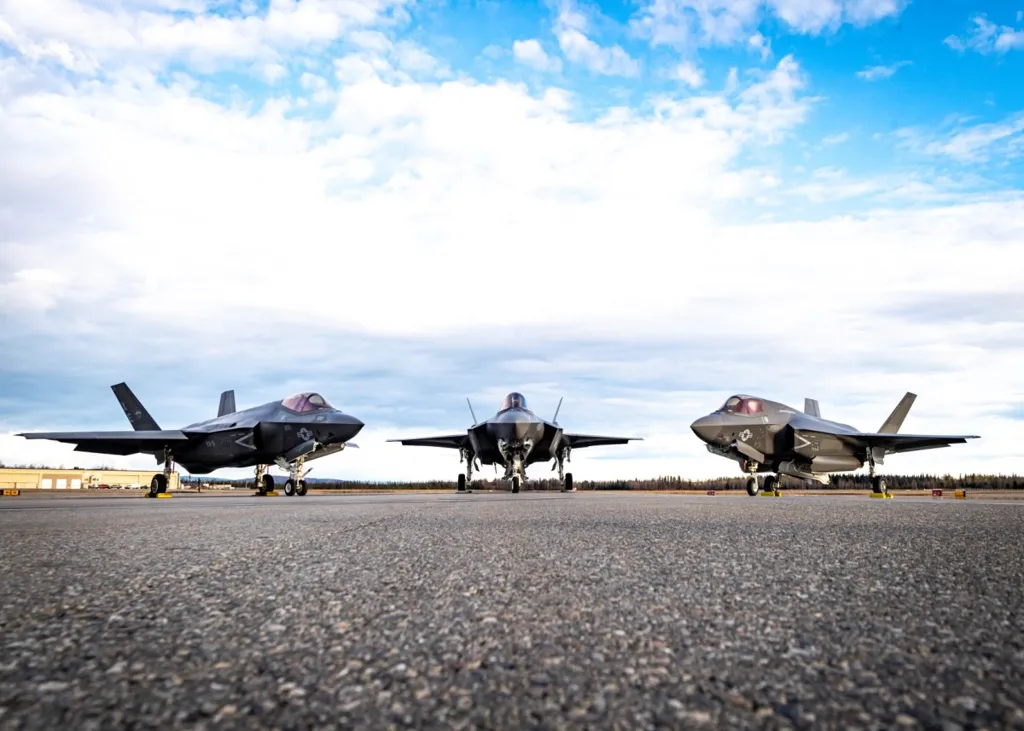
The United States F-35 fighter program recently hit significant milestones in both the number of aircraft delivered and components produced as 20 allied and partner nations rapidly field the stealth jet to bolster their air power amid adversary threats.
Lockheed Martin, the prime F-35 contractor, handed over 191 jets to operators in 2025, exceeding the previous record of 142. Meanwhile, Northrop Grumman, the program's principal partner, has delivered the 1,500th aircraft center fuselage for final assembly.
Considered one of the world's most advanced fighter aircraft and capable of evading radar detection, the F-35 has developed into three variants: the most common A model, which operates from conventional runways; the B model, designed for short takeoffs and vertical landings from ships; and the C model, built for aircraft carrier operations.
As of January, the F-35 program included the U.S. and 19 other countries, including Germany, Israel, Japan, South Korea and the United Kingdom, delivered nearly 1,300 jets in total. The aircraft has been used in combat, having participated in U.S. airstrikes on Iran's nuclear facilities and the capture of Venezuelan President Nicolás Maduro.
"Annual F-35 production is now running at a pace five times faster than any other allied fighter currently in production, underscoring the program's scale and maturity," Lockheed Martin said in a January 7 press release, announcing the new delivery record.
According to the F-35 website, 156 aircraft are expected to be built annually. All jets, with components from different suppliers, undergo final assembly at one of three sites: Fort Worth, Texas -- where 19,000 people work -- Cameri, Italy, or Nagoya, Japan.
During his tour of the F-35 assembly line in Fort Worth on Monday, U.S. Defense Secretary Pete Hegseth praised workers for delivering capabilities for the military, but also urged the country's defense industry to "go fast" amid the current environment.
"We've got to go fast. The warfighters need it; they deserve it. We've got new peer adversaries that are building at record speed," he said, without naming any country.
A Lockheed Martin fact sheet states that the global F-35 fleet surpassed 1 million flight hours in 2025, with more than 3,255 pilots trained so far. Currently, 39 air bases and 12 ships around the world are capable of hosting and operating the stealth aircraft.
Also on Monday, Northrop Grumman said its Integrated Assembly Line in Palmdale, California, produced the F-35 center fuselage with "speed and precision," aided by advanced manufacturing technologies that reduced assembly time by 35 percent.
Using augmented reality and virtual reality tools, Northrop Grumman can deliver one center fuselage every 30 hours. It is also responsible for developing the F-35's radar, communication, navigation and identification system, as well as stealth technologies.
In 2023, the company began construction of a second center fuselage Integrated Assembly Line in Weeze, Germany, in response to what it called "increased demands" for the fifth-generation fighter jet. The European facility started production in 2025.
U.S. Defense Secretary Pete Hegseth said: "I'm looking out into an incredible audience of Americans here who are committed to an incredible company that's building incredible platforms...Thank you for accepting and grasping the challenge of President Trump as well as our department. Thank you all so much for what you do, for why you're doing it. We are shoulder to shoulder with you because we can't deter the next conflict without the skills and capabilities you have."
Chauncey McIntosh, vice president and general manager of the F-35 program, said: "I'm immensely proud of the F-35 enterprise for delivering on our production commitments, performing with excellence and growing our global partnerships in 20256...As our warfighters continue to employ the F-35 to protect the interests of America and our allies around the world, we're committed to continuing to push the latest technology into the hands of the warfighter to defeat any threat."
It remains to be seen whether additional countries will procure their first F-35 jets or place further orders. The Trump administration is pressing allies, particularly NATO member states, to increase defense spending by purchasing American weapon systems.