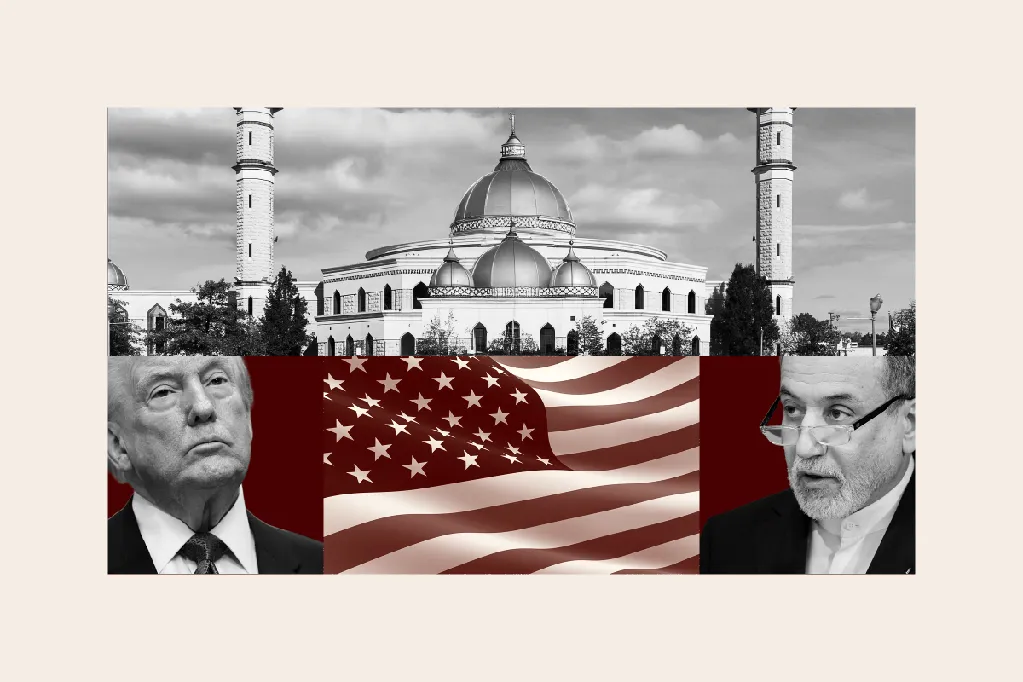
As the U.S.-Israel war on Iran raged into its third week, two communities across the country faced attacks that authorities say reflect a dangerous pattern: overseas conflict translating into domestic violence.
On March 12, a gunman opened fire at Old Dominion University's ROTC program in Norfolk, Virginia, killing Army instructor Lieutenant Colonel Brandon Shah and wounding two cadets. Hours later, in West Bloomfield, Michigan, a driver rammed a vehicle through the doors of Temple Israel, the nation's largest Reform synagogue, sparking a fire that trapped 140 children inside.
The FBI is investigating both incidents as acts of terrorism. But the incidents' connection to the Iran war remains unclear -- and experts warn that framing matters as officials and the public try to understand what's driving the violence. What is clear is the broader pattern these attacks reflect.
William Braniff spent years at the Department of Homeland Security's Center for Prevention Programs and Partnerships studying how overseas conflicts trigger domestic radicalization. When violence abroad collides with vulnerable populations at home, he said, the results can be deadly.
"Whenever countries go to war, there's the potential that individuals will take matters into their own hands at home based on what's happening overseas, whether that's hate crime against the population that we're at war against overseas, or retribution attacks against targets in the United States," Braniff, now executive director of the Polarization and Extremism Research and Innovation Lab at American University, told Newsweek. "War is violent politics and terrorism is also violent politics, so they're not unrelated."
The incidents arrive amid a measurable surge in online hate targeting Muslim Americans since the Iran war began on February 28. Between that date and March 5, researchers at the Center for the Study of Organized Hate documented 25,348 posts on X with Islamophobic content, and when accounting for reposts, the reach expanded to 279,417 mentions.
Braniff has observed this cycle before. After 9/11, a similar surge in Islamophobia followed, leading to profiling, surveillance, and domestic backlash against Muslim Americans that persisted for years.
But while the wounds from the recent Iran war escalation are still fresh within the Muslim American community, Jewish Americans have faced the same mechanism in the aftermath of October 7, 2023. When Hamas attacked Israel, antisemitism online surged sharply. In the six months following the attack, researchers at George Washington University's Program on Extremism tracking Arabic-language content found a tripling of confirmed antisemitic posts across major platforms, from 367 posts to 1,284 posts.
The nature of antisemitism shifted markedly: before October 7, dehumanizing and conspiratorial content dominated; afterward, violent antisemitism, Holocaust denial, and calls to violence against Jews increased dramatically. Posts glorified attacks on Jewish communities, with users praising attackers as "heroic mujahidin" and framing violence as a religious duty.
Ayal Feinberg, who directs the Center for Holocaust Studies and Human Rights at Gratz College, has spent years examining how international crises reshape domestic tensions. The mechanism is clear, she said: geopolitical events don't cause hate so much as they provide the narrative framework for it.
"Jews are often treated as uniquely responsible for the actions of Israel and are expected to denounce its conduct at higher rates than other groups are asked to answer for overseas events," Feinberg told Newsweek. That dynamic helps explain why moments of geopolitical crisis produce not just generalized backlash, but specifically antisemitic forms of collective blame.
Political rhetoric has amplified the crisis. In mid-February, Representative Randy Fine of Florida wrote on social media, "If they force us to choose, the choice between dogs and Muslims is not a difficult one." The comment drew immediate condemnation from Democrats and calls for his resignation, but House Speaker Mike Johnson remained silent, and Fine doubled down during a television appearance, saying his post was a response to "a major Muslim leader saying dogs should be forbidden."
Understanding how individual attackers rationalize violence requires looking at the ideological frameworks they adopt. Professor Kurt Braddock at American University has studied how extremist groups adapt global events to fit their narratives. The process is systematic, he explained.
"It's interesting how extremist ideologies adapt to what is happening in other parts of the world," Braddock told Newsweek. "The general answer is that domestic extremists are adept at interpreting overseas events as indicative of larger patterns that are part of their ideological narratives. They then use those patterns and interpretations of them as justification for what they do."
The Old Dominion shooting presents a particular challenge. Mohamed Bailor Jalloh, 36, a naturalized U.S. citizen from Sierra Leone, had been convicted a decade earlier of attempting to provide material support to ISIS. He was sentenced to 11 years in prison, released early in December 2024, and on March 12, walked into an ROTC classroom yelling "Allahu Akbar" before opening fire.
But the FBI has said investigators have found no mention of the Iran war as a possible motivating factor in the attack. Jalloh had praised the 2009 Fort Hood shooting and previously expressed interest in conducting a similar attack, suggesting his pathway to violence predated the recent conflict by years. The complications are significant: ISIS, as an organization, has explicitly rejected Iran and opposes Tehran's power in the region.
"We need to be careful about connecting the ISIS affiliated attacker directly to Iran," experts cautioned when discussing the incident. "ISIS hates Iran."
The Michigan incident offers a clearer geopolitical link. Ayman Mohamed Ghazali, 41, a Lebanese-born U.S. citizen, rammed his vehicle into Temple Israel on March 12, with fireworks and flammable liquid in the truck bed. A week before the attack, an Israeli airstrike in Machghara, Lebanon -- part of the escalating US-Israel war -- killed two of Ghazali's brothers, who were reportedly part of a Hezbollah rocket unit, along with family members, including a young niece and nephew.
Authorities confirmed that Ghazali posted images of his relatives who were killed in the Israeli attacks on WhatsApp in the hours before the attack.
Yet not all radicalization follows the same path. The Islamic State, in particular, has been explicit in weaponizing the Iran conflict. Beyond the domestic radicalization patterns already documented, the Islamic State has weaponized the Iran war to justify attacks on Jews and Christians in the West. Lucas Webber, senior threat intelligence analyst at Tech Against Terrorism, told Newsweek that IS propaganda frames the conflict as proof that Western "Crusaders" and "Jews" are at war with Islam and that "that retaliatory attacks on civilians in their homelands are a religious obligation."
In official publications and supporter channels, the distinction between combatants and civilians is deliberately erased, with all Western civilians treated as legitimate targets for retaliation.
The incitement is overwhelmingly online and highly adaptive. Core Arabic texts are translated into English slogans and messages that circulate on Telegram and dark web forums, pairing religious texts with images of bombed buildings to argue that Jews and Christians "everywhere" deserve to pay the price. Synagogues and churches are singled out as especially desirable targets.
This sustained incitement has intersected with a surge of IS-inspired attacks. In October 2025, the attacker at Manchester, England's Heaton Park Hebrew Congregation synagogue pledged allegiance to IS and killed two Jewish worshippers. Two months later, the Bondi Beach mass shooting during a Hanukkah event in Sydney, Australia was likewise deemed IS-inspired.
Pro-IS spaces praised the gunman at Old Dominion University as a "lone lion" answering calls to strike.
Authorities across Europe, North America, and Australia have reported multiple foiled plots in 2026 with the same fingerprints, with many suspects having consumed IS propaganda or pledged loyalty to the Islamic State.
The question facing officials and communities is how to interrupt this cycle before more attacks materialize. Corey Saylor, a senior policy analyst at the Council on American-Islamic Relations, has documented how violent extremism intersects with religious identity. The patterns he has observed reflect deeper dynamics at play.
"In my experience with white supremacists,sovereign citizens,p eople who claim Islam somehow sanctions their extremism ,neo-nazis and others ,what moves them to violence differs from person to person .That's part of why solving the problem of extremism ,whatever cause the person claims ,is so difficult," Saylor told Newsweek .
A public health approach to prevention -- combining mental health services ,threat assessment teams ,and community support --is more effective than reactive law enforcement alone ,experts like Braniff have argued .The shift away from prevention infrastructure represents a step backward ,he said .
"We have to invest in prevention if we want there to be a prevention ecosystem in place," Braniff said ."And unfortunately ,the administration has dismantled the prevention infrastructure in the United States over the last year."
Experts stressed that the task is not to assign blame to Trump or to suggest that overseas wars inevitably trigger domestic attacks .Rather ,they said ,the challenge is recognizing that in moments of geopolitical crisis ,extremists exploit vulnerabilities and offer simplified narratives to those struggling with grievances ,isolation ,or unstable life circumstances .
"The fundamental thing about traditional counterterrorism or physical security to hardened targets is that it is inherently reactive to already mobilizing threats," Braniff said ."You're assuming that the threats are going to be there and that the best you could do is disrupt them or deflect them temporarily .That's not strategy ,that's reaction."
"Prevention ,on the other hand ,works," he said ."You can give people who are struggling support so that they don't go down the rabbit hole and start self-medicating on hate or on violent ideology."
Feinberg echoed those sentiments ,stating that prevention requires moving upstream ,before violence becomes attractive to those struggling with unaddressed risk factors .
"The best prevention does not wait for violence; it reduces the social permission structures that make hate feel justified in the first place."