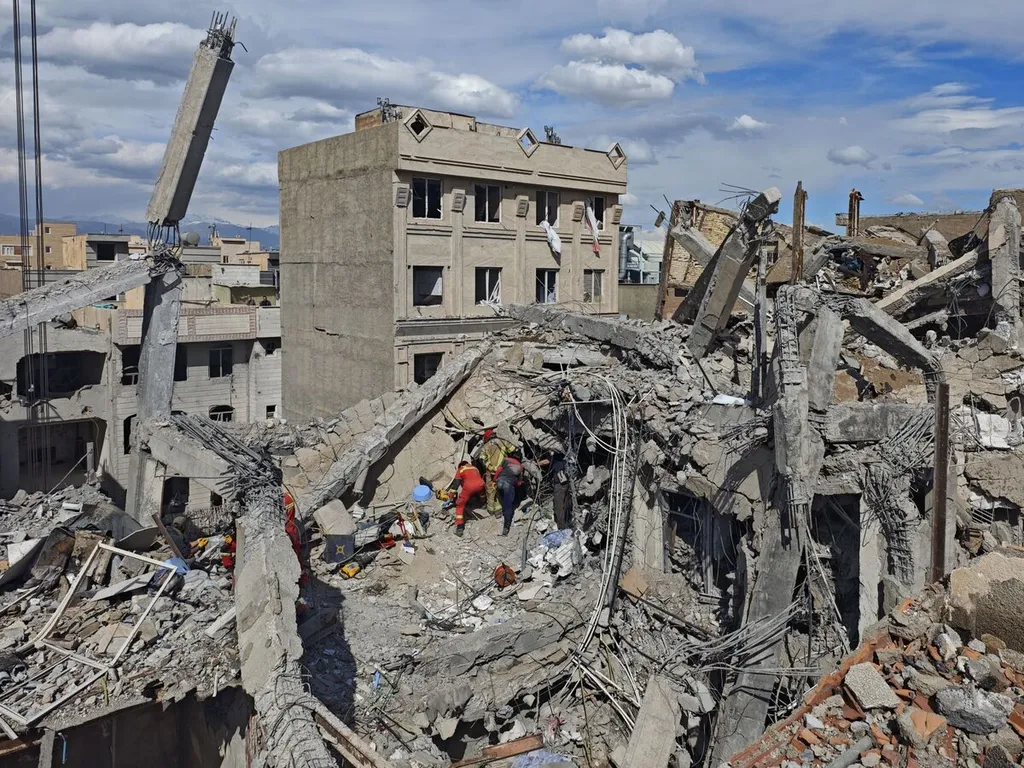
The US and Israel bombed several nuclear targets and steel facilities in Iran on Friday, as Tehran continued to launch strikes across the Persian Gulf and rebuffed President Donald Trump's increasingly insistent demands to end the conflict.
Airstrikes on Friday targeted a heavy water research reactor that's part of Iran's Arak nuclear complex and a yellow cake production plant in Yazd province, as well as two of the country's biggest steelmakers, according to Iranian state media reports.
Tehran fired numerous drones and missiles at Gulf neighbors, damaging two ports in Kuwait and prompting missile alerts in Doha, while warning of retaliation against steel plants across the Gulf and Israel. Saudi Arabian authorities reported intercepting numerous drones and missiles aimed at the capital Riyadh.
Israeli Defense Minister Israel Katz also said the country's military would escalate its assault on the Islamic Republic in response to the targeting of civilians.
The attacks came after Trump pushed back his deadline for Iran to agree to reopen the Strait of Hormuz or face strikes on its power plants. The 10-day extension was his second since Saturday's threat to destroy the infrastructure in the absence of Tehran reopening the critical waterway, a chokepoint that's become increasingly urgent with global energy and commodity shortages mounting.
Brent crude rose almost 3% to about $111 a barrel on Friday, extending its climb this year to 82%. The conflict has caused fuel shortages and fears of stagflation across major and emerging market economies.
Iran has rejected a 15-point list of ceasefire terms delivered by the Trump administration via intermediaries in Pakistan and has countered with five conditions of its own -- including maintaining sovereignty over the Strait of Hormuz.
While the two sides appear far apart in the effort to reach an agreement, Trump said talks with Iran are going "very well" and that the American war effort is "ahead of schedule."
Trump's extended deadline allows more time for the US to amass troops in the region, with speculation growing of an imminent land deployment.
The Wall Street Journal reported the Pentagon is considering sending as many as 10,000 additional soldiers to the Middle East. Asked about the Journal report, White House spokeswoman Anna Kelly said all such announcements would come from the Pentagon and Trump "always has all military options at his disposal."
Those new troops would be in addition to 5,000 Marines and more than a thousand paratroopers already ordered to the region, according to people familiar with the matter who asked not to be identified discussing plans that haven't been made public.
Some European governments think it's all but inevitable the US will deploy ground troops despite the high risk of casualties, according to a diplomat familiar with the matter who requested anonymity to discuss sensitive subjects.
On Friday, Secretary of State Marco Rubio told reporters in France after Group of Seven meetings that the war against Iran would not be a prolonged conflict and that the US could achieve its objectives without using ground troops.
Iran's government believes there's a high likelihood Trump will attempt to take over Kharg Island, the Persian Gulf site from which Iran sends most of its oil exports, according to an official from the Islamic Republic who spoke on condition of anonymity.
Military analysts said that aside from Kharg Island, the US could try to take control of the Iranian side of the Strait of Hormuz in a bid to reopen the vital waterway to oil and gas tankers and container ships. It could also send special forces to retrieve Iran's roughly 440 kilograms of highly-enriched uranium, the whereabouts of which have been a mystery to nuclear inspectors since the US and Israel last bombed Iran in June. All options would be exceptionally risky for US troops.
Publicly, Iranian officials remain defiant and said Trump is backing down from threats in order to lower energy prices.
Global stocks are experiencing their biggest monthly drop since 2022, with the selloff continuing on Friday. Bonds extended losses on fears of rising prices. The OECD has sharply increased its inflation forecast for Group of 20 economies this year to 4%, with an even higher pace in the US.
On Thursday, Iranian media indicated the country was still awaiting a response after rejecting a US proposal to end the war. The Iranian government has demanded certain guarantees in addition to its request to control Hormuz, including that the US and Israel won't resume attacks in the future and the payment of war reparations.
Iran also wants an end to the war on all fronts, a likely reference to Israel's parallel war against the Tehran-backed Hezbollah militant group in Lebanon.
Trump has said any peace agreement must prohibit Iran from ever obtaining a nuclear weapon or enriching radioactive material for civilian purposes. The US plan also stipulates that the Islamic Republic can only have a reduced missile arsenal for self-defense only, according to people familiar with the matter. Iran would get sanctions relief in return.
Reopening the Hormuz strait is key for Trump, with the waterway effectively closed since the start of the war. Normally, one fifth of the world's supplies of oil and liquefied natural gas flow through the passage.
In the US, pump prices have risen to almost $4 a gallon on average, which could hurt Trump's Republican party ahead of midterm elections in November.
Iranian lawmakers are drafting a bill to impose a transit toll in Hormuz, according to the Fars news agency, underscoring the country's confidence it can keep some form of control on the strait's traffic. It's already charging some ships millions of dollars for safe passage.
More than 4,500 people have been killed in the conflict so far, according to governments and non-governmental agencies. Around three-quarters of fatalities have been in Iran; almost 1,100 people have died in Lebanon where more than a million people have been displaced. Dozens of people have been killed in Israel and Arab Gulf states.