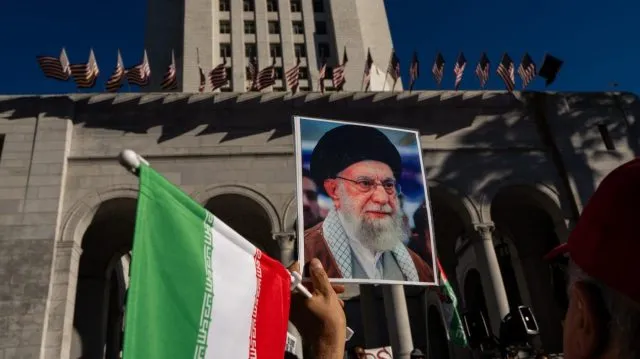
Iran now stands without its supreme leader for 36 years, Ayatollah Ali Khamenei, after joint strikes from the U.S. and Israel on Saturday killed him and attacked military command posts and missile sites across the country.
President Trump announced the strikes at 2:30 a.m. EST in a video shared on Truth Social. The mission, dubbed "Operation Epic Fury," has resulted in the deaths of at least 200 Iranians and injured about 750 more, Iran's Red Crescent told state media.
News of Khamenei's death initially came from Israeli Prime Minister Benjamin Netanyahu, who claimed an Israeli strike killed the supreme leader in his compound in Tehran. Trump later confirmed his death in a post on Truth Social.
Here are five things to know in the aftermath of Khamenei's death:
Trump pushes Iranians to embrace regime change
Trump, in his announcement that the U.S. attacked Iran, told Iranian citizens that the government "will be yours to take." He added that it could be "your only chance for generations." The regime Khamenei inherited had been in power since 1979 following the Iranian Revolution.
The president had already been calling for regime change during Iran's crackdown on anti-government protests last month. In an interview with Politico, he called Khamenei a "sick man."
Critics who spoke out before and after Saturday's attack slammed the notion of regime change, comparing it to the term's usage during the wars in Afghanistan and Iraq in the early 2000s. New American-backed governments could not fill the power vacuum, leaving room for militant groups to take over and foment harsher conditions for citizens in those countries and others.
Questions linger about Iran's future after Khamenei's death
It remains unclear who will become Iran's third supreme leader, as no potential candidates have stepped forward in the hours after Khamenei was confirmed dead. Khamenei was Iran's second supreme leader, succeeding Ayatollah Ruhollah Khomeini after his death in 1989. Khomeini came into power when the Islamic Republic of Iran took hold of the government a decade earlier.
Before his death, no one was selected to succeed Khamenei, though Reuters reported in 2015 that a successor was chosen but their name would not be disclosed.
Iranian President Masoud Pezeshkian reportedly survived Saturday’s attack. Israel reported that its strikes killed seven members of Iran’s senior defense leadership.
US hit a weakened Iran
The U.S. previously weakened Iran after it struck three of the country's nuclear sites in a joint-operation with Israel last June. Trump claimed the sites were "obliterated" and he defended himself after an intelligence assessment reported that one of the sites was mostly destroyed while the other two were not.
Saturday's attack was preceded by crippling attacks to Iran's military and its proxy network. Trump, during his first term in 2020, took credit for the drone strike that killed prominent Iranian Gen. Qassem Soleimani.
Iran's proxies in the Middle East have faced various crippling blows. Hezbollah's leader Hassan Nasrallah was killed in an Israeli airstrike in Beirut in September 2024. Israel killed brothers and leaders of Hamas Yahya Sinwar in October 2024 and Mohammed Sinwar in May 2025. A few months later, Yemeni Prime Minister Ahmed al-Rahawi, who ran the Houthi-led government, was also killed in an Israeli airstrike.
Trump says military strikes will continue
Trump's announcement that Khamenei was dead also indicated that U.S. strikes on Iran will persist, though he left the timetable open as to how long it could last.
"The heavy and pinpoint bombing, however, will continue, uninterrupted throughout the week or, as long as necessary to achieve our objective of PEACE THROUGHOUT THE MIDDLE EAST AND, INDEED, THE WORLD!"
Trump wrote.
The president's remark differs from the outcome of U.S. strikes on Venezuela in January. After U.S. forces captured President Nicolás Maduro, U.S. strikes ceased as both sides started conversations about the country's oil production and the possibility of new relations between both countries.
Democrats are pushing back, demanding vote on war powers
Democrats have largely condemned the Trump administration for carrying out the attack on Iran, with many saying it was done without congressional authorization and violated the Constitution.
Reps. Thomas Massie (R-Ky.) and Ro Khanna (D-Calif.) said they will force the House to vote on a resolution to prohibit military force against Iran without congressional approval. Most Democrats and one other Republican, Rep. Warren Davidson (Ohio), have said they will back the resolution.
Reps. Mike Lawler (R-N.Y.) and Josh Gottheimer (D-N.J.), however, said they will not back a war powers resolution. Last week, they both said the resolution would "restrict the flexibility needed to respond to real and evolving threats and risks signaling weakness at a dangerous moment."
Lawler on Saturday slammed the resolution attempt further, accusing Democrats of not understanding the War Powers Act. He also cited former presidents Obama and Biden carrying out strikes on countries without congressional approval, and said the last congressional approval to go to war was when the U.S. entered World War II in 1941.