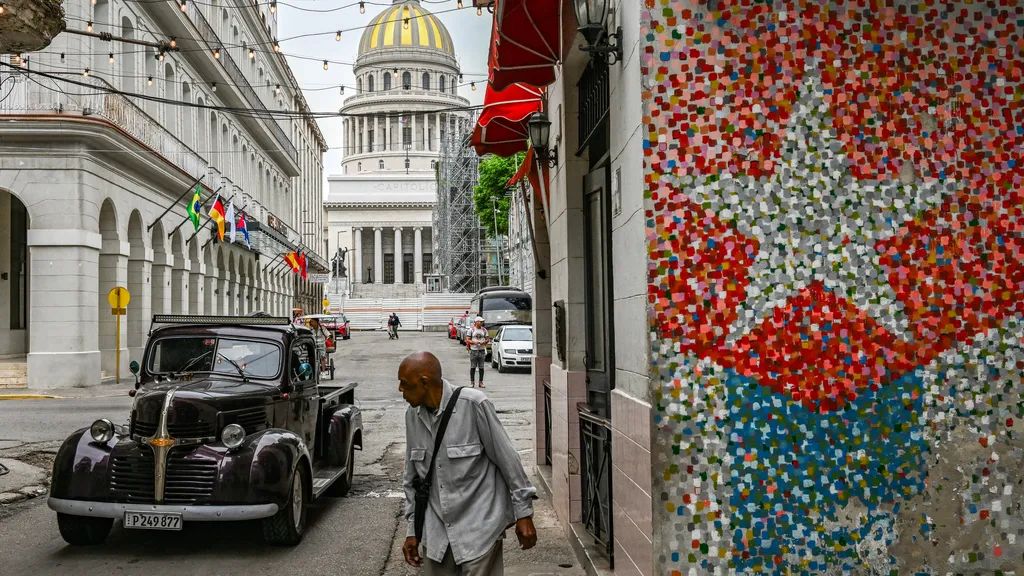
The Trump administration sent a senior delegation to Cuba last week to discuss a deal to address the humanitarian crisis on the island, marking a new diplomatic effort even as President Trump ramps up pressure on Havana.
A State Department delegation made the recent trip to meet with Cuban officials on the island, according to a senior U.S. official and another person familiar with the matter, who requested anonymity because of the secrecy of the talks. The officials warned in the meeting that Cuba's government had a small window before the humanitarian crisis on the island deepened, the senior official said.
Cuba has been in an economic free fall ever since the United States cut off oil shipments to the island from Venezuela and Mexico in January.
The group's visit late last week was the first time a U.S. government aircraft had landed in Cuba since March 2016, when President Barack Obama visited to expand diplomatic and trade relations between the nations. The more recent meeting by U.S. officials also served as a signal of Mr. Trump's willingness to seek the compliance of the Cuban government, rather than actively seeking regime change.
On Friday, Mr. Trump indicated he was keen to shift his focus from the war in Iran to Cuba.
"It's called a new dawn for Cuba," Mr. Trump said. "We're going to help them out with Cuba."
"Watch what happens," he added.
An official at the Cuban Ministry of Foreign Affairs did not respond to a request for comment.
President Miguel Díaz-Canel of Cuba urged supporters this week to prepare for serious threats, including military aggression.
"We do not want it, but it is our duty to prepare ourselves to prevent it and, if it becomes unavoidable, to prevail," he said.
Earlier this year, the Trump administration blocked foreign oil shipments from reaching Cuba, which depends on fuel imports and produces only about 40 percent of the oil needed for its power grid.
The blockade disrupted daily life in Cuba, causing blackouts, food shortages, canceled classes and deaths in hospitals and clinics. Mr. Trump has indicated he wants to topple the Cuban government, saying he would have the "honor of taking Cuba."
Last month, the Trump administration appeared to soften its stance by allowing a Russian tanker to deliver about 730,000 barrels of crude oil to the island "for humanitarian reasons," Karoline Leavitt, the White House press secretary, told reporters.
During the talks last week, the State Department official said, the American delegation insisted that Mr. Trump was open to a diplomatic solution to the crisis, but signaled that the United States would not tolerate resistance to its demands.
The administration has no specific, imminent operations against Cuba under consideration, according to two other U.S. officials.
The U.S. delegation last week proposed bringing Starlink satellite internet to the island and allowing free connectivity. It also urged the Cuban regime to make economic changes to attract foreign capital, grow the private sector and transition to a market-based economy.
These economic changes, the State Department official said, would also need to include ways to compensate U.S. citizens and corporations that had assets and properties confiscated in the 1960s.
Cuba would also need to release political prisoners, the official added, and allow greater political freedom. Earlier this month, the Cuban government said it would pardon more than 2,000 prisoners, one of the largest such releases in years, though it was unclear how many of them were jailed for their political beliefs.
A separate meeting in Havana, the official said, had involved a senior State Department official and Raúl Guillermo Rodríguez Castro, the grandson of the former Cuban president Raúl Castro, who succeeded his brother Fidel before stepping down in 2018 and still wields considerable influence.
Mr. Rodríguez Castro has been speaking with Trump administration officials to negotiate a political and economic transition for the island.
In the meeting last week, the American delegation also raised concerns about foreign intelligence and military groups operating in Cuba with the government's permission. Russia, China and Cuba have denied the presence of foreign spy bases on the island.
The demands by the American delegation would not represent the regime change pushed by some Cuban American lawmakers and many Cubans on and off the island. They would also fall short of the legal requirements to lift a long-running U.S. trade embargo on Cuba, like legalizing opposition parties, establishing an independent judiciary and holding free elections.
On Thursday, Michael Kozak, a State Department official who oversees diplomacy in the Western Hemisphere, refused to identify during a congressional hearing who in the Trump administration was negotiating with Cuba other than Mr. Trump and Secretary of State Marco Rubio, or to whom they were talking.
"We're engaged with the regime," Mr. Kozak said, to push them to undergo the "drastic reforms they need to take."
He added that the U.S. government was seeking economic, social and political changes in Cuba, including free elections.
"The goals are very clear," Mr. Kozak said. "What will happen, it remains to be seen."