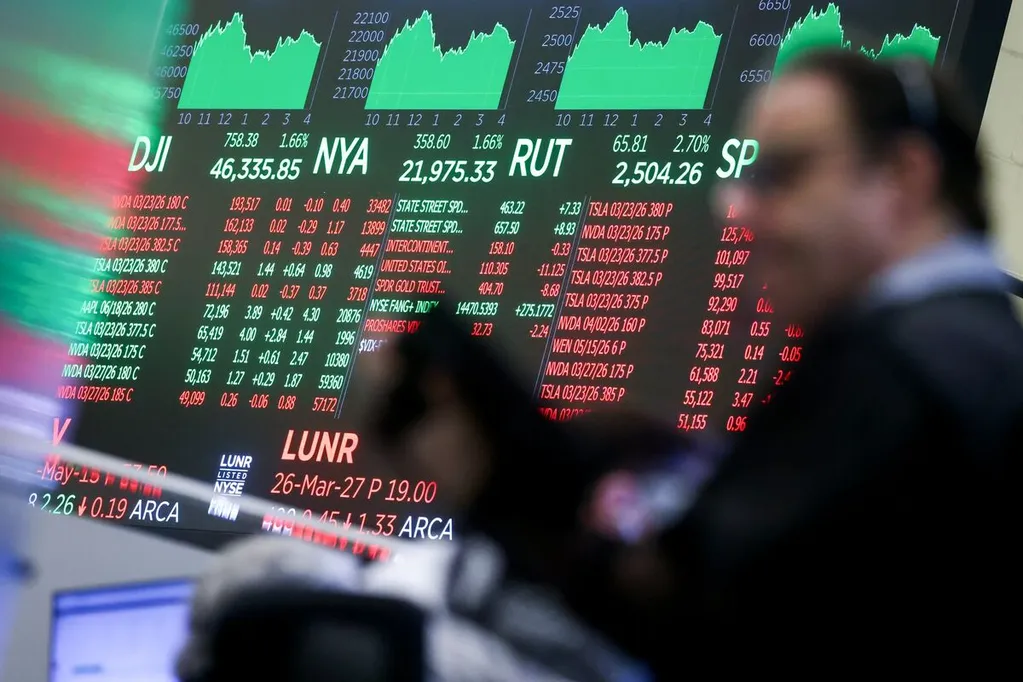
Many people seem surprised by the US stock market's resilience during the Iran war. I'm not one of them, and I don't see the war becoming a significant threat to the market, even if it drags on.
There are myriad reasons the Middle East conflict doesn't seriously threaten the stock market. Before getting into them, it's worth reexamining what's happened so far because the prevailing narrative that the war toppled the market in March -- and by implication may do so again if it intensifies -- isn't exactly right.
The S&P 500 Index began to decline modestly near the end of January, a month before the war started. What spooked the market was the so-called AI scare trade in which investors dumped shares of companies threatened by artificial intelligence, notably in industries related to software, logistics and white-collar services.
The AI-sparked selloff extended into March and overlapped with the start of the war, with the S&P 500 down nearly 8% for the month. About 60% of that decline was attributable to just 20 stocks, most of which are strongly correlated to AI sentiment, including the Magnificent Seven as well as Broadcom Inc., Micron Technology Inc., Lam Research Corp. and Applied Materials Inc. Those losses are more plausibly related to AI than the Iran war. Interestingly, the other 40% was concentrated across four sectors, one of which -- industrials -- is clearly exposed to the conflict, while the others -- financials, health care and other technology -- are not directly in harm's way. In any event, this group's individual losses, unlike the tech behemoths, were rounding errors in the S&P 500's overall decline.
Indeed, the market has recovered strongly in April even as the war has continued. Some attribute the turnaround to President Donald Trump's repeated assurances that a deal with Iran is near, but there's no sign of any such agreement and both sides say they're prepared to keep fighting. What has changed since the AI scare, however, is that some big money managers, including Goldman Sachs Group Inc., Morgan Stanley and JPMorgan Chase & Co., have advised investors to buy stocks beaten down by AI fears. And in fact, AI-adjacent stocks have led the surge this month.
Unless this war spirals into a global conflict, the stock market will continue to ignore it, despite fears to the contrary.
For investors of a certain age, Middle East wars conjure memories of 1970s-style oil embargos and ensuing inflation, recession and bear markets. But the global economy is much less dependent on oil today. Crude oil production as a share of global output, at about 2%, is nearly a quarter what it was during the Iranian Revolution in 1979. Of that, only a fifth transited through the now contested Strait of Hormuz.
Going forward, Iran's ability to disrupt the flow of oil will diminish further. As my Bloomberg Opinion colleague Javier Blas pointed out recently, Gulf Arab states will look to reestablish pipelines moving oil north through the Mediterranean, allowing them to bypass the strait in coming years.
That may explain why inflation expectations in the US haven't moved much. The five-year breakeven inflation rate is up just 0.2 percentage point to 2.6% since the start of the war. The two-year Treasury yield, which anticipates the federal funds rate, remains within the Federal Reserve's range of 3.5% to 3.75% for short-term interest rates, indicating that the central bank will not have to raise rates to fight off a fresh bout of higher inflation.
It may also explain why, in historical terms, the oil market's reaction has been relatively measured. Adjusted for inflation, the price of oil nearly tripled in 1973-1974 and more than doubled in 1979-1980; a far bigger jump than the roughly 40% increase since the start of this war. In addition, oil futures are in steep backwardation, meaning that the difference between the price today and the market's expected price several months out is larger than usual. The market is anticipating a significant decline, closer to $70 a barrel by early next year, despite the absence of any tangible evidence that this conflict is near an end.
All of that speaks to oil's declining importance and Iran's diminishing power to disrupt it.
Stocks have even more reason to ignore the war. For one, an extended conflict with Iran is unlikely to have a meaningful impact on businesses that dominate the broad US stock market. While about 30% of S&P 500 revenues come from overseas, less than 3% of the total is attributable to the Middle East and Africa. Sustained higher oil prices could slow consumption and thereby sales, but price pressures would presumably show up in meaningfully higher inflation expectations, which we have not yet seen. It’s also unclear the impact lower consumption would have on the big tech companies that drive the market.
Meanwhile, the market is riding a genuine tech-led boom that the war is unlikely to reach. The Magnificent Seven plus Broadcom and Micron Technology are expected to contribute 70% of the S&P 500’s revenue growth of 20% over the next 12 months, according to estimates compiled by Bloomberg. This tech-heavy market may be vulnerable to overconcentration and AI disruption but not an extended, regional conflict in the Middle East.
And don't underestimate the army of retail investors eager to buy dips. Having been berated endlessly to ignore volatility and keep buying, they appear to have internalized the message. They bought aggressively during the pandemic selloff in the spring of 2020 and again during the tariff panic last year. This war hasn't given them a comparable buying opportunity, although that may be partly because they haven't allowed it.
The US stock market isn't flirting with new highs because it thinks the Iran war is ending. It never cared about this war, and it won't unless the war spreads beyond the Middle East. Those who think a drawn-out conflict with Iran will hold back this market are in for more surprises.