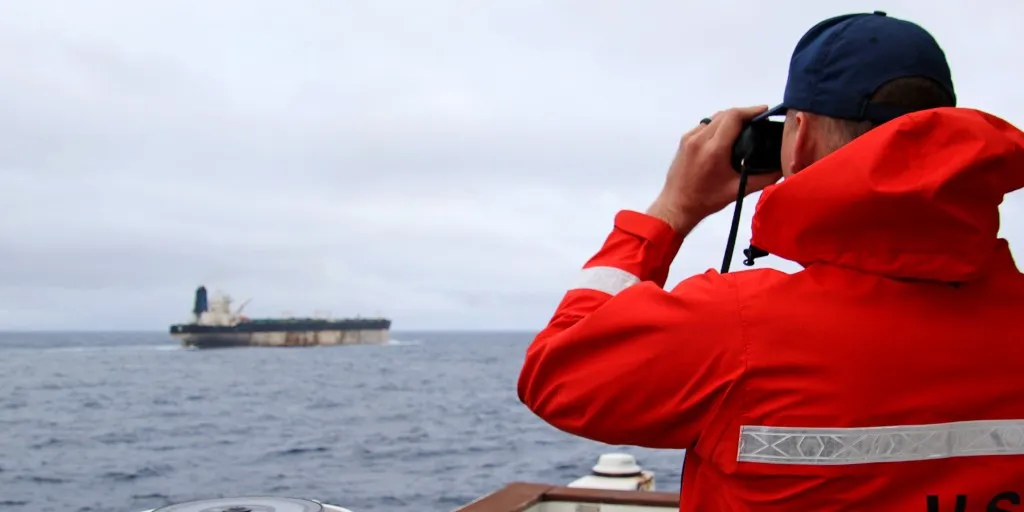
The U.S. seizure of a Russian-flagged oil tanker threatened new pressure on the "shadow fleet" that has helped prop up President Vladimir Putin's economy.
The American operation to take over the Bella 1 in the North Atlantic after a high-seas chase that began off Venezuela was "a gross violation" of maritime law, Russia's foreign ministry said Thursday. It expressed "regret and concern" over Washington's "readiness to generate acute international crisis situations."
The saga has highlighted the mixed response in the country to the fallout from the U.S. capture of Venezuelan President Nicolás Maduro.
While Moscow officially condemned the attack, its messaging has been restrained.
Russia may be reluctant to anger Trump at a precarious moment for the Ukraine peace talks, especially as his approach to Venezuela appears to validate its view of the world as divided into great-power spheres of influence. And despite the complications for the Kremlin and its war effort, some influential voices have expressed jealousy at the effectiveness of the American operation.
After a weekslong chase across the Atlantic, the U.S. took over the Bella 1 on Wednesday in an operation that defied Russian warnings.
The ship had changed its name to the Marinera and hoisted a Russian flag after escaping the U.S. blockade of Venezuela last month.
On the U.S. sanctions list since June 2024, it was a "poster child" for the shadow fleet operations, said Richard Meade, editor-in-chief of Lloyd's List Intelligence, a maritime data analysis company.
"It has operated out of Iran, out of Russia, out of Venezuela. It's done all of it, and it's done all of it while cycling through various false identities, false flags, with questionable or no insurance. It's exactly what the shadow fleet is there to do. It's to operate in the shadows," Meade told NBC News in a phone interview Thursday.
Ships like it smuggle oil for countries facing international sanctions, such as Venezuela, Russia and Iran, and often conceal or spoof their location data. Many are barely seaworthy and often engage in ship-to-ship transfers of their cargo while at sea in an effort to obscure the oil's origin.
Data from the International Maritime Organization ship registry shows that the tanker's registered owner is a company called Burevestmarine LLC, headquartered in Russia's western Ryazan region. The company appears in Russia's state commercial register and lists Ilya Bugai as the company's director. NBC News could not immediately identify a way to contact Bugai.
Russia has faced a slew of new sanctions in the aftermath of its invasion of Ukraine, including on its oil. It has resorted to using the shadow fleet to sell its discounted crude oil to allies to keep afloat its economy, which has required enormous military investment to sustain the war.
According to the Kyiv School of Economics' year-end analysis, Russia's shadow fleet continues to play a key role in transporting Russian oil. Its "Russian Oil Tracker" estimates that 173 Russian shadow fleet tankers carrying crude oil and oil products departed Russian ports and engaged in ship-to-ship transfers in the month of November.
For years, Kyiv has been calling for a greater crackdown on Russia's shadow fleet.
"Putin uses these tankers to finance his war, and most of these vessels are old, poorly maintained, and operate without any oversight," Ukraine's President Volodymyr Zelenskyy said in late 2024. His foreign minister, Andrii Sybiha, said Wednesday that Ukraine welcomed the tanker's seizure and Trump's "act, not fear" approach.
And while the seizure of the Bella 1 is unlikely to break the Russian economy, it adds a layer of complexity for the Kremlin and leaves the fate of other tankers uncertain.
At least three other sanctioned oil tankers that were operating near Venezuela in recent weeks have also changed their flags to Russia's, according to the Russian Maritime Register of Shipping.
"Russia is increasingly taking direct control of its export capabilities," said Meade. "And certainly in the last four months, we have seen a rapid increase of shadow fleet ships flagging to Russia. Now, given that they were unable to protect the Marinera, the question is, Will shadow fleet operators be quite so willing to move into Russia, and will Russia really want to keep pursuing that agenda of taking direct control of the shadow fleet?"
A lot now depends on whether the U.S., and to some extent the European Union and the U.K., are going to be prepared to execute seizures like the one conducted on Wednesday to try and disrupt those exports via shadow fleet ships.
"We don't know whether this was an anomaly or the start of a pattern of more robust enforcement," Meade said.
That uncertainty could be the reason behind Russia's muted response to the tanker seizure so far.
While some Russian lawmakers have called it "piracy on the high seas," Russia's foreign ministry appealed for "humane" treatment of the tanker's crew even as it urged Washington "to return to compliance with the fundamental norms and principles of international maritime navigation" on Thursday.
There has been no reaction from the Kremlin's spokesperson or Putin himself.
Moscow may want to be careful not to offend Trump while he is negotiating a peace deal in Ukraine that at times has seen him support Russia's hard-line demands.
It could also explain why Putin has not personally addressed the U.S. attack on Venezuela.
The operation to remove Maduro is a blow to the Kremlin, depriving it of a longtime ally. But what Moscow's foreign ministry condemned as an "act of armed aggression" left some of its influential military bloggers jealous of Washington's success.
When Putin invaded Ukraine in February 2022, he hoped to take Kyiv and capture Zelenskyy in as little as three days, expecting little resistance from Ukraine’s army. His plan centered on seizing the Hostomel airfield, a crucial staging post for an assault on the capital, but Putin’s forces got bogged down and eventually withdrew.
Trump’s removal of Maduro, which took hours and resulted in no U.S. deaths, drew admiration and unfavorable comparisons from Russia’s so-called “Z bloggers.”
“Most likely, our own special military operation was conceived in much the same way: fast, effective,” wrote prominent channel Two Majors, referring to the Kremlin’s term for its war in Ukraine. Another prominent Z-blogger, Voenny Osvedomitel, called it a “model military operation.”
Still, the focus on Venezuela could help distract from Putin’s reticence to strike a deal with Ukraine.
And Trump’s stated desire to dominate the Western Hemisphere lends validation to the ideas underpinning the Kremlin’s war: that great powers should be entitled to spheres of influence. In Putin’s eyes, at least, Russia’s sphere includes former Soviet states like Ukraine.