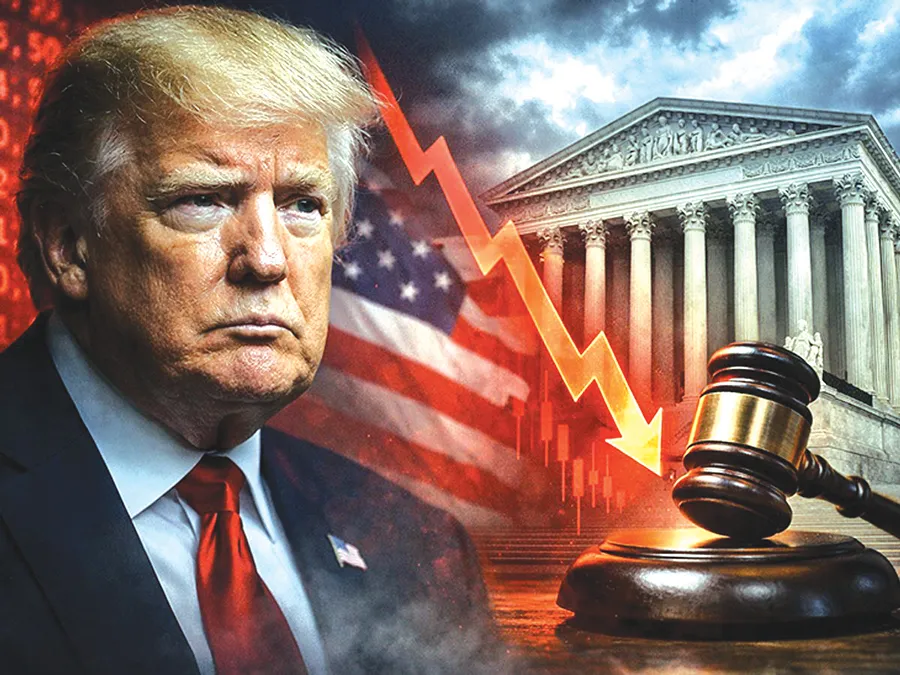
Washington: Following a US Supreme Court ruling that declared the reciprocal tariffs imposed by President Donald Trump illegal, the US government will stop such import tariffs from tomorrow.
In a statement, the US Customs and Border Protection said tariff collections under the 1977-era International Emergency Economic Powers Act will cease at 12.01 am local US time Tuesday.
Following a US Supreme Court ruling that declared the reciprocal tariffs imposed by President Donald Trump illegal, the US government will stop such import tariffs from Tuesday.
In a statement, the US Customs and Border Protection (CBP) said tariff collections under the 1977-era International Emergency Economic Powers Act (IEEPA) will cease at 12.01 am local US time (10.30 am IST) Tuesday, instructing importers that all related tariff codes will be deactivated in its cargo systems.
The suspension applies only to tariffs imposed under IEEPA and does not affect other Trump-era levies, including those under Section 232 national-security powers and Section 301 unfair-trade statutes.
If tariffs are such good idea, Trump should persuade Congress: Katyal
Washington: Stressing that if Donald Trump's tariffs are "such a good idea, he should have no problem persuading Congress", former Indian-origin US Acting Solicitor General Neal Katyal has said the President must seek legislative approval for sweeping tariff measures, as mandated by the American Constitution.
Katyal's remarks came a day after the US Supreme Court on Friday struck down Trump's far-reaching global tariffs imposed under an emergency powers law, including the "reciprocal" tariffs levied on nearly every other country.
The court ruled that Trump's use of emergency powers to impose import duties without the approval of Congress was illegal. Katyal, who served as Acting Solicitor General under former president Barack Obama, argued the high-stakes tariff case on behalf of small businesses and won.
In a social media post on Saturday, the Indian-origin lawyer said that if the Trump administration believes sweeping tariffs are necessary, the proper constitutional course would be to place the proposal before the US Congress for debate and approval rather than relying on emergency provisions.
"If he (Trump) wants sweeping tariffs, he should do the American thing and go to Congress. If his tariffs are such a good idea, he should have no problem persuading Congress. That's what our Constitution requires," he said.
Katyal, who was born in 1970 in Chicago to a paediatrician mother and an engineer father, both of whom immigrated from India, also questioned the legal basis of the Trump administration's move to invoke emergency powers to impose tariffs.
He said it would be "hard for the President to rely on the 15 per cent statute (sec 122)" when in a previous court case, the Justice Department had itself argued that the statute does not apply to trade deficit concerns.
"Nor does [Section 122] have any obvious application here, where the concerns the President identified in declaring an emergency arise from trade deficits, which are conceptually distinct from balance-of-payments deficits," Katyal quoted from the justice department's earlier submission to the court.