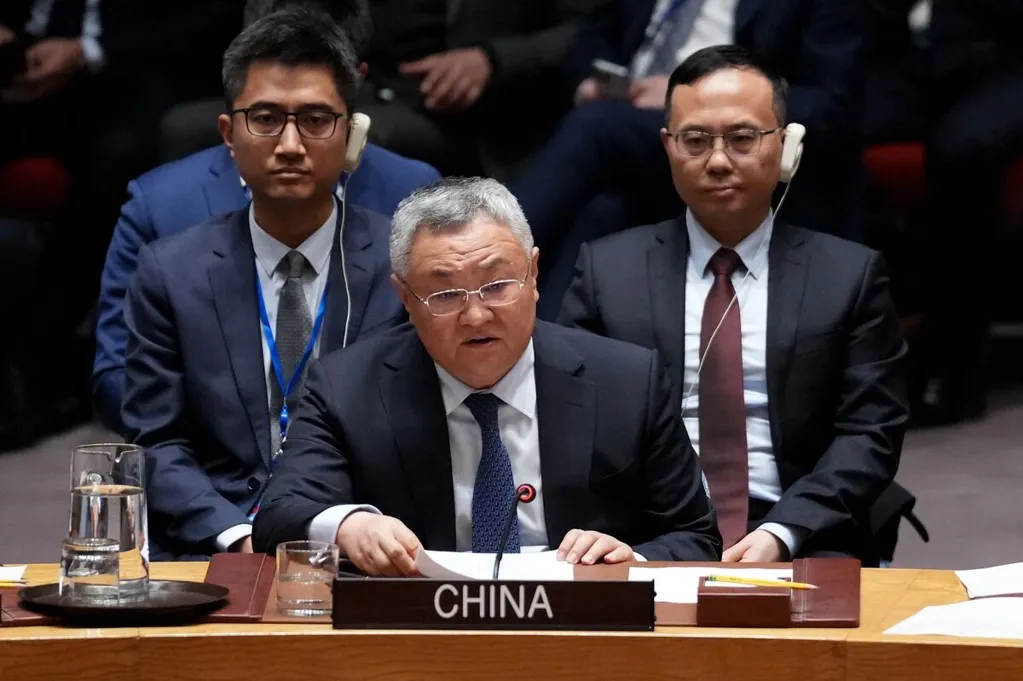
China has so far avoided direct involvement in the Iran war, with Liu Pengyu, spokesman for the Chinese Embassy in Washington, calling the "Axis of Chaos" theory "extremely irresponsible and purely groundless accusations and smears against China and relevant countries".
Washington's one-two punch capturing Venezuela's leader and then killing Iran's in coordination with Israel has put Beijing on the back foot, according to former US officials who have helped craft China policy.
Matt Pottinger, who served in President Donald Trump's first administration as deputy national security advisor, sees the Iran war as challenging what he calls a broader China strategy to use an "Axis of Chaos" to weaken America. That theory -- popularized by Pottinger -- places China at the center of a deepening partnership with countries such as Russia, Iran and North Korea.
"Beijing is the primary backer of a cohort of autocratic proxies who can challenge US influence, sap the attention and resources of Washington and its democratic allies, and generally weaken American prestige," he said. He took inspiration for his theory from President Xi Jinping's remarks in 2021 that the global situation was defined by "chaos" and "opportunities generally outweigh the challenges" for China.
But the removal of the leaders of Syria, Venezuela and now Iran means China's foreign policy faces the prospect of backfiring, said Pottinger, who heads the China program at the Foundation for Defense of Democracies. On the other hand, if Ukraine falls and the Iranian regime ultimately prevails, Beijing's strategy could be vindicated, Pottinger added.
China has so far avoided direct involvement in the Iran war beyond urging an end to the fighting and calling on all sides to protect ships transiting through the Strait of Hormuz, the chokepoint through which millions of barrels of oil and natural gas pass each day.
Liu Pengyu, spokesman for the Chinese Embassy in Washington, told Bloomberg "the so-called 'Axis of Chaos' is extremely irresponsible and purely groundless accusations and smears against China and relevant countries."
"The US has blatantly launched military strikes against Venezuela and Iran, which seriously violate international law and fundamental norms of international relations," Liu said.
While China has offered diplomatic, technological and economic support to US adversaries such as Russia and Iran, it has avoided formal military alliances apart from neighboring North Korea and says it adheres to the United Nations-backed global order. American allies also have questioned whether the Trump administration's recent actions complied with international law.
With Trump due to land in Beijing at the end of this month in a bid to maintain stable ties between the world's two largest economies, US officials from the president on down have softened the rhetoric against China. But Trump's willingness to stage dramatic interventions in Iran and Venezuela is changing the context -- and the power dynamics -- for what was expected to be a carefully choreographed meeting.
Relations with the US - and not its partnerships with countries like Iran - will drive Beijing's strategy ahead of the planned meeting between Trump and Xi, said Kit Conklin, a former US government national security analyst who now serves as chief global affairs officer at Exiger, a supply-chain risk management consultancy that works closely with US defense interests.
"With a Trump-Xi summit weeks away, China's access to global markets and advanced chips matters far more to Xi than solidarity with the Axis of Chaos," said Conklin.
Regardless of how one views the long-term implications of recent events for the group, the latest US-Israel attacks on Iran aren't good news for China right now, said Evan Medeiros, who served as a top adviser to then-President Barack Obama on China policy.
That's because "the stated goal this time is much broader and more consequential for China," said Medeiros, a leading Asia scholar at Georgetown University. "That is regime change, not just eliminating the nuclear weapon program."
Still, he and others said, China may benefit if the US gets bogged down in Iran and the Middle East.
The toppling of Venezuela and Iran's leaders is also a reminder of the inherent weaknesses of any "Axis of Chaos" strategy, as the group doesn't have the sort of security alliances the US enjoys.
"Russia, Iran, and North Korea don't share interests, institutions, or even genuine trust -- they share a common enemy," said Ryan Fedasiuk, who worked in the Biden administration's State Department.
"History suggests that coalitions built on shared resentment tend to fracture the moment the external pressure recedes or one partner's costs exceed their benefits -- which is exactly what we are seeing happen in Iran," said Fedasiuk, who now studies China and technology at the American Enterprise Institute.
The dynamic is such that axis members are "dependent on China to varying degrees, and China exploits their dependence," said Nazak Nikakhtar, who served as a senior Commerce Department official during Trump's first term and is now chair of law firm Wiley Rein's national security practice.
The US-led attacks on Iran and Venezuela have also exposed how cautious - and even weak - China's ruling Communist Party and its military are, other analysts contend. China's People's Liberation Army "has engaged in the largest peacetime buildup the world has ever seen but is evidently not up to defending its proxies kinetically at long distances from the mainland," said Jacqueline Deal, who runs the defense consultancy Long Term Strategy Group.
That may also have its advantages, however. Evan Feigenbaum, a former US State official under President George W. Bush, said avoiding wars a long way from home and not having binding security commitments to peripheral countries enables China to focus on its core interests.
"If you look at China's overall posture in both the Middle East and in Latin America, the better metaphor is a markets metaphor, which is portfolio diversification in every region," said Feigenbaum, who is now at the Carnegie Endowment for International Peace.
"They don't put all their eggs into the basket of having one partner," he said. "They have a diverse set of partners around a diverse set of issues."