Welcome to the online version of From the Politics Desk, a newsletter that brings you the NBC News Politics team's latest reporting and analysis from the White House, Capitol Hill and the campaign trail.
In today's edition, Henry J. Gomez and Matt Dixon dive into the nascent 2028 GOP presidential primary fight. Plus, Andrea Mitchell explores how officials in Denmark and Greenland are standing firm in the face of threats from President Donald Trump.
-- Adam Wollner
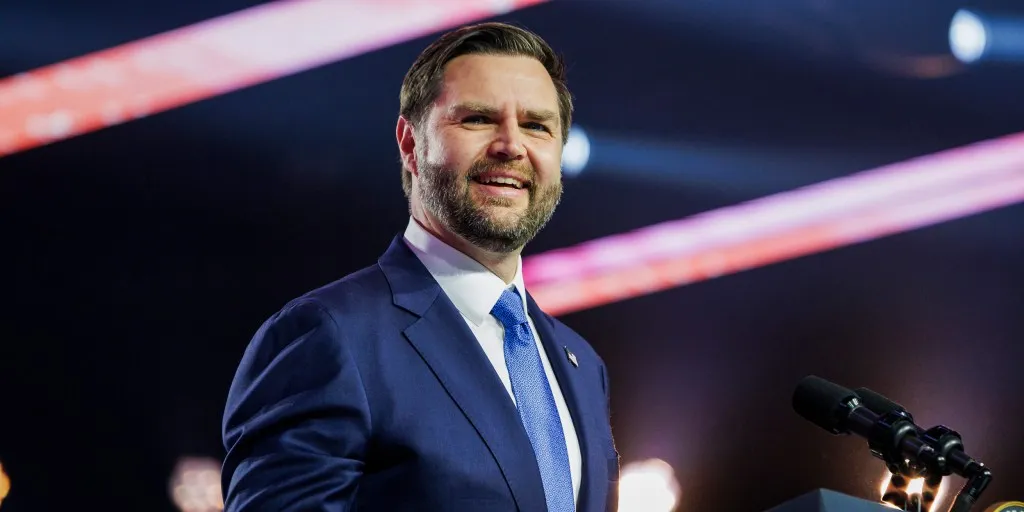
Vice President JD Vance begins 2026 with a healthy head start toward the Republican presidential nomination, which he is widely expected to seek in 2028.
Early polls show him with a commanding lead over would-be GOP rivals. Conservative activist Erika Kirk, who last year was named to head the influential Turning Point USA after the assassination of her husband, Charlie Kirk, has already endorsed him. President Donald Trump repeatedly identifies Vance, along with Secretary of State Marco Rubio, as an heir apparent to his MAGA movement. And Rubio has repeatedly deferred to Vance, insisting that the 2028 nomination is his for the taking.
The latest nod toward Vance came Sunday when another oft-mentioned Republican contender, outgoing Virginia Gov. Glenn Youngkin, struck a similarly deferential tone.
"I agree with President Trump. I agree with Marco Rubio. I think Vice President Vance would be a great nominee," Youngkin said in an interview with Fox News when he was asked whether he himself was ruling out a campaign for president in the future.
The (potential) challengers: But Vance's advantages haven't quieted speculation around a handful of other GOP prospects, including Florida Gov. Ron DeSantis and Sens. Ted Cruz of Texas, Josh Hawley of Missouri and Rand Paul of Kentucky. Except for Hawley, each has run for president before.
They and others have staked out or reinforced positions White House allies see, at best, as opportunistic and oppositional to Trump and Vance and, at worst, as purposely antagonistic. And they have homed in on thorny issues that can cause heartburn at the highest levels of the executive branch, such as artificial intelligence and the Jeffrey Epstein files.
The question: Whether any of their maneuverings make for a clear lane around Vance that can lead them to the nomination.
"Vance is the clear leader," said a veteran strategist from Trump's past campaigns, who was granted anonymity to candidly discuss the early contours of a potential 2028 primary fight. "The anti-Vance lane is mostly party elites hunting for defectors and pretending that's a coalition. That didn't work with Trump vs. DeSantis, and it won't work here either unless Vance hands them the opening himself."
President Donald Trump appears to be undeterred in his determination to take over Greenland, saying today that "we need it for national security" and that "anything less than" control of the Danish territory is "unacceptable." But at a White House meeting today, by officials from Denmark and Greenland sharply rebuffed Vice President JD Vance and Secretary of State Marco Rubio.
Danish Foreign Minister Lars Løkke Rasmussen told reporters afterward that there is a "fundamental disagreement" with Trump, who says Denmark cannot defend Greenland from Russia and China. Rasmussen said, "We want to work closely with the U.S.," adding, "It's not easy to think of solutions when you wake up every morning to threats."
"It is not a true narrative that we have, you know, Chinese warships all around the place," he said. "According to our intelligence, we haven't had a Chinese warship in Greenland for a decade or so."
Rasmussen also pointed out that during the Cold War, the U.S. had 17 military installations and bases on the island with 10,000 personnel but has since cut back to one base with 200 troops. Denmark has suggested that under a 1951 defense treaty with the U.S., it could establish more bases and send thousands of troops, rather than threaten to take the territory by force or pressure it into a sale. And NBC News reported today it could cost as much as $700 billion to buy the 800,000-square-mile island -- more than half the Defense Department's annual budget.
The distance between the U.S. and Denmark over the issue is as wide as the North Atlantic. A few hours after the White House meeting, Trump mocked Denmark as having added one dogsled to defend Greenland. But Denmark, a well-armed NATO member, has boosted its defense spending, announcing that aircraft, naval vessels and soldiers are being deployed to the Arctic territory. Rallying to Greenland's defense, Denmark's NATO allies from Sweden, Norway and France are also sending troops to Greenland, along with a reconnaissance team from Germany.
Danish leaders have also warned that if the U.S. used military force to take Greenland from Denmark, its fellow NATO members would face an impossible dilemma: whether to come to the aid of one NATO member, as is required by the alliance's mutual defense agreement, against another -- the most powerful of them all.
Speaking dismissively of NATO this week, Trump told reporters he didn't know whether NATO would come to the defense of the U.S. But the only time in its 76-year history that the alliance invoked its mutual defense commitment -- known as "Article 5" -- was after the 9/11 attacks to come to the defense of the U.S. Rasmussen pointed out today that Denmark lost as many troops fighting in Afghanistan per capita as the U.S. did. Those fallen soldiers are memorialized in a museum in Copenhagen.
A Senate delegation is heading to Copenhagen for meetings that start tomorrow to try to resolve the dispute -- peacefully.
That's all From the Politics Desk for now. Today's newsletter was compiled by Adam Wollner and Owen Auston-Babcock.
If you have feedback -- likes or dislikes -- email us at politicsnewsletter@nbcuni.com