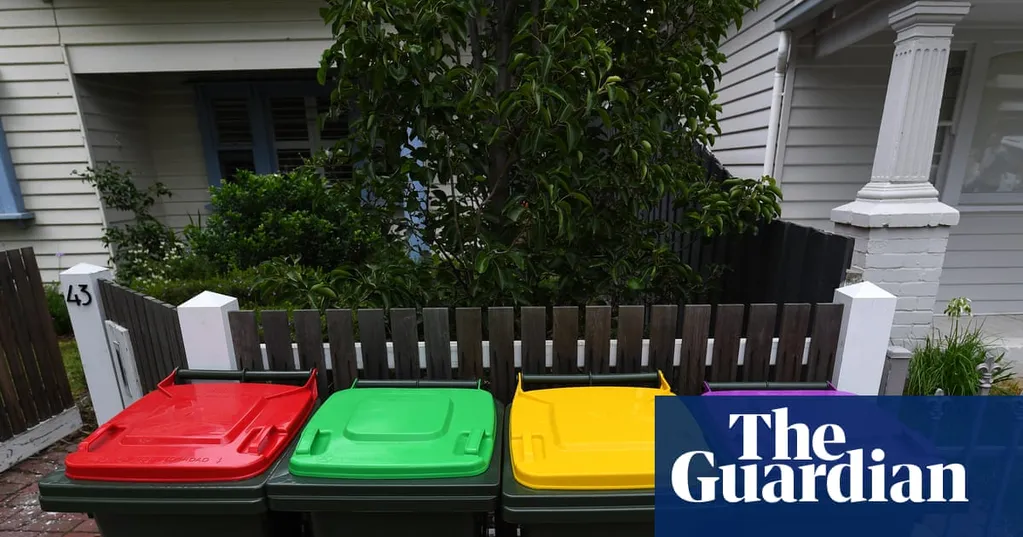
Local governments have until 1 July next year to introduce a four-bin recycling system, but some councils - and waste experts - say it's unnecessary.
When Victoria embarked on its four-bin system for household waste back in 2020, the goal was to position the state as a leader in recycling.
The rollout of a purple-lidded bin for glass - a fourth bin alongside organics, recycling and rubbish - would be a "gamechanging" way to keep glass and other valuable resources out of landfill, then environment minister Lily D'Ambrosio said.
Purple bins were trialled in some areas in 2019, with a statewide rollout expected to be completed by 1 July 2027.
But as local governments tally the costs of the extra kerbside service - particularly since the launch of the state's container deposit scheme, which accepts some glass bottles - concerned councils and residents are questioning whether four bins is better than three.
"Who has the space for all these bins?" asked one person on social media. "I have had a purple bin for 3-4 years. I have put it out for collection twice," said another. "Total waste of money."
Four bins for each household became the centrepiece of Victoria's recycling reforms, announced in the wake of waste export restrictions and the closure of major recycling company SKM Recycling. The overhaul also saw the launch of a container deposit scheme in 2023.
So far, 42 of the state's 79 councils have implemented a separate glass recycling service.
Now, as the deadline approaches, a coalition of 35 councils is calling on the state government to pause the glass bin deadline and consider alternatives, like expanding the range of containers able to be accepted under the container deposit scheme.
One of those councils is Manningham, which covers suburbs such as Bulleen and Doncaster in Melbourne's north-east. It says the group supports efforts to improve glass recycling but is concerned about the added cost of the service, which would ultimately be passed on to residents.
Independent research (commissioned by the group) estimates purple bin collection could cost a typical council $4m to implement, and $1.4m a year to operate.
Other criticisms include the lack of space available for accommodating four bins; the low use of the glass service in places where it has been rolled out; and the environmental impact of added truck movements.
Manningham mayor, Jim Grivas, says the council wants to work collaboratively on a solution. "We are asking the state government to listen to our concerns, delay the mandatory implementation date of mid-2027, and expand the container deposit scheme which is already in regular use," he says.
Several councils - including Boroondara, Stonnington, Whitehorse, Hume, Cardinia and Campaspe - have voted to postpone any rollout, despite it being a legal requirement from the state government.
Australians produce about 52kg of glass waste per capita each year, according to national data, most of which comes from households.
The national glass recycling rate for 2022-2023 - the latest full year with data available - was about 61%. South Australia has the highest recovery rate at 73%. Victoria recycled 71%.
Jeff Angel, director of the Total Environment Centre says glass has always posed a problem for commingled recycling.
"It's mixed up with all the other recyclables, gets contaminated itself, but also breaks up fairly easily - either when it's put in the bin or then lifted up into the collection truck," he says. "It just smashes, and when it smashes it infiltrates the other recyclables like paper and cardboard."
Separating the glass from other recyclable material helps by reducing contamination and improves the recovery rate. But a separate bin isn't the only solution, he adds.
Most container deposit schemes accept glass, as well as aluminium, plastic and paperboard drink containers and cartons, although the range of eligible items differs by state and territory. Most offer a 10 cent refund for each container.
Glass wine and spirit bottles have been accepted through Queensland's container refund scheme since 2023, which several other states - including Western Australia, South Australia and New South Wales - plan to follow. In Victoria, glass food jars and wine bottles are not eligible.
The quality of material returned through container deposit schemes is much cleaner, Angel says, with the refund providing an added incentive.
"So, it maximises the recycling, maximises the cleanliness, and as we're now discovering, relieves the local councils of millions of dollars of expense,"
South Australia claims about 11% of glass placed in kerbside bins was recycled back into glass containers, compared to 99% of material returned to container deposit depots. In Queensland's container refund scheme, the recovery rate for glass is about 88%.
Gayle Sloan, chief executive of the Waste Management and Resource Recovery Association of Australia, says a separate glass bin is unnecessary if kerbside and deposit schemes are working well together. "Three bins plus container deposit gives you a comprehensive service."
Jennifer Macklin, the circular economy lead at BehaviourWorks Australia, says greater source separation is generally positive and many councils have successfully introduced the new system, suggesting that the practical challenges - like space, logistics and behaviour change -- are real but manageable.
Container deposit schemes have excellent glass recovery options, including colour separation, she says, and could be expanded to include glass food containers alongside drink bottles.
"This type of expansion, while complex to implement, could reduce the need for kerbside glass separation altogether, while achieving even higher recovery rates and outcomes,"
a Victorian government spokesperson says the state has invested $129m to support councils with the rollout - including funding for new bins, drop-off facilities and to support the delivery of education campaigns.
"The container deposit scheme [CDS] has been embraced by Victorians and complements the rollout of Victoria's four-stream waste and recycling system. Many items, such as glass bottles and jars, are not suitable for CDS Vic - the glass bin allows households to conveniently recycle these at home."
the president of the Municipal Association of Victoria,jennifer Anderson,says waste collection is one of the highest costs for local government,councils want ability decide works best area."[Councils] want most effective efficient service behalf ratepayers,"she says.
Councils that are yet to introduce a glass service want a "two-way" conversation with the government - about what's best for the planet,the state's circular economy initiatives and financially sustainable,she says.
They also want to see the business case that underpinned the state government's decision.
Continuing to mandate the rollout of glass bins across Victoria is a kind of stubbornness, Angel says.
"It's obvious on economic and environmental grounds to use the container refund scheme,"
he says."We've spent enormous amounts of money investing in new return points and depots and reverse vending machines,and they have capacity take a lot more or be easily expanded."