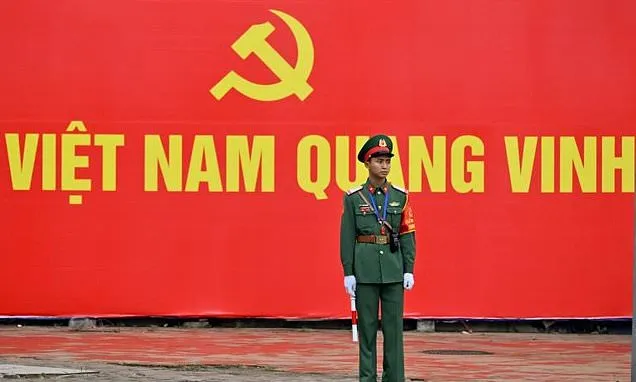
Vietnam's top leader To Lam is expected to address a twice-a-decade congress of the Communist Party on Tuesday, where he is seeking expanded powers similar to China's political structure.
The Southeast Asian nation of 100 million people is both a repressive one-party state and a regional economic bright spot, where the Communist Party has sought to deliver rapid growth to bolster its legitimacy.
Nearly 1,600 delegates gathered in Hanoi on Monday to kick off the week-long conclave where key policies will be set, meeting in a flag-draped auditorium watched over by a statue of party founder Ho Chi Minh.
The official opening ceremony will be broadcast live on Tuesday, state media said, and General Secretary Lam is widely expected to take the podium.
Since he ascended to the top role just 17 months ago, Lam has enthusiastically pursued an anti-corruption drive, thinned and streamlined bureaucracy, and accelerated infrastructure investment in reforms officials describe as a "revolution".
Lam will remain the party's top leader, according to sources briefed on key internal deliberations.
But he is seeking the presidency as well -- a dual role similar to Xi Jinping in neighbouring China.
Experts say clinching it will signal the supremacy of his security-dominated faction.
If Lam can claim both positions, he will have "the strongest mandate for the Vietnamese leadership since the end of the Vietnam war", said Nguyen Khac Giang of Singapore's ISEAS-Yusof Ishak Institute.
He and other analysts said Lam's reach will depend on who else secures top posts and politburo positions during the week-long conclave, particularly from the more conservative military faction that opposes him.
One source briefed on party deliberations told AFP that Lam's bid for expanded powers had been provisionally approved.
But some reports suggested he had to shelve his presidential ambitions in order to secure support for his reform agenda.
- Collective leadership -
Elevated to party chief after general secretary Nguyen Phu Trong's death in 2024, Lam has shocked the country with the pace of his reforms.
He has eliminated whole layers of government, abolishing eight ministries or agencies and cutting nearly 150,000 jobs from the state payroll, while pushing ambitious rail and power projects.
Experts say over the next five years he is expected to focus on spurring private sector, digital and technological growth as the manufacturing hub seeks to break into the club of upper middle-income countries by the end of the decade.
The ruling party tolerates little dissent and regularly jails critics, more than 160 of whom are behind bars, according to Human Rights Watch.
But unlike in present-day China or North Korea, political power in Vietnam has not been concentrated in one paramount leader.
Its collective system of government rests on four pillars: the party chief, president, prime minister and the chairman of the National Assembly. An internal Communist Party position was added as a fifth pillar last year.
If he gets the presidency, Lam would be the first person to be named to the top two jobs simultaneously by a party congress, rather than stepping in following a holder's death.