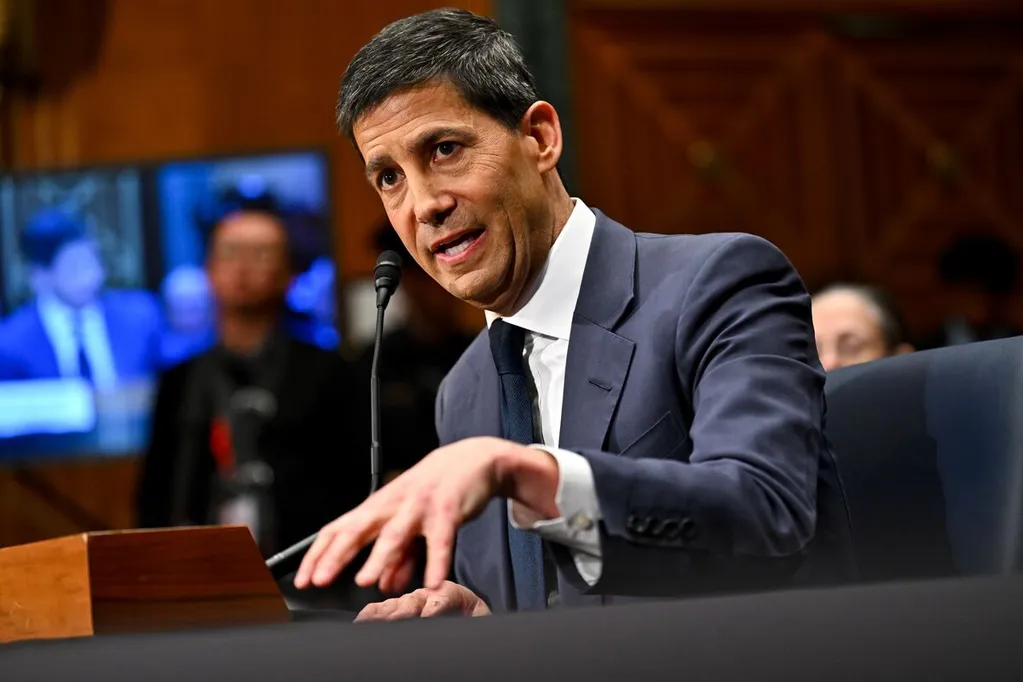
With so much attention on Federal Reserve independence, US senators spent relatively little time at a confirmation hearing Tuesday probing Kevin Warsh on his call to overhaul inflation data. The general ideas outlined by the would-be Fed chair hold inklings of promise, but Americans should be wary of his real motivations when it comes to questioning the integrity of our data on consumer prices.
It's important to note the partisan context in which this all came up. Senator Catherine Cortez Masto, a Democrat from Nevada, correctly noted that inflation has been elevated for five years. As she put it, inflation measured by the core personal consumption expenditures deflator -- a favored Fed measure -- had been running around a percentage point above the 2% target. She asked Warsh whether he agreed that tariffs were some part of that.
Warsh denied that was the case, and invoked his theory of flawed statistics to support this position. Here's how he put it (emphasis mine):
...among the projects I would hope to undertake as one of the first reforms at the Fed is a data project where we would go off and we would evaluate with the public sector and the private sector, including the Bureau of Labor Statistics, a survey of a billion prices. And what I'm really most interested, senator, is what's the change of that 500 millionth and one price. Because that's inflation... In a market economy, prices change all the time and I don't want to be confused by that.
To begin with, this was a roundabout way of dodging Cortez Masto's question -- something Warsh did time and again on Tuesday. Tariffs are a significant part of the reason that core PCE is 3% today -- this is fairly uncontroversial arithmetic. (Whether this should be treated as true inflation or a one-off change in the price-level is a semantic argument that's irrelevant to Americans suffering with higher living costs.) That being the case, it's reasonable to approach these comments with some healthy skepticism about Warsh's true motives.
Taking the comment at face-value, it's hard to argue with the proposition that US policymakers should employ the best data aggregation methods at their disposal.
In fact, the government is already doing a lot of this. Several years ago, the National Academies of Sciences, Engineering, and Medicine assembled an ad hoc panel of experts to review the precise question of how to update inflation data "for the 21st century." The resulting 180-page report provides a stellar blueprint for how to harness higher frequency alternative data and produce outputs that better represent the costs of living in the US.
One of the primary recommendations was that the Bureau of Labor Statistics better harness point-of-sale and web scraping tools to improve data collection. Extraordinary improvements in artificial intelligence may ultimately unlock even greater potential for those projects. And indeed, the BLS has already taken steps in this direction, despite ongoing budget cuts that have hamstrung the agency -- not to mention Trump's partisan attacks on the bureau's leadership, which certainly don't help matters.
But it's naive and misleading to assume that America could simply flip a switch and have vastly better data. While a lot of information can be gleaned from smart web-scraping, statistics agencies also need better cooperation with the private sector to understand how to weight consumer goods and services in inflation indexes.
What's more, many of the challenges center on inherently hard-to-measure categories that pose thorny methodological questions, notably shelter. For many Americans, housing is their single-largest expense, yet the "cost" of owner-occupied housing is essentially impossible to observe in real time. Some people have mortgages, others own their homes. In neither case are their housing costs precisely related to observed changes in market prices, so we use a rough modeled estimate.
This estimate moves at a snail's pace relative to market prices, giving armchair economists the impression that the BLS is delivering yesterday's housing news. While there's some truth to that, the BLS measure is still the best tool we have at our disposal to describe the experience of the average US consumer of housing. As the National Academies report points out, the government can draw on data from institutional landlords, property managers and tax records, for instance, to make incremental improvements. But the case for completely redesigning the metric is weak, as every viable alternative has pitfalls of its own.
More worryingly, Warsh's efforts to focus public attention on the data imperfections may be part of a backdoor strategy to push for a looser definition of the Fed's 2% inflation target. During an appearance in 2023, he said "we would not know the difference whether inflation was running at 1.7%, 2.0% or 2.3% in the United States or in the United Kingdom because we do not measure it that precisely." He added that he tends "to prefer ranges versus point estimates." At his Senate committee hearing Tuesday, he seemed to reprise some of that argument.
He's not wrong, of course: Data is inherently imprecise. The Bank of Canada and the Reserve Bank of New Zealand are examples of developed nation central banks that conduct monetary policy under just such a range-based framework. There's a certain intellectual honesty to ranges that's attractive to anyone who has spent a fair bit of time with inflation data.
But the Fed is the most important central bank anywhere, and its actions drive the reserve currency of the world. That means it should at least aspire to higher standards of precision. What's more, after half a decade of above-target inflation, any revision to the target today would look like moving the goalpost. It would undermine the public's trust in the Fed's ability to keep its promises.
If Warsh can use his mandate as the new Fed chair to attract more resources to modernizing data collection and analysis, it would go down as a valuable achievement. Yet he has no business using the existing data as an excuse to fabricate false narratives about tariffs, much less make the case for an ill-timed transition in the Fed's inflation-targeting regime.