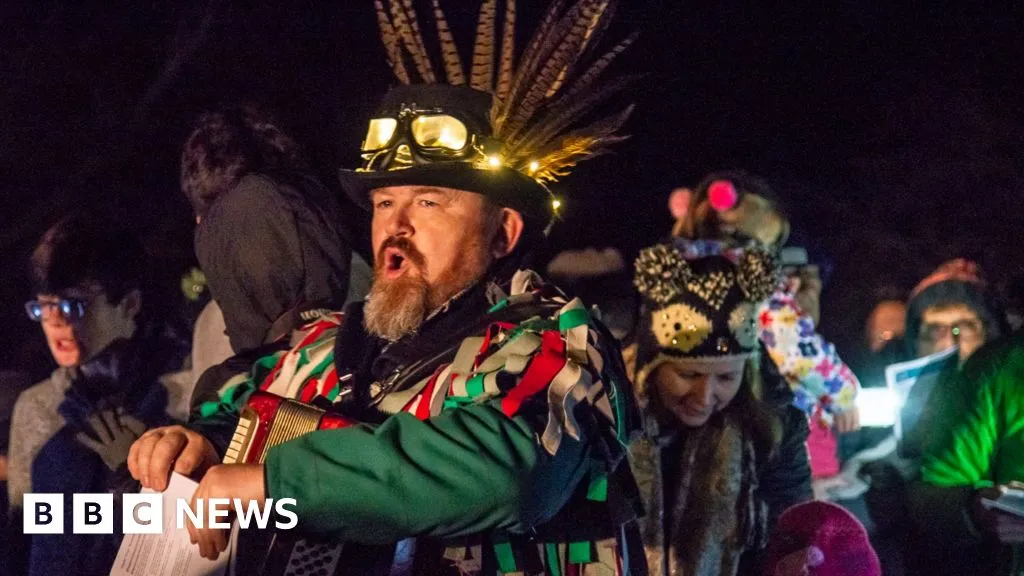
A folk musician who is writing a book about wassailing said the midwinter tradition appears to be enjoying something of a revival.
"Post-Covid, there has been a significant uptick in people holding wassails," said author Simon Bailes, from Dunton in Bedfordshire.
He wants to hear from groups who run gatherings, which often involve music and rituals around fruit trees to celebrate the harvest.
"It's a bit wacky to go into an orchard in the winter when it's cold - it's such a colourful part of our local community", he said.
Wassailing is a collection of folk traditions designed to bring communities together in mid-winter and encourage a good harvest.
Many events take place around Twelfth Night in early January and include singing and dancing, drinking and general merrymaking.
Mr Bailes runs his own wassailing event near Biggleswade, which now attracts about 250 people.
"Because it's big in the folky traditional world, it's become a popular community activity," he said.
"After wassailing in the farmyard and orchard, we have music in the village hall until the early hours."
His event - which includes Morris dancing, a Mummers play and local choirs - is popular with all ages.
"We do a lot of banging of saucepan lids. Parents bring tiny babies in papooses through to pensioners in their 80s," he said.
Other wassails are more of a daytime affair, such as at the Irvine Road Community Orchard in Colchester or People's Park in Luton.
Konni Deppe, project co-ordinator of Luton Orchards said: “Some people think of a cider-fuelled night-time fest with fire, but we’re not there yet.
“Bring a pot or pan, and a mug for some mulled juice. There will be drummers to make a lot of noise, and we normally paint our faces green,” she added.
Ms Deppe hopes wassailing and other events like Apple Days will encourage more interest in orchards.
“It’s just a thing of wonder that you have a tree there, and without you doing much, it gives you a crop,” she said.
Shaun Thomas said “the primary purpose” of the Irvine Road event was “for the local community to enjoy neighbourliness, and celebrate the orchard on our doorstep”.
“We have mulled cider and apple juice, and eat some leftover mince pies,” he said.
“Then we progress into the orchard, making as much noise as possible to ward off evil spirits, and put bird seed out for the robins.
“We play the Essex wassail song and have a bit of a sing - people really get into the spirit of it.
“Last year we had a really good wassail and a really good harvest.”
Mr Bailes said his research suggested two types of wassailing historically.
“One was a bit like Hallowe’en trick or treating, going from property to property and singing songs, dancing, and asking for a favour: money, beer or food.
“Those were widespread across England.
“The other form is agricultural wassailing - it’s a celebration of the crop and encouraging a better crop next year.
“People also wassailed bees for the honey, and livestock like cows and oxen.”
He dismissed the idea that it was “an ancient pagan custom”, but said there was often a “spiritual” element.
“People talk about scaring off evil spirits, which is certainly common in the historic record, as well as waking up the spirit of the tree,” he said.
“I’ve also found modern wassails with a Christian bias - usually because the local vicar runs it.”
Mr Bailes' book will focus less on history and more on 21st Century wassails - which he believes are becoming more popular thanks to a rise in community orchards.
“Groups want more than just an apple day in October. Wassailing in January fits a dead time of year.
“My feeling is people have always done something in the middle of winter, and gathered together for a bit of a party,” he said.
While many events spring up from local groups, organisations such as the National Trust are also running wassails over the Christmas season.
Connor Brown of National Trust Lyveden in Northamptonshire said: “It’s a great opportunity to learn about the old traditions and have some fun, while warding off bad spirits and encouraging a good harvest for the season ahead.”