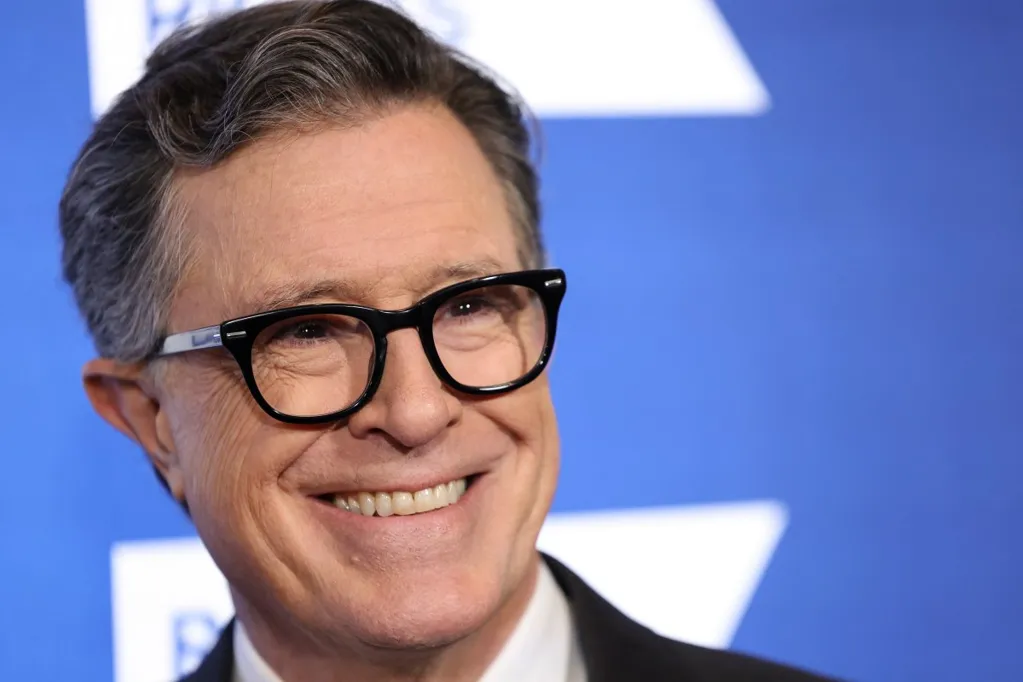
Stephen Colbert said CBS did not allow him to air a scheduled interview with Texas State Representative James Talarico, a Democrat running in the state's U.S. Senate primary, citing concerns about federal election rules.
Colbert said on Monday's broadcast that network attorneys instructed him "in no uncertain terms" not to air or even mention the pulled segment, citing concerns about the FCC's "equal time" rules.
"So I'm not allowed to air the interview," he said, adding that he posted the conversation on The Late Show's YouTube channel instead.
The decision by CBS to block Stephen Colbert's interview with Talarico lands at a delicate moment in the network's relationship with its late-night host.
In July 2025, CBS announced it would end The Late Show with Stephen Colbert in May 2026, retiring the entire Late Show franchise after more than a decade. The cancellation came days after Colbert publicly criticized a $16 million settlement between CBS's parent company, Paramount Global, and President Donald Trump.
Talarico, 36, serves in the Texas House and is campaigning in the Democratic primary for U.S. Senate. A Presbyterian pastor with a growing national profile, he rose to wider prominence after he and fellow Democrats left the state in an effort to block a Republican-backed redistricting plan supported by Trump.
In the interview posted online, Talarico addressed the controversy surrounding the unaired segment.
"I think that Donald Trump is worried that we're about to flip Texas," he said after Colbert jokingly asked whether he had intended to cause trouble.
Texas has not elected a Democrat to statewide office since 1994. Talarico, widely described as a rising star within his party, framed CBS’s decision as part of a broader Republican effort to influence media narratives.
"This is the party that ran against cancel culture, and now they're trying to control what we watch, what we say, what we read," he said. "And this is the most dangerous kind of cancel culture, the kind that comes from the top."
He then accused conservatives of targeting media outlets and entertainers they oppose.
"They went after The View because I appeared on there. They went after Jimmy Kimmel for telling a joke they didn't like. They went after you for telling the truth about Paramount's bribe to Donald Trump," Talarico said, referring to a legal settlement involving CBS's parent company, Paramount Global.
"Corporate media executives are selling out the First Amendment to curry favor with corrupt politicians," he continued. "And a threat to any of our First Amendment rights is a threat to all of our First Amendment rights."
Colbert responded with a pointed aside: "Just to fact-check you, my network said our cancellation was a purely financial decision," referencing CBS's announcement that The Late Show will end in May.
Talarico has been described by Democratic strategists as a rising figure and as part of a broader effort to reconnect Christian voters with the party.
The FCC's "equal time" rule, formally known as the equal opportunities provision, stems from the Communications Act of 1934 and applies to broadcast television and radio stations that operate on public airwaves. The rule requires stations that give airtime to one legally qualified candidate for public office to provide comparable opportunities to other candidates running for the same position.
There are important exemptions. The rule does not apply to bona fide news programming, including regularly scheduled newscasts, news interviews, documentaries, and live coverage of events.
Late-night talk shows have traditionally fallen under this news exemption, which has allowed them to interview candidates without triggering equal time requirements. The rule applies only to over-the-air broadcasters such as CBS, not to cable channels, streaming platforms, or online outlets.
Colbert said on air: "Then I was told, in some uncertain terms, that not only could I not have him on, I could not mention me not having him on," he said. "And because my network clearly doesn't want us to talk about this, let's talk about this."
Talarico posted on X: "This is the interview Donald Trump didn't want you to see. His FCC refused to air my interview with Stephen Colbert. Trump is worried we're about to flip Texas."
Sonny Bunch, culture editor of The Bulwark, posted on X: "Main takeaway from the Talarico-CBS-Colbert thing is, once again, that the FCC should probably just be abolished, and in an age of unlimited reach thanks to the internet, most rules governing broadcast media are completely obsolete."
While Talarico is currently leading the polls for the Democratic primary, beating Texas Representative Jasmine Crockett, he still faces an uphill battle in Texas. A new poll shows both trailing two of three leading Republican candidates in hypothetical Senate matchups and tying with state Attorney General Ken Paxton. GOP Senator John Cornyn, who currently holds the seat, is also seeking reelection.