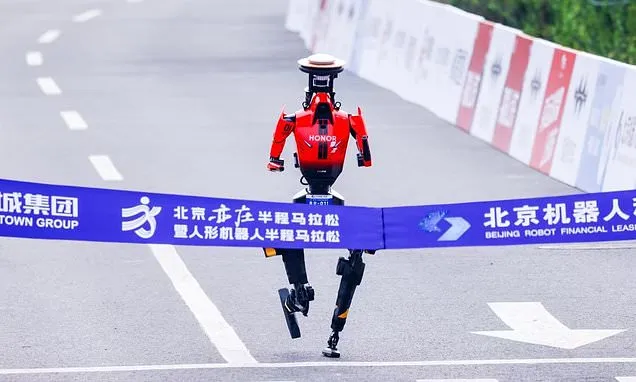
During last year's shambolic Beijing robot half marathon, humanoid machines tripped, shuffled, and occasionally shattered into pieces as they collapsed under the strain.
But 12 months later, supporters looked on in awe as a new generation of speedy robotic racers left the human athletes in the dust.
More than 100 robots competed alongside 12,000 human counterparts, separated by a barrier to prevent collisions.
Lightning, the winning bot developed by Chinese smartphone maker Honor, not only beat the best human that day but smashed the world record, set only last month.
The robot completed the 13.1-mile (21 km) course in a blistering 50 minutes and 26 seconds, far faster than the 57 minutes and 20 seconds record set by Ugandan runner Jacob Kiplimo.
That was more than three times faster than last year's winning robot, which finished the race in a time of two hours and 40 minutes.
In another stark example of just how quickly robot technology has advanced, nearly half of this year's entries raced autonomously, navigating the winding course without human intervention.
Honor, a Huawei spin-off company, bagged all three podium spots with self-navigating robots - all of which posted world-record-breaking times.
A humanoid robot smashed the human competition at the Beijing half marathon, finishing the 13-mile (21 km) course in a blistering 50 minutes and 26 seconds
Not every robot competitor performed quite as well as Lightning, and there were still a number of robots that crumbled under the pressure.
In one incident, a robot tripped and collapsed before crossing the start line, bursting into dozens of pieces as it continued to thrash on the ground.
There were also familiar navigation errors, with robots bumping into barriers or suddenly veering off in an unexpected direction.
However, the overall quality of the humanoid robots on display was an astonishing improvement over the last race just 12 months ago.
Xioadi Du, an engineer from Honor's winning team, said that the record-breaking bot had been developed intensively over the last year.
The engineer said that Lightning had been fitted with extra-long 90 to 95 cm legs to mimic the build of human elite runners.
The robot is also fitted with liquid cooling technology to help manage the intense heat generated by its massive leg motors.
According to the state media outlet Global Times, one Honor robot actually posted an even faster time of 48 minutes and 19 seconds but was pushed off the podium under the weighted scoring rules for being remotely controlled.
Lightning, the winning robot designed by smartphone maker Honor, beat the human record of 57 minutes and 20 seconds set by Ugandan runner Jacob Kiplimo last month
More than 100 robots competed in the race, running separated by a barrier from their human competitors
Mr Du says: 'Running faster may not seem meaningful at first, but it enables technology transfer, for example, into structural reliability and cooling, and eventually industrial applications.'
However, he added that the technology was still in its nascent stage, with plenty more advancements ahead in the coming years.
Amongst the crowd of onlookers, the mood was a mixture awe and apprehension as fans considered the consequences of robots overtaking humans for the first time.
Han Chenyu, a 25-year-old student who watched the race from behind a safety barrier, told AFP she thought the event was 'pretty cool'.
However, Ms Han added: 'As someone who works for a living, I'm a little worried about it sometimes. I feel like technology is advancing so fast that it might start affecting people's jobs.'
Likewise, Xie Lei, 41, who watched Sunday's race with his family, said: 'For thousands of years, humans have been at the top on planet Earth.'
'But now, look at robots. Just in terms of autonomous navigation, at least in this specific sport event, they're already starting to surpass us.
'On one hand, it does make you feel a little bit sad for humanity. But at the same time, technology, especially in recent years, has given us so much imagination.'
In a massive improvement from the 2025 robot half marathon, more than half of the entries ran the course autonomously and navigated without human intervention
There were still a few robotic disasters, with a number of robots collapsing, tripping, or running into the barriers
China has become increasingly keen to showcase national advances in humanoid robotics.
Earlier this year, during the CCTV Spring Festival gala, which is China's most-watched TV show, dozens of Unitree robots demonstrated their kung fu skills.
Wearing red vests, the robots performed kicks, flips, and even moves with nunchucks, swords, and poles.
Amazingly, their daring performance took place just metres away from human child performers.
In the future, it is hoped that robots will replace human workers in areas such as factory labour and even in caring for the elderly in social care settings.
Three Chinese companies, AGIBOT, Unitree Robotics and UBTech Robotics Corp, are widely considered to be leading developers of this technology.
This is particularly important for China, which has one of the fastest ageing populations on Earth and a dwindling supply of working-age adults.
According to the World Health Organisation, the population of people over 60 years old in China is projected to reach 28 per cent by 2040.
WILL YOUR JOB BE TAKEN BY A ROBOT? PHYSICAL JOBS ARE AT THE GREATEST RISK
Physical jobs in predictable environments, including machine-operators and fast-food workers, are the most likely to be replaced by robots.
Management consultancy firm McKinsey, based in New York, focused on the amount of jobs that would be lost to automation, and what professions were most at risk.
The report said collecting and processing data are two other categories of activities that increasingly can be done better and faster with machines.
This could displace large amounts of labour - for instance, in mortgages, paralegal work, accounting, and back-office transaction processing.
Conversely, jobs in unpredictable environments are least are risk.
The report added: 'Occupations such as gardeners, plumbers or providers of child- and eldercare - will also generally see less automation by 2030 because they are technically difficult to automate and often command relatively lower wages which makes automation a less attractive business proposition.'