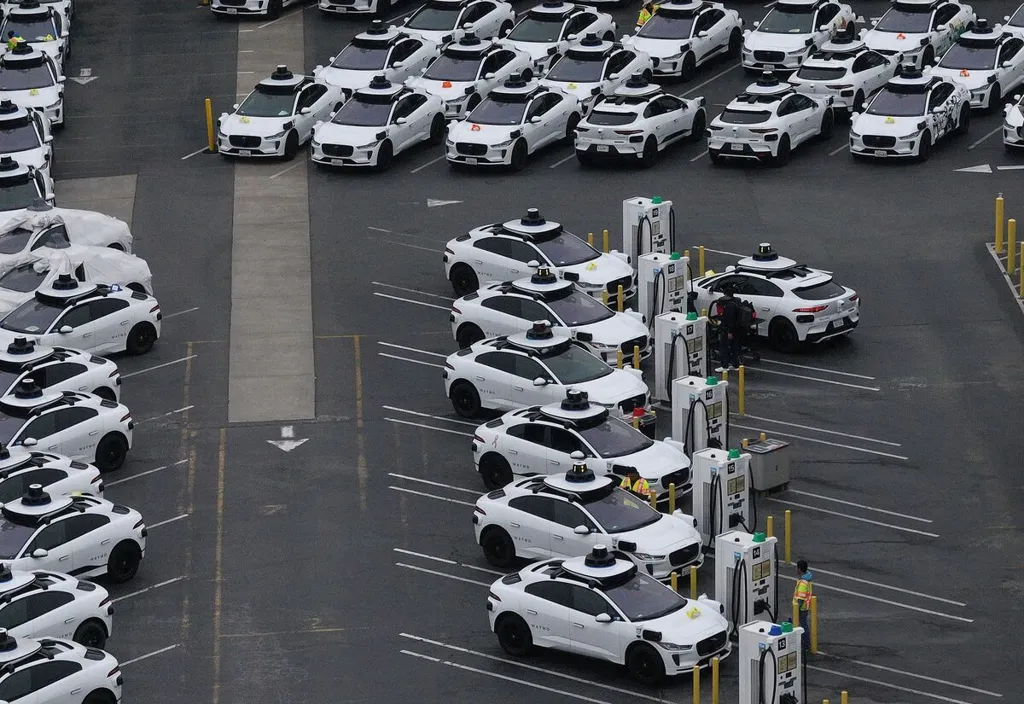
The collaboration with DeepMind will help the expansion of Waymo self-driving services across more markets, according to the company, and aid in making autonomous vehicle systems more reliable in uncommon scenarios.
Alphabet Inc.'s Waymo said it is using DeepMind's Genie 3 AI model to create realistic, digital worlds for its autonomous driving technology to train on edge-case scenarios.
The self-driving tech developer published a blog post on Friday about a new Waymo World Model, built atop Genie 3's ability to construct virtual environments based on text prompts. The collaboration with another segment of Google's tech ecosystem will help the expansion of Waymo self-driving services across more markets, according to the company.
Genie 3 drew widespread renown last week with demonstrations of its so-called world-building capabilities, triggering a selloff in companies that provide game development and graphics creation tools. Waymo said it has customized it to generate synthetic driving footage and depth perception data as if they were captured by cameras and lidar sensors on vehicles.
Waymo's new system can also take real-life dashcam datasets and convert them into scenes and depth maps for vehicle simulations, the company said. The combination will aid in making autonomous vehicle systems more reliable in uncommon scenarios.
"Traditional AV simulation models are constrained by the on-road data they collect," a spokeswoman for Waymo said. The new world model "allows us to explore situations that were never directly observed by our fleet."
"This will enhance Waymo's ability to safely scale our service across more places and new driving environments," she added.
Robotaxi operators and artificial intelligence companies more broadly have been seeking more sources of data in the race to advance their models. Nvidia Corp., which supplies chips and AI models for developers of self-driving technology, has partnered with rideshare leader Uber Technologies Inc. to collect millions of hours of robotaxi-specific driving data to fuel driverless model training and validation.
SoftBank Group Corp.-backed Wayve Technologies Ltd., which plans to trial robotaxis on the Uber platform in the UK this year, has announced its own world model to generate synthetic driving data. And Tesla Inc. has also said it built a similar simulator.
Having bigger training data sets will be crucial for Waymo as it faces safety probes from US authorities after a series of software mishaps in recent months. The National Highway Traffic Safety Administration and the National Transportation Safety Board are looking into several incidents where Waymo failed to stop for parked school buses in Austin, violations that also prompted Waymo to file a voluntary software recall.
The Waymo spokesperson declined to comment on whether it has conducted simulations on stopped school bus encounters, or mass power outages like the one that disrupted its San Francisco operations last December. But she said the Waymo World Model "can simulate virtually any scene."
Incorporating Google's Genie 3 model could be a boon for Waymo's plans to expand to about a dozen cities this year. Simulation is just one tool that it uses to prepare its autonomous systems for certain situations and to validate its safety, the spokesperson said. In December, the company said that there is "no substitute" for its experience driving in the real world. It surpassed more than 20 million autonomous trips that months, Alphabet said on Wednesday, more than any other provider in the US.