Skeins of geese fill the air with their music and the farm, stripped of its foliage, reveals its essential loveliness.
The warm colours of the drystone walls, or dykes as we call them here in Galloway, are picked out by the low winter sun and the magnificent architecture of the trees can be appreciated more meaningfully.
Our dairy herd is 'dried off' now before calving, so the bustle of milking twice a day gives way to a maternal serenity as the heavily pregnant cows in their shaggy winter coats waddle around their sheds to feed, then lie in their beds - or cubicles - chewing the cud.
The silence is punctuated only by the thin song of robins in the woods and the daily routines of the feeder wagon spreading steaming rows of green gold silage for the cows to eat.
I love this time of the year. But it is bitter sweet for farmers. Moments spent feasting with family and friends pile on extra pressure to get jobs done during the short hours of daylight and most of one's time is spent stumbling around in the cold and the dark, keeping things working while the weather throws everything it has at the farm.
If the cattle are lowing loud enough to wake a baby, it might mean a pipe has burst and they have no water. One Christmas, it froze so hard that we spent hours wrestling with hoses and bathtubs to rig up a Heath Robinson supply to the cattle sheds from a nearby cottage.
A winter gale might see me with the chainsaw clearing fallen trees off roads. Wet weather might trigger floods and leaking roofs. The snow plough attachment for the JCB sits in the corner of the yard as a reminder of what trials might yet come.
Despite these hardships, the days over Christmastide have traditionally been ones of hope. The darkest week is behind us and the car headlights pick out snowdrops poking stubbornly through the verges as a fragile promise of spring.
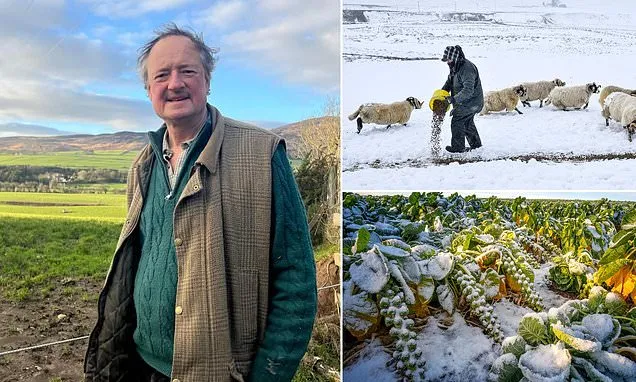
One Christmas, writes Jamie Blackett, it froze so hard that we spent hours wrestling with hoses and bathtubs to rig up a Heath Robinson supply to the cattle sheds from a nearby cottage.
Despite Labour's changes this week to inheritance tax on land and business assets, the damage already wrought on British farms has been catastrophic.
But there is little hope just now, thanks to governments here in Scotland and in Westminster which appear to hold the rural community in complete disdain.
You might think we farmers would be overwhelmingly grateful following Labour's decision this week to lift the threshold for the imposition of 20 per cent inheritance tax on land and business assets.
The new figure of £2.5 million - up from the £1 million announced by Rachel Reeves in her first, woeful budget 14 months ago - is certainly welcome. But the damage already wrought on British farms has been catastrophic.
Investment in family farms stopped stone dead after her dreadful decision, as we spent money on professional advice, struggling to protect our businesses from the taxman before next April's deadline.
Some landowners even boasted to me that they deliberately devalued their farms by letting them deteriorate in order to minimise their death tax liability. The country's agricultural base was needlessly eroded. So much for the Chancellor's mantra of economic growth.
Every relevant select committee, every organisation, even the supermarkets, criticised the policy which has caused serious harm to the rural economy - even though it would have raised less money than the government dishes out to farmers in the developing world via overseas aid. It is class war of the most cynical nature.
In our case, we spent some £10,000 on lawyers', accountants' and valuers' fees. After that first Budget I realised that my life's work - buying back this farm after my father sold it, ironically to pay death duties in the 70s - would have been for nothing if I failed to hand it over to my son intact. So I took out an inordinately expensive life insurance policy.
The Government was warned that farmers - whose machinery and livestock alone, without the land, can often be worth £1 million and more - did not have anywhere near the income to pay 20 per cent of the value of their holdings to the taxman.
It was warned that farms would be split up, sold off, and production diminished. And that a number of farmers would contemplate suicide as a result of the policy - some did reportedly kill themselves. Yet for so long the Government did nothing. And now we are expected to be grateful because it has been forced into a U-turn?
The £2.5 million threshold will undoubtedly save a good number of farming families who were facing an existential threat. But in my part of the world, many dairy farms will still be unable to escape the pernicious tax.
Farmers cannot abide this government. Many believe Sir Keir Starmer only capitulated because of the prospect of being dragged into a coroner's court following a suicide caused by this inheritance tax policy.
The Government was warned that farmers - whose machinery and livestock alone, without the land, can often be worth £1 million and more - did not have anywhere near the income to pay 20 per cent of the value of their holdings to the taxman.
Farmers cannot abide this government. Many believe Sir Keir Starmer only capitulated because of the prospect of being dragged into a coroner's court following a suicide caused by this inheritance tax policy.
Whether true or not, Labour seems to have waged all out war on the countryside since it came to power.
The latest assault came this week with the launch of its animal welfare strategy and plan to outlaw 'trail' hunting, where hounds chase a rag soaked in animal scent. The Scottish Parliament has already banned this part of our culture, and here on the farm we have a reminder of that fact which is felt keenly on this day of all days.
We always used to host the Boxing Day meet in front of our house. People came from far and wide, farming neighbours, children with tinsel on their bridles, several Santas, and after port and mince pies we would spill out on horseback, on foot or quad bike, performing a community rite as old as mankind.
The hunt kennels at the heart of the farm now lie empty. A silent kennels is a tragic, soulless thing haunted by memories of horses and hounds departed.
It was until recently the hub of a friendship group that stretched across two counties and drew together young and old from all walks of life. It also provided employment. It is no coincidence that our village school closed when our huntsman left, taking his young family with him.
Today in England and Wales, thousands of countrymen and women will gather at meets across the country. But this could be the last time.
Under pressure to throw red meat to his backbenchers, Starmer has followed Scotland's lead and the same hollowing out of rural communities is likely to happen down South.
In stark contrast to the Republic of Ireland where the Dáil voted this week, by 124 votes to 24, not to ban hunting. In Ireland they still value their farming communities and respect their culture.
True, a Boxing Day meet does not provide us with our daily bread. But it binds our community together, involving those of every ilk, most of them 'working people' who could not be more different from Labour's lazy 'toff' sterotype in its bigoted identity politics.
Here in Galloway, like other farmers, we will continue to venture into the cold and dark this Christmastide, to run our business as best we can. We have already tightened our belts as the milk price is crashing around the world.
There is Blue Tongue, a disease that causes hideous abnormalities in calves; it has been identified in Ulster to our West. If it comes here it could have a devastating effect on our income.
Meanwhile, the rain has been brutal, with our winter wheat lying under water. Next year's harvest may be light as a result, or the crop may even need re-planting.
But market fluctuations, animal diseases and bad weather are normal vicissitudes we take in our stride.
What we cannot take are political leaders who seem to loathe our very existence. Yes, they have been forced into a climbdown on inheritance tax - but only after a year and more of causing misery and carnage.