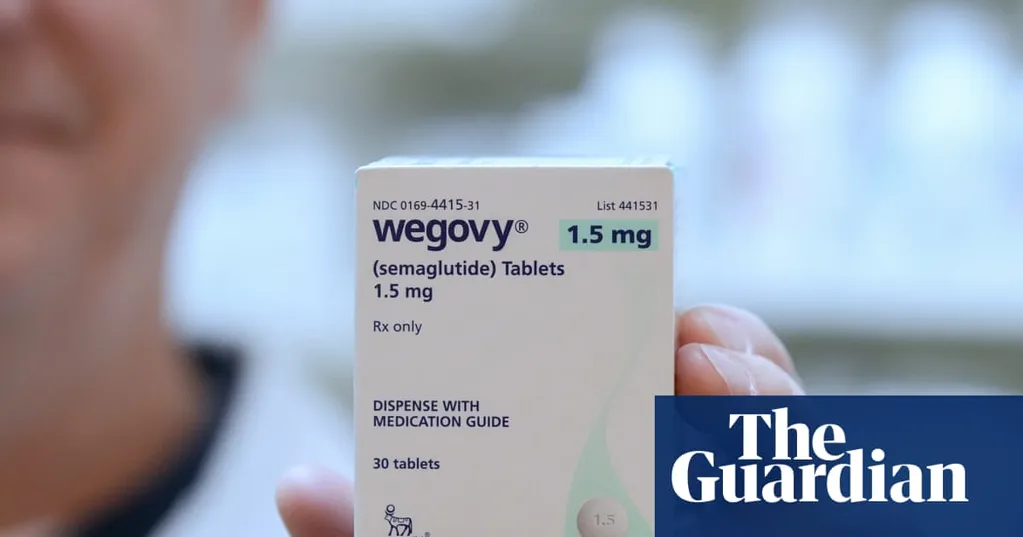
"I just felt slow: I want to be able to do anything my kids want to do and not have weight be a factor. Even a ride or a water park - things have weight limits," says Melody Ewert, 44, from Minnesota.
Ewert has just switched from Eli Lilly's Zepbound weekly injection to Novo Nordisk's new daily Wegovy pill. Analysts believe the arrival of easy-to-take tablets could push weight-loss treatments further into the mainstream in a year that has been described as "pivotal" for the booming anti-obesity market. The new pills, like the jabs, mimic the gut hormone GLP-1 that regulates appetite.
Denmark's Novo set down a marker last month, with the US launch of its daily pill - the first oral GLP-1 drug for weight loss.
The Wegovy pill has got off to a strong start in the US, with 50,000 prescriptions a week by late January, more than for the Wegovy shot after launch in June 2021 and rival jabs at that stage. It was "the fastest drug launch ever", according to health analysts at Leerink Partners, after the US regulator FDA gave the green light on 22 December.
However, concerns over the price, global supplies and side-effects of treatments persist in the rapidly growing sector, estimated to be worth $200bn (£145bn) by the end of the decade.
Determined to lose weight, Ewert initially lost 16.6kg (37lb) without medications, but quickly put most of it back on, and started taking Zepbound in late July. She shed 22.7kg, enabling her to ditch the seatbelt extender on planes. "To be able to shop in the normal shop is a big deal; before I would have to just order clothes, try them on at home and then return them," she says.
She switched to the Wegovy pill because her health insurance changed, meaning that she would go from paying $25 a month to $449 a month for Zepbound. Ewert, who runs a graphic design and video production business with her husband, says she feels better on the medications and has been eating more protein, fibre and vegetables, and avoiding deep-fried food.
Unlike with the Zepbound jab, when she had higher appetite in the last two to three days before her next dose, on the Wegovy pill "it is consistent every day how my appetite feels and the food noise is very low, even on the starter dose", although she "loved only needing to take the shot once a week".
Dr Eric Perakslis, chief science officer at the US weight-loss tracking app Shotsy and a former chief scientist at the FDA, says there has been "a flood of both" new patients and people switching to the Wegovy tablet from jabs.
"It's very simple, just to take a pill," says Patrick, 33, a parts manager for a fire truck repair facility from New Jersey. He has been on the Wegovy tablet for a month and has lost 6.8kg on the starting dose.
He had used the weekly Wegovy injection a couple of years ago and lost 34kg in six months, but stopped taking it because his new health insurance did not cover it after he changed jobs.
He regained three-quarters of the weight and, when the Wegovy pill came out, decided to pay for it out of his own pocket, at $150 a month for the starter dose. He is hoping to lose as much weight as last time by taking higher doses that cost up to $300.
Pills are likely to attract people who are averse to needles; they are also cheaper than injections, and do not need to be kept in the fridge.
In the UK, the Wegovy pill is being assessed by the medical regulator and expected to hit the market later this year, but it is too soon to say whether it will be available on the NHS. There are already fears that fake versions could flood the market because pills are easier to manufacture for fraudsters than jabs.
Despite many reports of British users secretly taking the drugs or appearing to have "Ozempic face", there are signs the stigma is fading and more people are open about taking them.
There were 1.6 million users in England, Scotland and Wales between early 2024 and early 2025, twice as many women as men, typically people aged 45 to 55, according to a study by UCL researchers. Many are paying out of their own pockets as NHS coverage is limited to the most obese. Nearly two-thirds (64%) of adults were overweight or obese in England in 2022.
Another 3.3 million people were interested in using weight-loss drugs in the near future, especially people who are struggling financially, among whom obesity is more prevalent, the study said. This means nearly one in 10 adults in Britain have recently used a weight-loss drug or would like to use one. This compares with one in eight users in the US, a recent KFF poll showed, even though half say the drugs are difficult to afford.
This week, high street retailer Boots launched a pilot of an in-store service which will allow customers in London, Manchester and Edinburgh to be assessed to see if they are eligible for a weight loss jab.
With global obesity levels forecast to accelerate rapidly this decade, particularly in lower-income countries, demand for weight-loss medications is soaring. The GLP-1 market is expected to ramp up from $75bn at present to $200bn by the early 2030s, JPMorgan Chase analysts predict.
More than half of adults are predicted to be overweight or obese by 2050, according to a study in The Lancet.
Researchers at the University of Chicago Medicine found last summer that, despite other health benefits such as reduced risk of strokes and heart attacks, GLP-1 injections fell well short of standard benchmarks for cost-effectiveness for governments because of their high cost. However, researchers, led by Dr Jennifer Hwang from the university, believe pills could be more cost effective for the US government.
A recent study showed people who stop taking GLP-1 jabs regain all the weight they lost in under two years.
There can be significant side-effects, and experts have called for more research into a potential link between GLP-1 jabs and a rise in gallbladder removals by NHS England.
The cash price of the Wegovy pill ranges from $149 to $299 a month depending on the dose, less than the recently lowered cash prices for injectable products after pressure from Donald Trump.
Novo shares plummeted 17% in a single day in early February when the company forecast a steeper-than-expected drop in sales and profits this year, after meteoric growth that made it Europe's most valuable company, worth more than the entire Danish economy. It issued several profit warnings and cut 9,000 jobs last year.
There was some scepticism that Novo could quickly ramp up manufacturing of the tablet, which is a reformulation of semaglutide, the same ingredient as in the Wegovy jab, but at a much higher concentration. This means it has to be taken on an empty stomach "with a small sip of water".
Novo's main rival, Eli Lilly, the maker of the popular Mounjaro and Zepbound jabs, is not far behind with the US launch of its weight-loss pill orforglipron expected as soon as April. Unlike the Wegovy pill, it is a small molecule not a peptide (large protein) and more easily absorbed by the body without a fasting requirement.
Many people have been opting for Mounjaro over the Wegovy shot because clinical studies show it leads to greater weight loss.
Analysts at Goldman Sachs predict 2026 will be a "pivotal year for the development of the obesity market" with the launch of the Novo and Lilly pills "potentially significantly increasing the addressable population for obesity medications".
Crucially, the US Medicare health insurance programme will start covering GLP-1 medications for the first time from April.
Analysts at UBS forecast peak annual sales of $3.25bn for the Wegovy pill compared with $16bn for the injection in coming years pointing to a higher drop-out rate in studies (one in 10 stopped taking it because of side-effects including nausea and vomiting).
Both the Novo and Lilly pills are less effective than GLP-1 injections. Analysts say obese people who need to lose more weight will probably stick with jabs while pills could attract new patients who are overweight or mildly obese.
There are other pills in development notably from California biotech companies Structure Therapeutics and Viking Therapeutics. Britain's biggest drugmaker AstraZeneca's obesity and diabetes pill acquired from Chinese drug developer Eccogene is in mid-stage clinical trials.
Companies such as AstraZeneca are also working on injectable drugs targeting hormone amylin for enhanced weight-loss regimes combining different drugs and medicines designed to preserve muscle mass.
Dr Sophie Dix head of medical affairs at UK online pharmacy MedExpress who previously worked for Lilly says: "If we're looking at global impact these [GLP-1 drugs] we haven't even scratched surface yet terms eligible population." She takes Mounjaro. "I personally prefer take weekly jab rather than daily pill just terms remembering."
"We still have a lot of people to reach," says Hwang. "Because price coming down more options terms formulations very high efficacy drugs hopefully go right direction."